Festive Home Decor Ideas for 2026: A Complete Upholstery and Fabric Guide

Key Takeaways
- The best festive home Decor ideas start with the fabric underneath, not the lights on top: set a Martindale floor of 20,000+ rubs for a family sofa, 30,000+ if kids, pets, or a full guest season are in the mix.
- Match fibre to climate before you match it to colour. Cotton or linen blends suit hot, humid regions; performance polyester suits monsoon-prone areas; velvet belongs in climate-controlled rooms.
- A fabric’s “grade” label reflects cost to the manufacturer, not quality to you. Two fabrics at the same grade can differ widely in rub count and stain resistance.
- Rexine and fabric solve different festive problems. Fabric brings warmth to formal seating; rexine handles spill-heavy zones like dining nooks and children’s corners far more forgivingly.
- Five quick swatch checks separate premium rexine from stock that peels within a year: a grain-and-backing look, a smell test, a flex test, a scratch test, and a water-drop test, all under five minutes.
- Curtains and upholstery should be planned together, since curtain weight and drape directly affect how much light, heat, and sound a festively decorated room holds during a full house.
- A physical swatch test under real home lighting prevents the most expensive festive-season mistake, catching issues no showroom sample under fluorescent light will reveal.
- Deep cleaning before the season matters more than decorating during it. Sofas and curtains hold a year of dust and allergens that guest volume and closed windows during smog season only worsen.
A sofa or curtain that performs fine on a normal Tuesday gets tested completely differently during a festive-season weekend. Guest volume goes up. Children move through the house more freely. Food and drinks travel further from the dining table than usual. And because most Indian festive seasons, from Diwali through the wedding season that often follows, land during the transition out of monsoon humidity and into drier winter air, fabric that felt fine in July can behave completely differently by November.
Here’s a scenario most furniture buyers recognise: you walk into a showroom, fall in love with a sofa’s silhouette, and never once flip the seat cushion to read the fabric composition tag. A few monsoons later, the upholstery has pilled, faded near the window, and developed a permanent outline of a Sunday-afternoon nap. The frame is fine. The foam is fine. It’s the fabric that failed, and the festive season is exactly when that failure becomes visible to everyone who visits.
Two shifts make 2026 an easier year to buy in than most:
- Performance fabrics are now baseline, not premium: Engineered textiles that resist stains, repel liquids, and withstand serious abrasion have moved from a niche family-friendly option to a standard expectation across price points.
- Warm neutrals have replaced cool grey: Sand, mushroom, and terracotta now dominate showroom floors, and they photograph far better under the warm lighting most Indian homes use during the season.
The Pre-Season Upholstery Audit: What to Check Before You Buy Anything
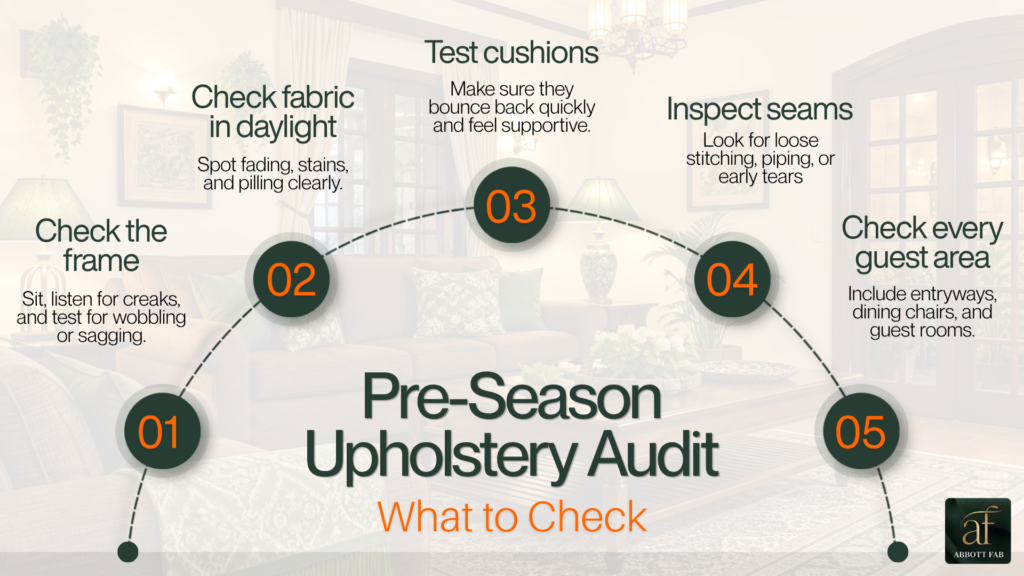
Before deciding what to refresh, spend twenty minutes doing an honest walk-through of every seating and soft-furnishing surface in the rooms guests will actually use.
- Check the frame first, not the fabric: Sit in every sofa and armchair. Listen for creaks, feel for sagging in the seat base, and check whether the arms wobble. A structurally sound frame is the single factor that determines whether recovering a piece makes sense at all.
- Look at fabric in daylight, not lamp light: Fading, pilling, and stains are far more visible in natural light, exactly the light guests will see the room in during daytime gatherings.
- Test cushion resilience: Press down on seat cushions and see how quickly they spring back. Flattened foam or collapsed fibre filling is a comfort problem no amount of styling fixes.
- Inspect seams and piping: Loose stitching along arms and cushion edges is where tears usually begin, and it’s a far cheaper fix now than after it rips mid-gathering.
- List every room guests will actually enter, not just the living room: Entryway benches, dining chairs, and guest bedroom throws all belong on the festive-readiness list.
- Check the frame first, not the fabric: Sit in every sofa and armchair. Listen for creaks, feel for sagging in the seat base, and check whether the arms wobble. A structurally sound frame is the single factor that determines whether recovering a piece makes sense at all.
This audit produces a simple, prioritised list: what needs full reupholstery, what can be revived with rexine or fabric slipcovers, and what’s simply due for a proper deep clean.
Understanding Fabric Types: What Actually Performs Best in a Festive Home
Every sofa fabric on the market falls into one of three categories: natural fibre, synthetic fibre, or a blend. The “best” choice depends entirely on how a household actually lives, not on how a fabric looks folded on a showroom shelf.
Cotton and Cotton Blends
Cotton is one of the best sofa fabrics for Indian households because it breathes exceptionally well in heat, feels cool against skin, and takes dye beautifully. Pure cotton wrinkles and stains easily, which is why the real workhorse is a cotton-polyester blend, typically 60/40 or 70/30. The polyester component adds wrinkle resistance and colour retention without sacrificing much breathability. Quality cotton blends typically score between 15,000 and 30,000 Martindale rubs.
Linen and Linen Blends
Linen has a natural slub texture that hides dust well and gets softer with age, and it’s naturally mildew-resistant, making it a strong option for humid coastal cities. The catch is that pure linen wrinkles dramatically, shrinks when washed in hot water, and weakens under prolonged UV exposure, so it needs to stay away from south-facing windows. A linen-cotton or linen-viscose blend solves most of these issues and suits formal living rooms with moderate traffic.
Velvet and Performance Velvet
Velvet is firmly back for 2026, but the category has split into two very different products. Traditional cotton velvet breathes reasonably well and develops a lived-in patina over time; polyester velvet traps heat and should be avoided in hot climates. Performance velvet, a newer category using solution-dyed synthetic fibres, offers stain resistance and easy cleaning while keeping velvet’s signature sheen, with Martindale scores that can exceed 50,000 rubs. Velvet’s one universal drawback is that it’s a dust magnet and shows “tracking” marks where the pile direction changes, which some households love, and others find maddening.
Polyester and Microfibre
Polyester is the industry’s workhorse: fade-, moisture-, and mildew-resistant, and colourfast even in direct sunlight. Microfibre, essentially ultra-fine polyester woven tightly, is one of the most stain-resistant fabrics available and works especially well in humid climates because it wicks moisture and dries quickly. The trade-off is breathability, since polyester can feel warm against skin in peak summer without air conditioning. Solution-dyed polyester, where colour is embedded in the fibre itself rather than applied on top, offers the best fade resistance in the category.
Leather and Rexine (Faux Leather)
Genuine leather breathes better than most people assume and develops character over time, but it needs conditioning in dry climates and turns uncomfortably sticky in heat without air conditioning. Today’s premium rexine has closed much of that quality gap, handling humidity and temperature swings better than real leather while requiring almost no maintenance, which is exactly why high-quality rexine has become so popular for India’s monsoon-heavy conditions.
Bouclé, Chenille, and Corduroy
These textured fabrics are defining the 2026 upholstery aesthetic. Bouclé’s looped yarn adds tactile depth and hides minor wear, with contemporary versions favouring tighter, subtler loops than the oversized textures of 2023 to 2024. Chenille delivers a plush hand-feel with good stain resistance, and wider-wale corduroy has re-emerged as a design-led choice balancing nostalgia with warmth. All three disguise dust, pet hair, and everyday use better than flat-weave fabrics, making them genuinely practical despite looking indulgent.
Matching Fabric to India's Climate Zones
Fibre choice should be matched to climate and expected stress before colour enters the conversation at all. A home in Delhi preparing for a Diwali gathering in a room without reliable air conditioning is setting itself up for a very different fabric conversation than the same gathering happening in a fully climate-controlled apartment further south.
Climate zone | Example cities | What to prioritise | Fabrics that work | Fabrics to avoid |
Hot and humid | Mumbai, Chennai, Kolkata | Breathability, mildew resistance | Cotton blends, linen blends, microfibre | Polyester velvet, pure leather |
Hot and dry | Delhi, Jaipur, Ahmedabad | Dust and UV resistance | Polyester blends, performance fabrics | Pure linen, silk |
Moderate | Bangalore, Pune | General versatility | Velvet, linen, cotton blends | Few hard limits |
Cold and dry (hills) | Shimla, Leh, Srinagar | Warmth and insulation | Wool blends, velvet, chenille, corduroy | Thin cotton, lightweight linen |
Monsoon-prone / coastal | Goa, Kerala, Northeast | Moisture and mould resistance | Performance polyester, microfibre, solution-dyed acrylic | Pure cotton, untreated linen |
Moisture resistance matters just as much for curtains as it does for sofa fabric in coastal and monsoon zones. The room-by-room curtain fabric guide covers it space by space.
Fabric vs. Rexine: Choosing the Right Material for Each Room
This is one of the most common decisions Indian households face when refreshing furniture before a festive season, and the right answer depends entirely on which room is being furnished, not on which material simply looks nicer in a showroom.
Rexine began as a British leathercloth trademark in the early twentieth century, originally made by coating cloth with a mixture of cellulose nitrate, camphor oil, pigment and alcohol rather than the PU or PVC used in modern versions. The name has since gone generic across India for any leather-look coated fabric, which is why rexine sofas remain such a common, budget-friendly choice in Indian homes today.
- Fabric wins for formal living rooms and guest-facing seating: The warmth, texture, and softness fabric provides suit spaces where guests sit for extended conversations, and it feels noticeably more premium under festive lighting.
- Rexine wins for high-spill, high-traffic zones: Dining nooks, children’s play corners, and entryway benches benefit from rexine’s easier wipe-down maintenance, a real advantage during a season with a steady stream of guests, sweets, and drinks moving through the house.
- A mixed approach often works best: Many households furnish the primary living room seating in fabric for the festive-season centrepiece look, while keeping secondary or overflow seating in rexine for practicality during the actual event days.
- Fabric wins for formal living rooms and guest-facing seating: The warmth, texture, and softness fabric provides suit spaces where guests sit for extended conversations, and it feels noticeably more premium under festive lighting.
The full fabric vs. rexine sofa comparison breaks the decision down further by cost, comfort, durability, maintenance, and climate performance, including how abrasion ratings actually work between the two material families.
Curtains and Upholstery: Planning Them Together, Not Separately

Curtains rarely get the same scrutiny as sofa fabric during festive-season prep, but they influence a room just as heavily, controlling light, sound, and how warm or cold a space feels once it’s full of people.
Before choosing any curtain fabric, three questions determine everything downstream:
- How much light should be blocked? None, some, or all via a blackout lining.
- How much privacy is needed at night? Sheers turn transparent once interior lights come on, so street-facing windows need a second layer.
- How often will the fabric realistically be cleaned? Kitchens and children’s rooms need machine-washable materials; formal spaces can handle dry-clean-only silk or velvet.
- How much light should be blocked? None, some, or all via a blackout lining.
Fabric choices then sort fairly cleanly by room:
- Lightweight linen filters light gently and suits living rooms, though it usually needs dry cleaning or a very gentle wash.
- Cotton is the most forgiving all-rounder: fully machine washable, with moderate light control, comfortable in almost any room.
- Velvet, much heavier, belongs in bedrooms and formal spaces where near-total light blocking and a dry-clean-only routine aren’t an inconvenience.
- Polyester is the practical choice for kitchens and bathrooms, since it shrugs off humidity and cooking odours in the wash.
- Silk dupioni looks beautiful in a formal living room but offers very little light control on its own and needs a lining behind it.
- Triple-layered blackout polyester is one of the more practical bedroom choices for guest rooms during the festive season, since it blocks the bulk of outside heat and intense sunlight, useful when festive sleep schedules are already disrupted by late-night gatherings.
- Lightweight linen filters light gently and suits living rooms, though it usually needs dry cleaning or a very gentle wash.
For the living room, a smooth polyester curtain pairs well with a heavy-duty suede-velvet or premium rexine sofa, since matching texture and formality level across curtains and upholstery is what makes a room read as coordinated rather than assembled piece by piece.
The 2026 Festive Decor Palette: Colours, Textures, Lighting
Home Decor trends shift every year, but 2026’s direction is unusually clear and unusually practical for festive hosting: everything is moving toward warmth, texture, and tactility rather than the cooler, sparser minimalism of recent seasons. Warm, earth-connected neutrals like sand, mushroom, and terracotta have taken over from the cool greys that once dominated, while jewel-toned upholstery in deep emerald, sapphire, and burgundy continues to lead festive-season interest because these tones photograph exceptionally well under warm LED lighting, exactly the lighting most Indian homes switch to during Diwali and the wedding season that follows.
Lighting and fabric are more connected than most festive planning treats them. Warm-toned lighting in the 2700K to 3000K range makes deep, rich fabric tones look considerably more luxurious than the same fabric under cooler white light, which tends to flatten colour and make festive choices look washed out. Households investing in new upholstery specifically for the festive season should test fabric swatches under the actual lighting setup planned for the gathering, not just daylight or a phone flashlight, since the mismatch between a swatch seen in daylight and the same swatch under evening festive lighting is one of the more common sources of post-purchase disappointment.
Cushions and the Fastest Decor Refresh Available

If there’s one single change that delivers the most visible transformation for the least investment, it’s cushions. A room’s cushions do more to signal “freshly decorated” than almost any other element, because they sit at eye level, catch the light, and are the first texture a seated guest actually touches.
A few principles separate a curated cushion arrangement from a cluttered one:
- Vary size and shape, not just colour: A mix of square, lumbar, and round cushions in complementary (not identical) tones reads as intentional styling rather than a matched set bought off one shelf.
- Keep to two or three fabrics per sofa: Bouclé, velvet, and a woven textured cotton together create depth; five different patterns competing for attention create visual noise.
- Anchor with one dominant tone: Whatever the season’s accent colour is, let it appear as the largest cushion and repeat in smaller doses elsewhere, rather than spreading it evenly across every piece.
- Don’t overfill or underfill: A cushion insert one size larger than its cover gives the plump, structured look that flat, underfilled cushions never achieve.
Cushions are also the cheapest entry point into a broader budget refresh. Swapping covers, adding a throw, and layering a rug can transform a room for a fraction of what a renovation costs.
Dining Chairs, Guest Rooms, and Entryways: Extending the Refresh Beyond the Living Room
Living room seating gets most of the attention in any Decor guide, but a genuinely festive-ready home extends the same care to every space guests will actually use.
- Dining chairs take some of the heaviest use of the entire season: hours of seated meals, inevitable spills, and constant pushing back from the table. A rexine or performance-fabric seat cover is one of the most practical upgrades here, since either can be wiped clean between gatherings without a full reupholstery job.
- Guest bedrooms deserve the same attention on a smaller scale. A headboard, an accent chair, or the throw at the foot of the bed makes an outsized impression, since a guest bedroom is scrutinised far more closely by its actual occupant than a living room ever is by a visiting relative.
- Entryways are where the very first upholstered surface a guest sees usually sits, and frequently the first thing they set a bag or coat on. A small, high-visibility investment here in a durable, stain-resistant fabric sets the tone for the whole home before anyone reaches the living room.
- Dining chairs take some of the heaviest use of the entire season: hours of seated meals, inevitable spills, and constant pushing back from the table. A rexine or performance-fabric seat cover is one of the most practical upgrades here, since either can be wiped clean between gatherings without a full reupholstery job.
One safety note for the season: rooms hosting pooja ceremonies or diya displays near curtains should prioritise fabrics that aren’t highly flammable synthetics, given the open flame typically involved. A flame-retardant leatherette or a naturally less-flammable fibre is the safer call near any open flame.
Pre-Festive Deep Cleaning: The Step Everyone Skips
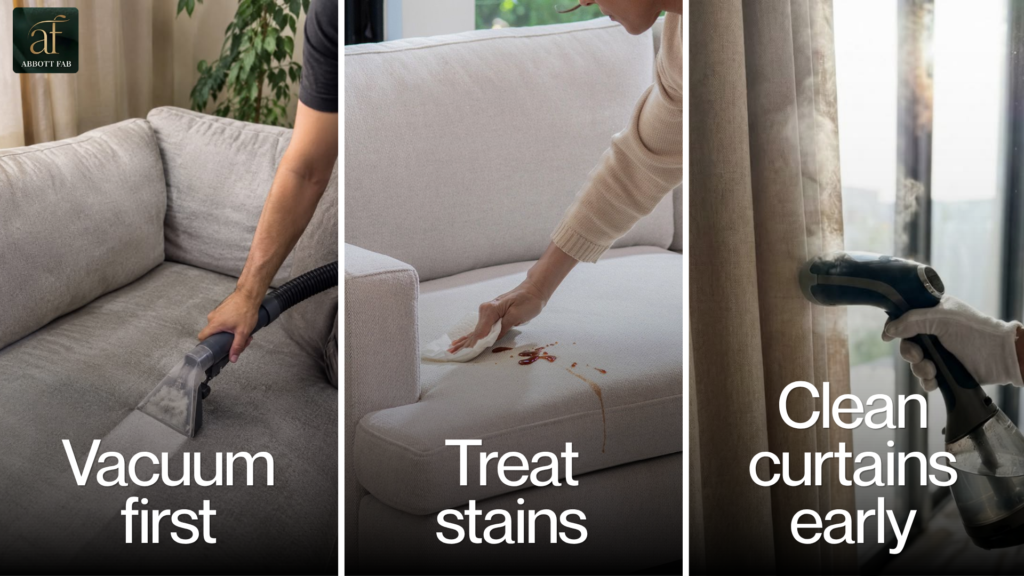
Decorating a home around sofas and curtains that haven’t been properly cleaned in months undermines the entire effort, no matter how well the fabric or colour choices were made. Deep cleaning upholstery and curtains falls low on most festive prep lists precisely because it’s invisible work; nobody compliments a freshly deep-cleaned sofa the way they compliment new cushion covers or string lights. But dust, allergens, and accumulated grime sitting in fabric fibres become considerably more noticeable once windows close for smog season and a house fills with more people breathing the same indoor air for longer stretches than usual.
A practical sequence:
- Vacuum first: Use an upholstery attachment across every seam, crevice, and the area beneath removable cushions, since this is where a year’s accumulated dust actually settles rather than on the visible top surface.
- Spot-treat stains next: Use a fabric-appropriate treatment, testing any cleaning solution on a hidden area first, since festive timelines don’t leave room for a cleaning mistake to be corrected before guests arrive.
- Handle curtains a week ahead: They typically need either a gentle machine wash or professional dry cleaning depending on fabric composition, and heavier drapes can take longer to fully dry and rehang properly.
- Vacuum first: Use an upholstery attachment across every seam, crevice, and the area beneath removable cushions, since this is where a year’s accumulated dust actually settles rather than on the visible top surface.
Fabrics marked with an “X” care code require professional cleaning only, and ignoring this code risks damage no home technique can reverse. Velvet, silk-blend, and heavily embellished festive drapery generally fall into this category, and booking a professional cleaner well ahead of the season avoids the scheduling crunch that hits every cleaning service in the weeks immediately before major festivals.
Common Buying Mistakes That Undo a Festive-Season Refresh
Certain buyer mistakes come up again and again, and avoiding them saves both money and frustration during a season when there’s little time to correct course.
- Choosing fabric under showroom lighting. Showroom lighting is designed to make fabrics look their best. Always take a swatch home and evaluate it in morning light, afternoon sun, and evening artificial light before committing.
- Equating fabric grade with fabric quality. Grades reflect cost, not performance; always ask for the technical specifications separately.
- Ignoring cleaning instructions before purchase. Some fabrics require professional dry-cleaning only; others shrink when washed. A fabric that can’t be maintained the way it demands isn’t worth buying no matter how it looks on day one.
- Not checking weave direction. Fabric has a “nap” or pile direction, particularly in velvet and corduroy. Panels cut in different directions make sections of a sofa appear to be different colours under the same light, a common error with cheaper upholsterers.
- Falling for “anti-microbial” marketing without verification. Many anti-microbial treatments wash out after a few cleanings; only treatments embedded in the fibre itself tend to last the life of the fabric.
- Not ordering enough fabric. Fabrics are dyed in batches, and running short mid-project risks a reorder that doesn’t match the original dye lot. Always order 10 to 15% more than an upholsterer’s estimate and confirm the dye-lot number is consistent across every roll received.
- Choosing fabric under showroom lighting. Showroom lighting is designed to make fabrics look their best. Always take a swatch home and evaluate it in morning light, afternoon sun, and evening artificial light before committing.
Building a Festive-Ready Timeline: 8 Weeks Out to Day Zero
Coordinating fabric orders, reupholstery bookings, and styling touches works far better with a clear runway than as a last-minute scramble.
- 8 weeks before: Complete the full upholstery audit; decide which pieces need reupholstery, rexine covers, or replacement; request swatches and test them under real lighting.
- 6 weeks before: Place fabric or rexine orders, since sourcing and cutting take the longest lead time; book professional reupholstery appointments if needed.
- 4 weeks before: Apply fabric protection treatments to existing upholstery; deep clean rugs, curtains, and any fabric not being replaced; book professional cleaning for anything marked with an “X” care code.
- 2 weeks before: Style the final cushion and throw arrangement; test how the finished room looks under the actual festive lighting setup planned for the gathering.
- 1 week before: Final walk-through of every space guests will use, including entryways and guest bedrooms; confirm dye lots match across any newly delivered fabric.
- 8 weeks before: Complete the full upholstery audit; decide which pieces need reupholstery, rexine covers, or replacement; request swatches and test them under real lighting.
Where to Source Festive Upholstery and Rexine: The AbbottFab Range
For festive-season upholstery and rexine in one place, AbbottFab is a Delhi-based fabric and rexine supplier that carries both the soft furnishing fabrics for formal seating and the wipe-clean rexine for high-spill zones, so a single household doesn’t need two suppliers to cover both sides of the fabric-versus-rexine decision this guide walks through. It operates out of the Timber Market in Kirti Nagar, New Delhi, one of the city’s established furnishing hubs.
The range maps directly onto the room-by-room calls made earlier in this article:
Festive need (from this guide) | AbbottFab material | Verified spec | Best-fit room |
Warm, premium formal seating | Micro velvet / suede velvet | 320–400 GSM, 137 cm (54 in) wide, polyester | Living room, formal lounge |
Textured, dust-hiding upholstery | Suede leather, jacquard, printed upholstery | Suede 100–450 GSM, 140 cm wide | Living room, accent chairs |
Durable everyday sofa fabric | Polyester sofa fabric (plain and printed) | 54 in wide, made in India | Family sofas, high-use seating |
Wipe-clean, spill-resistant seating | PU and PVC rexine, leatherette | Tricote and sandwich rexine, ~1.0 mm | Dining nooks, kids’ corners, benches |
Open-flame-adjacent safety (diyas, pooja) | Jasper flame-retardant leatherette | PVC leather, flame-retardant grade | Seating near diya or pooja displays |
Guest-room light and heat control | Blackout sofa and curtain fabric | Listed blackout range | Guest bedrooms, west-facing windows |
A few things worth knowing before ordering:
- Both material families under one roof: Cotton, linen, velvet, suede, and jute for the formal living room; PU and PVC rexine for the dining nook and children’s corner. That matters because most festive refreshes need both, and matching them from one supplier keeps the dye and texture logic consistent across a room.
- Swatches sized to actually test: Samples are large enough to take home and check under real festive lighting and against a water drop, rather than judged off a showroom shelf, which is the single test this guide recommends most.
- A flame-retardant option exists for ritual spaces: The Jasper leatherette is a genuine flame-retardant grade, which is the safer specification for any seating placed near the open flames common in Diwali and pooja setups.
None of this shortcuts the actual work. The audit still has to be done, and the call on what needs full reupholstery versus a simple slipcover still belongs to whoever is hosting. AbbottFab’s role is the step after those decisions: sourcing fabric and rexine that hold up through the season rather than becoming next year’s problem. For the single most useful next read, the complete sofa fabric guide covers fibre selection, rub-count thresholds, and climate matching in one place.
The Bottom Line
A home doesn’t feel festive because of the lights or the rangoli at the door; it feels festive because the space underneath actually holds up to being lived in, sat in, and gathered in by the people it was decorated for. The best festive home Decor ideas are the ones made a few weeks early, not in a last-minute rush without checking a rub count or how a swatch behaves under real lighting.
Getting it right comes down to a short decision framework:
- Match fibre to climate before colour.
- Choose fabric or rexine by how each room is actually used.
- Set a Martindale floor of 20,000+ (30,000+ with pets or kids).
- Deep clean what’s already there before adding anything new.
The single mistake to avoid is buying off showroom appearance alone. Do that, and the home stays looking ready well past the first evening of guests.
Frequently Asked Questions
Start with the upholstery and fabric rather than the Decorations. Choose a sofa fabric rated 20,000+ Martindale rubs, match fibre to your local climate, refresh cushions and throws for an instant lift, and deep clean existing pieces before styling. These choices still look good long after the festival ends.
A cotton-polyester blend with a Martindale rub count of 20,000 or higher balances breathability with stain and wear resistance well. For pets or a heavy guest count, push that floor to 30,000 rubs.
Fabric suits formal seating for longer conversations, while rexine handles spill-heavy zones like dining nooks more easily. Many households mix both across the same living space.
Velvet looks striking under warm festive lighting but performs best only in climate-controlled rooms with reliable air conditioning. In humid or non-AC spaces, it can feel heavy and trap moisture.
Five checks on a swatch reveal most issues in under five minutes: the grain and backing, a smell test, a flex test, a scratch test, and a water-drop test. Run all five on the exact swatch you plan to order.
At least one to two weeks before, to allow time to book professional cleaning and properly dry heavier fabrics. Fabrics needing professional-only cleaning need even more lead time.
W means water-based cleaners are safe, S means solvent-only, WS allows either, and X means professional cleaning only. Ignoring these codes risks damage no home technique can reverse.
No. Grade labels reflect cost to the manufacturer, not quality to the buyer, so two fabrics at the same grade can perform very differently. Always check the actual Martindale rub count instead.
Cotton or linen blends breathe well in hot, humid conditions without heavy air conditioning. Performance polyester and microfibre suit monsoon-prone regions better, since moisture resistance matters more there.
Yes. High-traffic living rooms and dining nooks benefit from durable blends or rexine, while lower-traffic formal rooms can support more delicate fibres like linen or velvet.