Rexine Fabric: Types, Grades, Uses, and Buying Guide (2026)
Quick Answer: How to Choose Upholstery Fabric
Upholstery fabric is a heavy-duty textile engineered to protect furniture. Choosing the right one depends on three factors:
- Durability (Double Rubs): Aim for 15,000+ for everyday use, and 30,000+ for pets or kids.
- Fibre Type: Natural fibres (linen, wool) offer luxury; synthetics (microfiber, polyester) offer durability; blends offer the best of both.
- Use Case: Use performance fabrics for high traffic, solution-dyed acrylic for outdoors, and delicate weaves like brocade for accent pieces.
What Is Rexine Fabric?
Rexine is a coated synthetic fabric widely sold as artificial leather or faux leather that imitates the appearance and texture of genuine leather. It consists of a textile base, typically cotton, polyester, or a cotton-polyester blend, bonded to a polymer coating, most commonly PVC (polyvinyl chloride) or PU (polyurethane). The surface is embossed with grain patterns that replicate animal hide at a fraction of the cost.
The word “Rexine” originated as a British brand name in the early twentieth century. Like Velcro or Xerox, it became a genericised trademark and is now widely used across South Asia, particularly in India, Pakistan, and Bangladesh, to refer to any PVC or PU-coated synthetic fabric, whether marketed as Rexine, artificial leather, or faux leather.
A Brief History of Rexine
Early 1900s: British origins. Rexine was developed in Great Britain as a practical substitute for expensive natural hides, initially used in bookbinding, carriage interiors, and heavy luggage.
Mid-20th century: Commonwealth expansion. Post-World War II industrial growth spread demand for affordable durable goods across Commonwealth countries, and manufacturers outside the UK began producing their own coated fabrics.
Post-independence India (1950s–1970s). Rapid industrialisation created enormous demand for low-cost leather substitutes. Indian manufacturers adopted the process, and the name “Rexine” stuck permanently, even as the original British trademark faded.
Today. India’s artificial leather industry, Rexine at its core, is a multi-thousand-crore sector with specialised manufacturing clusters in Kanpur, Mumbai, Surat, Kolkata, and Chennai. Modern production incorporates microfiber bases, foam backings, UV-resistant coatings, and increasingly eco-friendly formulations.
How Rexine Is Made: Composition and Structure

Rexine has a layered construction. Understanding each layer helps you evaluate quality accurately.
The Base Layer (Substrate)
The base is a woven or knitted textile that provides structural strength and flexibility.
- Cotton fabric: good strength, breathability, and dye absorption; common in traditional grades
- Polyester fabric: higher tensile strength and better stretch resistance; used in premium grades
- Cotton-polyester blend: the most common choice in mid-range products; it balances both properties.
- Non-woven fabric used in budget or speciality grades where uniformity matters over strength
- Microfiber base found in premium artificial leathers; provides a soft, suede-like backing
The Coating Layer
The coating gives Rexine its leather-like surface.
- PVC (Polyvinyl Chloride) is the most common coating; water-resistant, durable, easy to clean, and inexpensive; available in a wide range of textures and finishes
- PU (Polyurethane) is softer, more breathable, and more eco-friendly than PVC; increasingly used in premium furniture, automotive, and fashion applications.
- Acrylic-based coatings are used in specific industrial or speciality applications.
Optional Foam Backing
Many upholstery-grade Rexines include a polyurethane foam layer laminated between the base fabric and the outer coating. This adds cushioning, improves insulation, and gives the material a premium padded feel. Foam thickness typically ranges from 3 mm to 10 mm.
Surface Finishes
- Embossed patterns: lichi grain, crocodile, buffalo grain, pebble, snake
- Smooth or glossy finish: polished, formal look
- Matte finish: modern, understated appearance
- Metallic or pearlescent finish for fashion and decorative uses
- Antique or distressed finish mimics aged leather
Types of Rexine Fabric
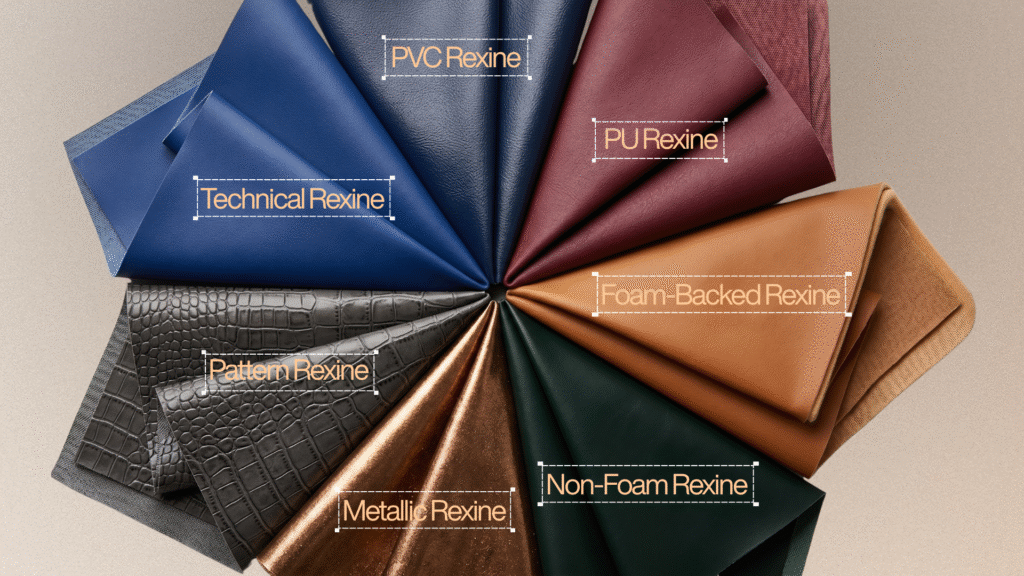
1. PVC Rexine (Standard Grade)
The most widely available form in the Indian market. Durable, fully waterproof, easy to clean, and available in hundreds of colours and textures. Comparatively stiff.
Best for: School bags, office bags, footwear, book covers, economy furniture upholstery, and auto-rickshaw seats
2. PU Rexine (Polyurethane Artificial Leather)
The premium segment of the artificial leather market. Softer, more flexible, and more breathable than PVC. More eco-friendly due to lower VOC emissions. Higher abrasion resistance in quality grades, but more expensive.
Best for: Premium furniture, automotive seat covers, high-end bags, fashion garments, and luxury hotel interiors.
3. Foam-Backed Rexine (Sponge Rexine)
A foam layer is sandwiched between the base fabric and the outer coating. Available in PVC or PU variants with foam thickness from 3 mm to 10 mm. Adds weight compared to non-foam versions.
Best for: Sofa upholstery, car seat covers, padded headboards, hospital furniture, and wall panels.
4. Non-Foam (Plain) Rexine
Leaner and flatter than foam-backed variants. Lightweight and more flexible for folding and stitching.
Best for: Bookbinding, stationery, bags, wallets, and small leather goods.
5. Metallic and Fancy Rexine
Features metallic, glitter, or pearlescent finishes. High visual impact, but less durable under heavy use. Available in gold, silver, rose gold, holographic, and multi-colour variants.
Best for: Fashion accessories, jewellery boxes, event décor, and footwear accents.
6. Embossed Pattern Rexine
Available in dozens of textures that mimic natural leather grains:
- Lichi grain is a small, pebbly texture; one of the most popular patterns in India
- Crocodile grain: larger, dramatic reptile-skin pattern
- Buffalo grain: rough, natural-looking texture
- Elephant grain: deep, coarse texture
- Plain grain: smooth surface, no embossing
Best for: Fashion accessories, jewellery boxes, event décor, and footwear accents.
7. Industrial / Technical Rexine
Engineered for specific performance requirements:
- Fire-retardant Rexine: public transport, cinema seating, aircraft interiors
- Anti-bacterial Rexine: hospitals and clinics
- UV-resistant Rexine: outdoor furniture and vehicles
- Heavy-duty Rexine: thick, reinforced for high-wear applications
Grades of Rexine: What the Market Offers
The Indian market operates across three quality tiers. Terminology is not always standardised; suppliers may use terms like “first quality,” “export quality,” or “local quality.”
| Grade | Coating | Base Fabric | Price Range (2026) | Typical Use |
|---|---|---|---|---|
| Grade A / Premium | High-quality PU or premium PVC | Polyester or microfiber | ₹90–₹400+ per metre | Premium furniture, automotive, export goods |
| Grade B / Mid-Grade | Standard PVC | Cotton-poly blend | ₹40–₹90 per metre | Commercial bags, office upholstery, mid-range footwear |
| Grade C / Economy | Thin PVC | Lower-grade or recycled base | ₹20–₹40 per metre | Notebooks, disposable linings, short-life applications |
Buyer’s note: Always request a physical sample before placing bulk orders. Pricing fluctuates with petroleum raw material costs, roll width, and backing fabric density.
Key Applications Across Industries

Furniture and Commercial Upholstery
Upholstery is the largest single market for Rexine in India. Commercial spaces, restaurants, airports, corporate offices, and banquet halls rely on it where fabric fails due to staining and wear.
Minimum specs for high-traffic commercial seating: top-layer coating of at least 1.0 mm; foam backing of at least 5 mm; high scratch resistance; UV colourfastness for installations near windows.
Automotive and Transport Interiors
Indian vehicle interiors can reach temperatures exceeding 60°C when parked in direct sunlight, making material selection critical. Standard consumer-grade Rexine will crack under these conditions.
Applications: Car seat covers, door card inserts, dashboards, steering wheel wraps, gear boot sleeves, headliners.
Required spec: Heat-stabilised PVC or PU, UV inhibitor treatment, and often perforated construction to allow heat dissipation and airflow.
Bags, Luggage, and Accessories
Synthetic leather dominates India’s luggage manufacturing sector for its rigid structure and complete waterproofing.
- Structured goods (backpacks, briefcases, travel luggage) are thicker, stiffer, non-foam PVC with lichi or matte grain.
- Soft accessories (wallets, belts, pouches), in-gauge, highly flexible PU that mimics calfskin drape
- Fashion handbags with tassels, embossed, or high-gloss patent finishes, sourced heavily from Surat
Footwear Manufacturing
India is among the world’s largest footwear producers, and Rexine is a primary input for mass-market shoes, sandals, and chappals.
| Attribute | Requirement | Why It Matters |
|---|---|---|
| Flex resistance | 50,000+ continuous flex cycles | Prevents the shoe upper from cracking at the toe crease |
| Adhesion strength | High chemical bond compatibility | Ensures industrial adhesives bond Rexine to PVC, TPR, or PU soles |
| Weight | Lightweight and hydrophobic | Keeps footwear nimble and water-impervious |
Healthcare and Institutional Environments
Fabric upholstery is too porous for clinical settings; genuine leather cannot withstand medical-grade sanitisation. Healthcare-grade artificial leather is formulated with anti-microbial additives embedded directly into the polymer and must withstand continuous wiping with isopropyl alcohol and chemical disinfectants without hardening, discolouring, or melting.
Applications: Medical examination tables, dentist chairs, blood donation beds, and waiting room benches.
Bookbinding and Corporate Stationery
One of the oldest uses of the material. Premium diaries, corporate planners, menu cards, certificate folders, and desk pads use ultra-thin fabric-backed Rexine for a formal leather aesthetic at a fraction of the cost.
Apparel and Fast Fashion
Ultra-supple, lightweight faux leather is used for jackets, skirts, and trousers. This grade is engineered to stretch, drape, and sew cleanly on standard garment manufacturing lines.
Interior Décor and Architectural Panels
Padded Rexine panels are increasingly specified for vertical wall cladding, acoustic headboards, and accent walls, particularly in home theatres and commercial lounges, where both sound dampening and aesthetics matter.
Sports and Fitness Equipment
High-tensile industrial grades are used for gym benches, boxing bags, and protective padding. Speciality grades are also used for synthetic cricket balls for wet-weather practice.
Rexine vs. Genuine Leather vs. PU Leather
| Property | Genuine Leather | Rexine (PVC) | PU Leather |
|---|---|---|---|
| Cost | High | Low | Medium |
| Durability | Very high (decades) | Moderate (3–5 years | Good (5–10 years) |
| Water resistance | Moderate (absorbent unless treated) | High (fully waterproof) | High (water-repellent) |
| Breathability | High | Low (can feel hot) | Moderate |
| Maintenance | High (requires conditioning) | Very easy (wipe clean) | Very easy (wipe clean) |
| Eco-friendliness | Complex (animal by-product + chemical tanning) | Lower (PVC production concerns) | Better than PVC |
| Ageing | Ages with patina; softens over time | Prone to cracking in economy grades | Retains flexibility; ages better than PVC |
| Cruelty-free | No | Yes | Yes |
| Best for | Luxury goods, premium footwear, heirloom furniture | Mass-market seating, utility cases, medical furniture | Contemporary furniture, fashion, and mid-range footwear |
Choose genuine leather when longevity and premium aesthetics justify the cost. A well-maintained leather item can last decades.
Choose PVC Rexine for high-traffic, budget-conscious, or high-sanitisation environments, such as diner booths, medical examination tables, and public transport seating.
Choose PU leather as the middle ground for modern consumer products where comfort and appearance matter, but budget constraints exist.
How to Assess Rexine Quality Before Buying
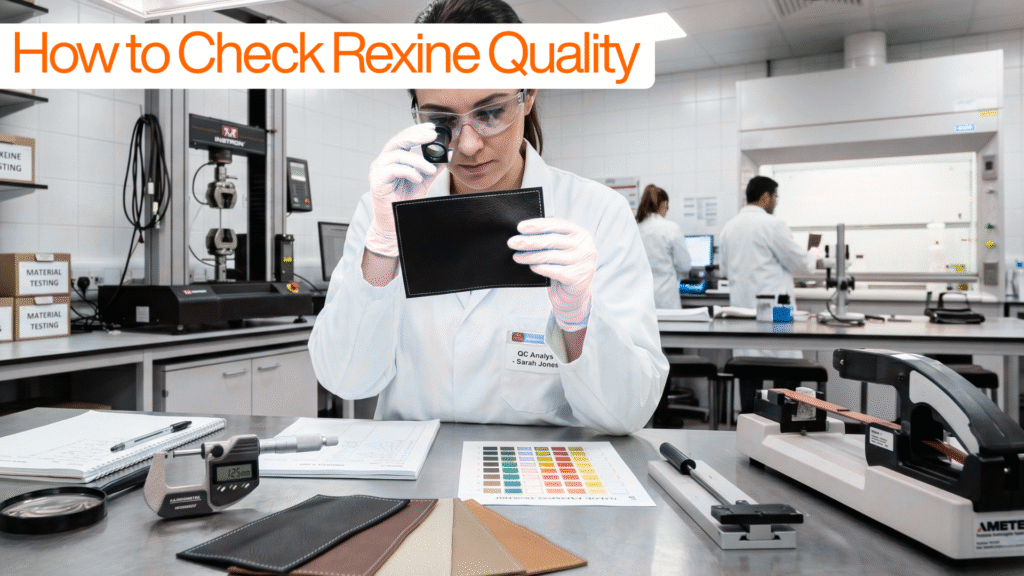
Visual Inspection
- Colour uniformity, patchy or faded areas indicate poor dyeing or coating
- Surface consistency: no bubbles, peeling, or rough patches across the roll
- The embossing alignment pattern should run straight and consistently
Physical Tests (Always Do These on a Sample)
The Bend Test: Fold the material sharply. Quality Rexine bends without cracking or showing white stress marks. Economy grades crack at the fold, a critical failure point for bags, footwear, and wallets.
The Peel Test: Try peeling the coating from the base fabric with a fingernail. In quality Rexine, adhesion should be firm. Weak adhesion means surface peeling in use.
The Scratch Test: Run a fingernail firmly across the surface. Superficial scuffs that stay minor are acceptable. Scratches that cut through the coating indicate a thin or under-treated surface.
The Stretch Test: Pull the material in both directions. Quality Rexine stretches evenly. Uneven stretching or base fabric showing through suggests poor coating coverage.
The Heat Test (for automotive/outdoor use): Hold the material near a warm surface. Automotive-grade Rexine should not become tacky or deform.
The Water Test: Pour a small amount of water on the surface. It should bead up rather than soak through.
Specifications to Request from Suppliers
- GSM (grams per square metre): furniture Rexine typically runs 600–1,000 GSM; bag Rexine 400–700 GSM
- Coating thickness stated in mm or microns; higher thickness generally means more durability.
- Roll width standard widths are 54 inches and 60 inches
- Foam thickness in mm, if applicable
How to Buy Rexine in India: A Practical Sourcing Guide
Step 1: Define Application and Performance Requirements
Before approaching any supplier, lock down your exact physical parameters: required thickness, backing type, and any special resistance properties such as UV stability, fire retardancy, or anti-bacterial treatment.
Step 2: Match to the Right Technical Category
| Application | Material | GSM Range | Foam | Grain |
|---|---|---|---|---|
| Furniture and upholstery | Foam-backed PVC | 600–900 | 3–5 mm | Lichi or matte |
| Bags and luggage | Non-foam PVC | 400–600 | None | Smooth or embossed |
| Automotive | Heat and UV-stabilised PVC or PU | 700–900 | Optional | Matte or perforated |
| Notebooks and bookbinding | Ultra-thin non-foam PVC | 300–450 | None | Plain or lichi |
| Apparel and fashion | Pure PU | 300–500 | None | Smooth or soft grain |
Step 3: Identify Your Sourcing Hub
Delhi-NCR: Nabi Karim (Paharganj) and Hardhian Singh Road, Karol Bagh are the primary wholesale hubs for bag, automotive, and upholstery Rexine.
Kanpur (Uttar Pradesh): The Anwarganj and Meston Road cluster is one of India’s largest artificial leather manufacturing hubs. Best for bulk industrial pricing.
Mumbai (Maharashtra): Dharavi and Crawford Market for premium finishes and baggage-grade materials.
Kolkata (West Bengal): Burrabazar for bookbinding, stationery, and utility case materials.
Surat (Gujarat): The go-to hub for high-fashion, designer, and fancy textured variants.
Online platforms: IndiaMART and TradeIndia are reliable for locating and vetting verified suppliers before committing to offline purchases.
Step 4: Test Physical Samples
Never authorise a bulk order based on digital swatches. Request a sample of at least 30 cm × 30 cm along with the supplier’s technical data sheet. Perform the bend, peel, and stretch tests described above
Step 5: Verify Certifications
For institutional or export orders, confirm the following directly with the supplier:
- BIS fire retardancy standards for commercial interiors, public transport, and institutional use
- OEKO-TEX Standard 100 is critical for fashion goods and children’s products with direct skin contact
- Global Recycled Standard (GRS) for backing fabric made from recycled PET
Step 6 Vet Supplier Reliability
Before signing a long-term contract, confirm:
- Can Batch consistency the supplier guarantee colour-matching (ΔE variance control) across future lots?
- Minimum order quantity: wholesale rolls typically run in 50-metre lengths; custom colours may require multi-roll commitments.
- Return policy: Does the supplier offer recourse for rolls with un-bonded sections, visual spotting, or uneven thickness?
Care and Maintenance of Rexine
Regular Cleaning
Dust and body oils break down the top polymer layer over time, causing premature peeling.
- Weekly wipe: Clean the surface with a slightly damp microfiber cloth to remove surface dust
- Mild stains: Mix a few drops of liquid dish soap in warm water; wipe the stain with a wrung-out soft cloth in circular motions; follow with a clean, damp cloth to remove soap residue; dry with a soft towel
Never use: Acetone, bleach, isopropyl alcohol, or multi-surface glass cleaners. These strip the plasticisers from the coating, leaving the material brittle, sticky, and prone to cracking.
Conditioning
PU Rexine can dry out over time. Every 6 to 12 months, apply a thin layer of synthetic leather conditioner or a mild water-based PU protector. Do not use petroleum- or oil-based shoe polishes; they cannot penetrate synthetic coatings and leave a greasy residue that attracts dust.
Protection from Environmental Stressors
UV and sunlight: Prolonged direct sunlight breaks down chemical bonds in PVC, causing fading and surface cracking. Position the Rexine furniture away from uncovered windows, or use window tints and curtains.
Heat and ventilation: Trapped heat accelerates polymer ageing in hot, humid climates. Ensure adequate room or cabin ventilation. Keep Rexine furniture away from radiators and heat vents.
Sharp objects: Unlike genuine leather, deep scratches in Rexine are permanent. Keep keys, pet claws, and sharp metal fixtures away from the surface.
Storing Rexine Fabric Rolls
- Roll, never fold. Folding creates permanent crease lines and weakens the vinyl layer; roll with the coated side facing outward around a sturdy cardboard core.
- Cool and dry storage store rolls horizontally, away from direct sunlight and moisture.
- Avoid heavy stacking pressure, combined with heat, which can cause synthetic layers to bond or fuse together.
Environmental Considerations
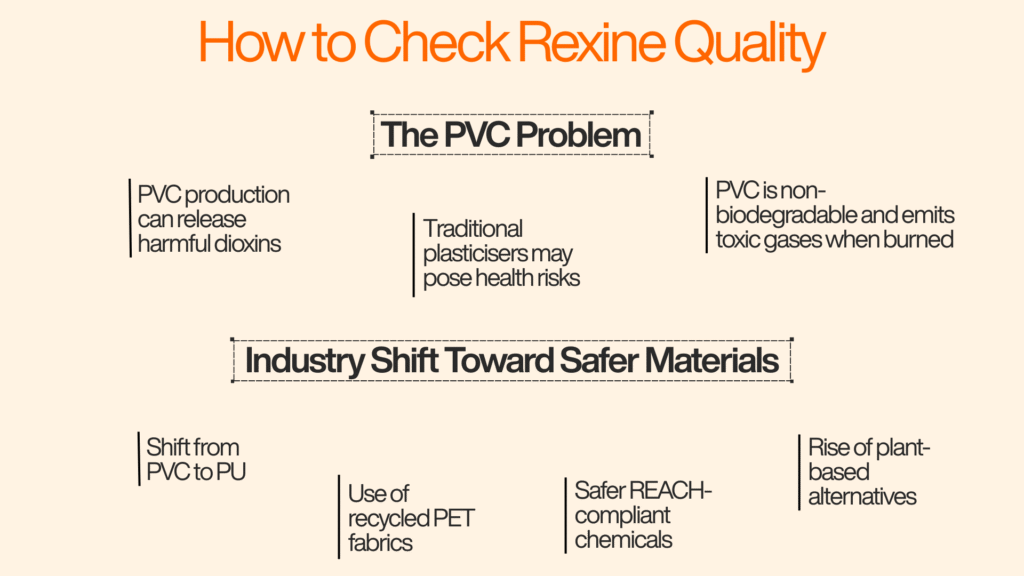
The Problem with PVC
Traditional PVC-based Rexine carries a significant environmental footprint at every stage of its lifecycle:
- Production PVC manufacturing involves chlorine chemistry, which can release dioxins if not strictly controlled
- Plasticisers, traditional phthalate plasticisers, used to make PVC flexible, have been flagged as endocrine disruptors and are restricted in consumer goods sold in the EU and many other markets.
- End-of-life PVC does not biodegrade; improper incineration releases toxic gases
How the Industry Is Responding
Shift to PU: Polyurethane coatings do not rely on chlorine chemistry, require fewer volatile organic compounds, and produce a softer, more breathable result. PU is rapidly gaining market share from PVC.
Recycled substrates: Manufacturers are replacing virgin polyester backing fabric with recycled PET (rPET) made from post-consumer plastic bottles.
REACH-compliant chemistry: Under EU REACH regulations, legacy phthalate plasticisers are being replaced with safer, non-toxic alternatives that deliver equivalent flexibility without the health risks.
Plant-based alternatives: A premium tier of next-generation materials bypasses plastics entirely:
| Material | Source | Key Benefit |
|---|---|---|
| Piñatex | Pineapple leaf fibres | Utilises agricultural waste; provides income to farming communities |
| Cactus leather | Nopal cactus leaves | Very low water requirements; high breathability |
| Mycelium leather | Mushroom root structures | Lab-grown in days; naturally biodegradable |
| Fruit-waste leather | Apple or mango peels | Repurposes food industry by-product |
These plant-based options currently occupy a premium niche due to lower production scale, but represent the direction the industry is heading.
If you want to source responsibly today: choose PU over PVC when budget and performance allow; ask for OEKO-TEX Standard 100 or REACH compliance documentation; and verify GRS certification on the backing fabric.
Why Manufacturers and Buyers Trust Abbott Fab for Rexine
These plant-based options currently occupy a premium niche due to lower production scale, but represent the direction the industry is heading.
If you want to source responsibly today: choose PU over PVC when budget and performance allow; ask for OEKO-TEX Standard 100 or REACH compliance documentation; and verify GRS certification on the backing fabric.
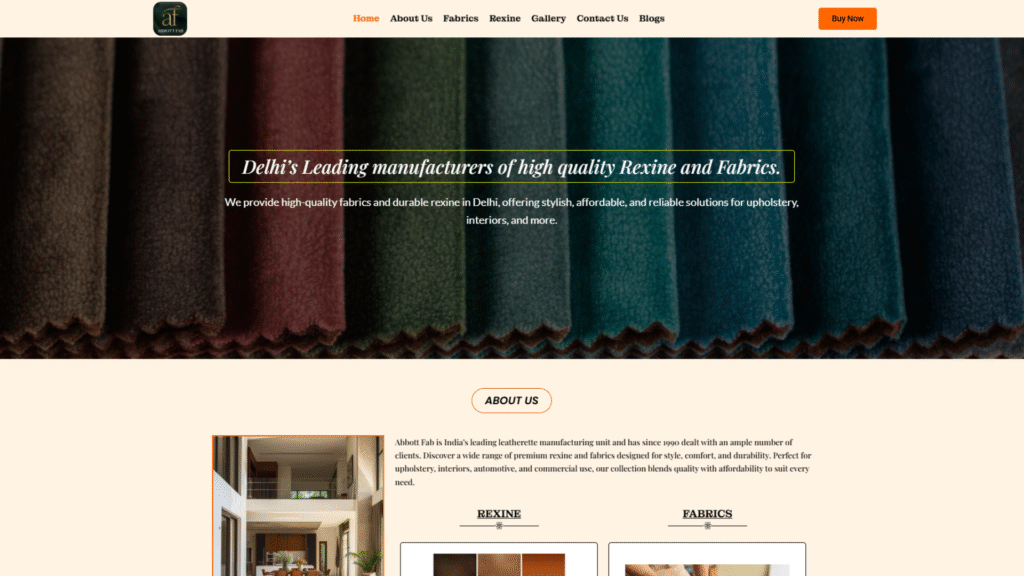
Reading about grades and specifications is one thing. Finding a supplier who actually delivers consistent quality across bulk orders is another problem entirely.
Abbott Fab has spent years solving exactly that. As a dedicated Rexine fabric supplier, Abbott Fab stocks a wide range of PVC and PU variants from economy-grade plain Rexine for stationery and packaging to foam-backed upholstery grades built for high-traffic commercial seating. Every roll that leaves the warehouse has been sourced from verified manufacturers and checked for coating uniformity, backing adhesion, and colour consistency before it reaches the buyer.
What this means for you in practice:
- No grade guesswork. Abbott Fab categorises stock clearly by application: furniture, automotive, bags, fashion, and institutional, so you are not left decoding supplier jargon to figure out whether a material will perform.
- Samples before commitment. Before placing any bulk order, Abbott Fab provides physical samples with full technical data so you can run the bend, peel, and stretch tests yourself.
- Consistent batch matching. For manufacturers running repeat production, colour and texture matching across lots is a non-negotiable. Abbott Fab maintains batch records and works with suppliers who can hold ΔE variance within tight tolerances.
- Export-ready documentation. For buyers supplying institutional clients or exporting finished goods, Abbott Fab can provide material documentation, including OEKO-TEX and REACH compliance, where applicable.
Whether you are a furniture manufacturer placing a standing order for foam-backed PVC, a bag maker sourcing lichi-grain for the next season, or a small studio buying a few metres of metallic PU for a fashion project, the range, the transparency, and the after-sales support are there.
Reach out to Abbott Fab directly to discuss your application, request samples, or get a quote on bulk procurement.
Conclusion
Rexine is not a single material; it is a family of coated fabrics, each with different polymer chemistry, base construction, foam density, and surface treatment, each suited to a specific set of demands. A sofa destined for a corporate lounge needs a fundamentally different specification than a school bag, a medical examination table, or an automotive seat cover.
The decisions that matter are concrete ones: PVC or PU, foam-backed or plain, what GSM, what coating thickness, what grain. Get those right, and the material performs. Get them wrong, and you are replacing upholstery in two years instead of ten.
For buyers and manufacturers operating in India’s Rexine market, the other variable is the supplier. Pricing is easy to find. Consistent quality across repeat orders, accurate grade labelling, and reliable batch matching are harder to come by.
That is where Abbott Fab fits in, not as a generic intermediary, but as a supplier that understands the material well enough to match it to the application correctly the first time.
If you are working on a new project, scaling up production, or simply trying to move away from a supplier that has been inconsistent, start with a sample order. Test it the right way. Then decide.
Frequently Asked Questions
The polymer surface of Rexine is fully non-porous and repels water effectively. However, stitched seams, needle holes, and areas of heavy wear can allow water ingress. For complete waterproofing in industrial or marine applications, sealed seams (high-frequency welding) or waterproof seam-sealing tape are required.
It depends on grade and usage conditions. Premium Grade A Rexine in well-maintained indoor furniture can last 8 to 15 years. Economy grades can begin to crack and peel within 2 to 3 years in high-friction or outdoor environments. The primary causes of premature ageing are sustained UV exposure and trapped heat.
Yes, with the right setup. Use a leather needle (chisel-point or cutting-point) and heavy-duty polyester thread. Replace the standard presser foot with a Teflon foot or roller foot. This prevents the polymer surface from dragging or bunching as it feeds through the machine. Thin fashion-grade PU Rexine can be sewn on a powerful home machine; thick industrial grades require a commercial machine
Three factors: economy grades have an extremely thin PVC coating with minimal wear resistance; the adhesion between the polymer layer and the base textile is chemically weak and separates under stress; and premium Rexine uses plasticisers to maintain PVC flexibility, which economy grades skimp on, resulting in material that becomes brittle when exposed to heat and UV radiation
Minor surface cracks and small punctures can be repaired with commercial PVC repair kits or colour-matched liquid leather compounds that fill the damaged area and reseal the surface. Large areas of peeling indicate the polymer bond has failed completely at this point, spot repairs are ineffective, and the material requires full reupholstery.
Consumer-grade Rexine tolerates normal room and outdoor temperatures. Automotive-grade Rexine is specifically formulated with UV and thermal stabilisers for the extreme temperatures inside parked vehicles. No grade of Rexine resists direct heat sources; hot utensils, steam irons, or open flames will permanently melt the polymer coating and damage the textile base.
Rexine and faux leather are the same category of material, a coated synthetic fabric that imitates genuine leather. “Rexine” is the term commonly used in South Asia (particularly India), while “faux leather,” “vegan leather,” or “synthetic leather” are more common in Western markets. Both terms can refer to PVC-coated or PU-coated fabrics, depending on the grade.
Rexine is made of a woven or knitted textile base (cotton, polyester, or a blend) bonded to a polymer coating, most commonly PVC or PU. Many variants also include a foam interlayer for cushioning. The surface is embossed with grain patterns to mimic natural leather.
Pingback: Rexine Bags for Diwali Gifting 2026: A Buyer's Guide
Pingback: Best Upholstery Fabrics for Festive Home Decor (2026 Ranking)