Best Curtain Fabric for Monsoon Humidity in India: The Complete 2026 Guide

Key Takeaways
- Synthetics win on physics, not opinion. Polyester’s commercial moisture regain is around 0.4%, against roughly 8.5% for cotton and 12% for linen a 20- to 30-fold difference in how much water the fibre holds.
- Mould is a moisture problem before it’s a fabric problem. Building-science standards treat sustained surface relative humidity at or above roughly 80% as the point where mould growth becomes likely on susceptible materials.
- Health, not just housekeeping. The CDC notes that mould grows readily on fabric and upholstery, and that exposure can trigger a stuffy nose, coughing, wheezing, burning eyes or skin rash, with more severe reactions in people who have asthma or a mould allergy.
- Synthetic doesn’t mean immune. Clean synthetic fabric won’t feed mould, but the dust, skin oils and cooking residue that settle on it will. This is why washing matters even for polyester.
- Your monsoon isn’t everyone’s monsoon. Mumbai, Kolkata and Delhi-NCR peak with the southwest monsoon from June to September. Chennai’s main rainy season is the northeast monsoon, roughly mid-October to December. Same fabric logic, different calendar.
- Layering beats picking a single hero fabric. A sheer polyester inner panel against the glass plus a heavier synthetic outer drape gives you fast-drying protection and a finished look.
The Short Answer
For Indian monsoon conditions, choose polyester, solution-dyed acrylic, or olefin (polypropylene). All three absorb almost no water and dry within hours rather than days, which is what actually determines whether a curtain grows mildew. Treated or blended cotton works in genuinely cross-ventilated rooms. Store velvet, silk, jute, brocade and heavy linen for the season; they combine the highest moisture uptake with the slowest drying.
One caveat worth stating upfront: fabric choice reduces risk; it does not eliminate it. Mould needs sustained moisture, and no curtain will fix a room that sits at 85% relative humidity for eight weeks. Fabric is one lever. Ventilation and dehumidification are the other two.
Why Curtains Take the Worst of the Monsoon
Curtains hang exactly where humid air enters a home: windows, balcony doors, kitchen openings. They are the first textile to meet rain-laden air, and the first to show what that air does over eight to twelve weeks.
The numbers are not marginal. Mumbai’s monthly average relative humidity peaks near 86–89% in July, against an annual average of roughly 71–75%. Kolkata runs at about 83–88% through July and August. Delhi-NCR is drier on average but swings hard during the monsoon months, with humidity readings above 80% common on rainy days. Chennai’s own peak arrives later, with relative humidity highest in October and November.
Those are outdoor observations. Indoors, in the naturally ventilated homes most Indian families live in, humidity tracks outdoor conditions closely, which is precisely the problem. Sealed, air-conditioned flats fare better, because cooling dehumidifies, but only while the unit is actually running.
Why does this matter for a curtain specifically? Because of what mould needs. Laboratory and building-science work converges on a threshold: sustained surface relative humidity around 80% is where germination becomes likely on susceptible materials, with visible growth following over days to weeks of continued exposure. ASHRAE’s moisture-design standard uses a 30-day running average surface RH below 80% as its criterion for avoiding mould growth. A cotton curtain hanging in a Mumbai bedroom in July can sit above that line for most of the season.
The consequence isn’t only cosmetic. The US Centres for Disease Control and Prevention lists fabric and upholstery among the materials mould grows on, and recommends keeping indoor humidity below 50% all day long as a core prevention step. The CDC also notes that the 2004 Institute of Medicine review found sufficient evidence linking indoor mould exposure to upper respiratory symptoms, cough and wheeze in otherwise healthy people, and to asthma symptoms in people who already have asthma.
Realistically, no Indian home is holding 50% RH indoors in July without mechanical help. That’s the argument for choosing fabrics that don’t hold water and for running an AC on dry mode or a dehumidifier in the rooms that matter most.
The Science: Moisture Regain, and Why it Decides Everything
Every fibre has a moisture regain: the weight of water it holds, expressed as a percentage of its own oven-dry weight. Trade values are standardised under ASTM D1909 and measured at a reference atmosphere of roughly 21°C and 65% relative humidity.
Two things follow from that definition. First, these are comparative benchmarks, not monsoon predictions. At 90% RH, every hygroscopic fibre in the table below holds considerably more water than its listed figure. Second, the ranking holds regardless, and the ranking is what you’re buying on.
| Fibre | Commercial moisture regain | What it means for a curtain |
|---|---|---|
| Olefin (polypropylene) | ~0% | Effectively nil. Nothing for mildew to feed on or hold onto |
| Polyester | 0.4% | Barely absorbs; surface moisture flashes off quickly |
| Acrylic | 1.5% (published range 1.0–2.5%) | Very low; engineered originally for outdoor exposure |
| Nylon (polyamide) | 4.0–4.5% | Low-moderate; uncommon in curtains |
| Acetate | 6.0% | Moderate, and weak when wet |
| Cotton | 8.5% | Moderate. Workable with ventilation and a wash routine |
| Silk | 11.0% | High. Water-spots, loses lustre, weakens |
| Viscose rayon | 11–13% | High, and loses significant strength when wet |
| Linen (flax) | 12.0–12.4% | High; slow-drying, sags, mildews |
| Jute | ~13.75% | Very high; a lignocellulosic fibre that genuinely rots |
| Wool | 16.0% | Highest in common use; included for scale |
Put plainly: cotton holds roughly 21 times more water than polyester at the same conditions, linen about 31 times, wool about 40 times. That gap doesn’t close because of how a fabric is woven or which colour it’s dyed.
The Nuance most Guides Skip
Synthetic fibres resist mildew because fungi can’t digest them; polyester, acrylic and olefin offer no nutrition. But mould doesn’t only eat fabric. Extension research and textile-conservation guidance both make the same point: soiled synthetic fabric stored warm and damp can and does mildew, because the growth happens on the deposited organic soil dust, skin oils, cooking grease rather than on the fibre.
This is the single most useful correction to “just buy polyester and forget it.” Polyester buys you a fibre that won’t rot. It doesn’t buy you a curtain that never needs washing. Through peak monsoon, a wash every two to three weeks removes the soil layer that mould would otherwise colonise, even on a fabric that is technically mildew-proof.
The Best Curtain Fabrics for Indian Monsoon Humidity
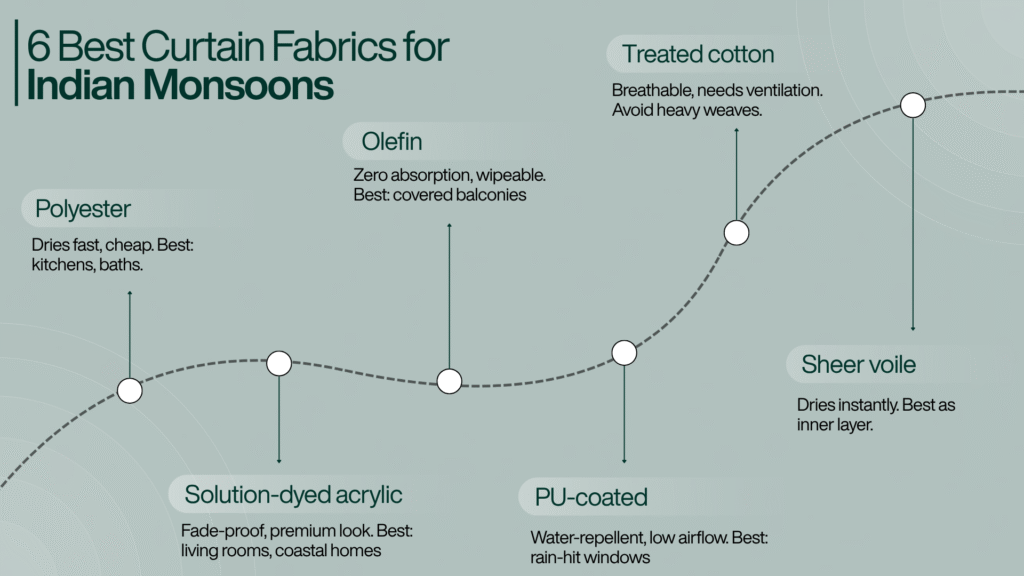
1. Polyester: the default right answer
Polyester’s near-zero regain and hydrophobic surface mean water sits on it rather than in it. It dries fast, washes easily, costs the least of the high-performance options, and is widely available in every weave from sheer voile to blackout.
Two honest limits. First, standard polyester is not inherently fade-proof; dyed polyester needs UV stabilisation or solution-dyeing to hold colour through years of strong Indian sun. Second, it isn’t antimicrobial unless it’s been given an antimicrobial finish; its mildew resistance comes from being inedible and dry, not from killing anything.
Best for: kitchens, bathrooms, balcony-facing rooms, children’s rooms, rentals, and anyone who wants one fabric that works everywhere.
2. Solution-dyed acrylic: premium look, weather-grade performance
Acrylic sits at about 1.5% regain with strong mildew resistance. The version worth paying for is solution-dyed (also called dope-dyed), where pigment is added to the polymer before the fibre is spun rather than applied to finished yarn. Colour runs through the fibre rather than sitting on it, which is why solution-dyed acrylic sets the benchmark for fade resistance in outdoor textiles.
Best for: living rooms and bedrooms where the fabric has to look considered, semi-outdoor verandahs, and coastal homes facing both humidity and hard sun.
3. Olefin (polypropylene): the specialist for coastal homes
Olefin has essentially zero moisture regain. Mildew, sour odours and damp stains have nothing to hold onto, and it can be wiped or hosed down.
The correction worth making: olefin is not naturally UV-resistant. Unstabilised polypropylene degrades under prolonged sun; chains break down, and the fabric fades and embrittles. Specify UV-stabilised, solution-dyed olefin, and prefer it for covered or partially shaded positions rather than full-sun west-facing glass.
Best for: homes right on the coast Mumbai, Goa, Vizag, Kochi in covered balconies, verandahs and utility windows.
4. PU-coated fabrics: maximum water repellency
A polyurethane coating on a polyester or blended base turns a water-resistant fabric into a genuinely water-repellent one. The trade-off is breathability: a coated fabric blocks airflow, so it protects the panel while doing nothing to help the room dry. Use it where water contact is the threat, not where trapped humidity is.
Best for: rain-battered west-facing windows, ground-floor balcony doors, and kitchen or bathroom frames that take direct splash.
5. Treated or blended cotton: the Indian classic, done properly
Cotton drapes and breathes in a way synthetics still struggle to match, and at 8.5% regain, it isn’t disastrous; it’s manageable. Untreated cotton in a still, closed room is a different matter.
Make it work: hang in genuinely cross-ventilated rooms; choose light weaves (voile, muslin, mulmul) over canvas and heavy multi-layer drapes; apply a mildew-inhibiting finish before the season; keep panels clear of damp sills and floors; wash every two to three weeks and dry fully, indoors under a fan if the sun doesn’t cooperate.
Avoid: thick cotton canvas, heavy lined cotton drapes, and floor-length panels that touch wet surfaces.
6. Sheer polyester and voile: the underrated layer
Sheers get dismissed as decorative. In a humid room, they’re functional: they dry almost immediately, add no meaningful moisture load, and preserve the airflow that helps the room itself dry out. Used as the inner layer against the glass, a polyester sheer takes the ambient moisture hit so the heavier outer panel doesn’t have to.
Polyester vs Treated Cotton vs Acrylic: The Quick Verdict
| Polyester | Treated cotton | Solution-dyed acrylic | |
|---|---|---|---|
| Moisture regain | ~0.4% | ~8.5% | ~1.5% |
| Drying speed | Very fast | Moderate to slow | Fast |
| Mildew resistance | High (clean fabric) | Moderate, finish-dependent | High |
| Fade resistance | Needs UV stabilisation | Moderate | Excellent |
| Feel and drape | Good to excellent | Excellent | Very good |
| Relative cost | Low | Low to medium | Medium to high |
| Monsoon suitability | ★★★★★ | ★★★☆☆ | ★★★★★ |
Bottom line. If you want one fabric that performs everywhere with minimal thought, polyester. If you want the hand and breathability of a natural fibre and you have real cross-ventilation, treated cotton earns its place. If the budget allows and you want a designer finish that still survives coastal sun and salt air, solution-dyed acrylic is the upgrade.
Fabrics to Store Away for the Season
| Fabric | Why it fails in sustained humidity |
|---|---|
| Velvet | Dense pile traps moisture deep in the base; dries very slowly |
| Silk | ~11% regain; water-spots permanently, loses sheen, weakens when damp |
| Heavy linen | ~12% regain plus weight; sags, holds moisture, mildews |
| Brocade/jacquard | Complex multi-layer weave traps moisture inside the structure |
| Jute/burlap | ~13.75% regain; a natural fibre that genuinely rots |
| Thick cotton canvas | Takes days to dry; becomes a localised damp trap |
| Chenille | Looped pile holds atmospheric moisture; the classic source of musty odour |
If any of these are hanging in a high-risk room right now, this is the season to swap them out and store them properly. See the storage note in the care calendar below.
Room-by-Room Fabric Guide
| Room | The specific challenge | Recommended fabric |
|---|---|---|
| Living room | Main entry point for rain-laden air | Cotton-polyester blend outer + sheer polyester inner |
| Kitchen | Steam and cooking grease on top of humidity | 100% polyester, or PU-coated for splash zones |
| Master bedroom | Comfort and aesthetics with overnight humidity | Treated cotton or acrylic blend |
| Children’s room | Needs frequent, hot washing | Pure polyester |
| Bathroom | Continuous water and steam | Polyester, olefin or PU-treated |
| Balcony / verandah | Direct rain and wind | UV-stabilised olefin, solution-dyed acrylic, or PU-coated polyester |
| Study / home office | Moderate humidity, long occupancy | Cotton-linen blend with a mildew-inhibiting finish |
| Dining room | Elegance without fragility | Polyester-linen blend |
City by City: Your Monsoon is not Everyone's Monsoon
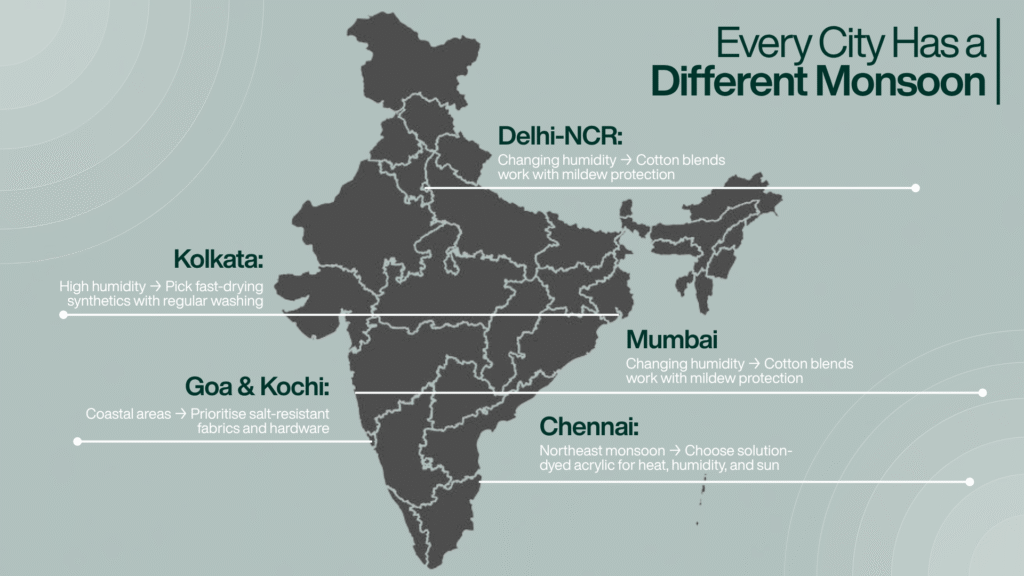
The southwest monsoon, which the India Meteorological Department tracks as the June to September season, is what most of India means by “the rains.” Peninsular India’s east coast is the exception, and it changes the calendar completely.
Mumbai: Monthly average humidity peaks near 86–89% in July, with the season running June through September. Sea-facing and west-facing rooms take salt air alongside rain. This is the one city where high-performance fabric shouldn’t be treated as optional: UV-stabilised olefin or PU-coated polyester in exposed positions, polyester everywhere else.
Chennai: Chennai’s main rainy season is the northeast monsoon, roughly mid-October to December; it normally sets in around 20 October and delivers close to half of Tamil Nadu’s annual rainfall. Humidity peaks in October and November, not July. Plan your fabric swap and pre-season treatment for late September, not May. Solution-dyed acrylic handles the local combination of heat, humidity and strong coastal sun particularly well.
Kolkata: July and August average around 83–88% humidity, with the wettest month bringing roughly 350 mm of rain. Sunshine is scarce, so drying is the binding constraint. Pair a fast-drying synthetic with active cross-ventilation and a stricter wash schedule than drier cities need.
Delhi-NCR: The monsoon typically sets in late June and withdraws around 25 September, and the IMD’s regional data puts Delhi’s seasonal normal at roughly 640 mm. Humidity here swings rather than sitting high, which gives treated cotton and cotton-polyester blends genuine room to work, provided the pre-monsoon mildew treatment actually happens.
Goa, Kochi and the coastal west. Treat these like Mumbai, with more emphasis on salt-air corrosion of hardware.
The layering Strategy
The highest-utility recommendation in this guide, and it costs less than upgrading to a premium fabric throughout.
Hang a lightweight sheer polyester or voile against the glass, and a heavier polyester, acrylic or cotton-polyester outer panel in front of it. The sheer intercepts the ambient moisture at the window, dries within minutes, and washes easily. The outer layer stays drier, lasts longer, and gives the room its finished look. In a bedroom or living room in any high-humidity city, this two-layer setup outperforms a single heavy panel of almost anything.
For room-by-room styling logic beyond the monsoon, see our companion guide: How to Choose the Best Curtain Fabric for Every Room.
Weave, Dye and Finish Matter as Much as Fibre
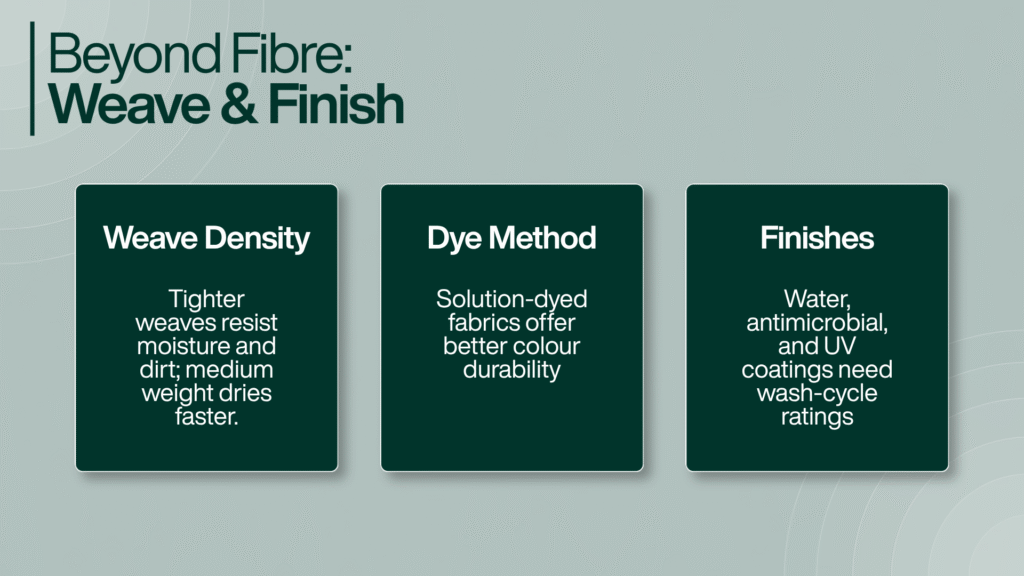
Not all polyester performs alike. Three variables separate a fabric that lasts eight seasons from one that fails in two.
Weave density: A tighter weave resists moisture penetration and soil deposition better than a loose weave of the same fibre. It also dries slower, which is why mid-weight beats heavyweight for monsoon use.
Dye method and this is where most guides get it wrong: Cotton and other cellulosics are dyed with reactive dyes; polyester is dyed with disperse dyes; the two aren’t interchangeable, and “reactive dyed” on a polyester label is a red flag rather than a feature. The genuine colourfastness answer for synthetics is solution-dyeing, where pigment goes into the polymer before spinning. That’s what separates a premium acrylic or olefin from a surface-dyed one.
Finishes: Water-repellent, antimicrobial and UV-stabilising finishes are applied treatments, and applied treatments wear off with washing. Ask how many wash cycles a finish is rated for. A fibre-level property- regain- solution-dyed colour doesn’t wash out. A finish does.
Colour and pattern for monsoon light
Monsoon skies replace hard summer sun with flat grey light. Colour either fights that or compounds it.
- Lifts a room: warm earth tones (terracotta, ochre, copper), deep jewel tones (teal, mustard, indigo), and warm whites in sheers.
- Use with caution: pure white cotton and linen, which show every watermark; and very dark heavy natural fibres, which amplify musty odours in still rooms.
- Practical bonus: prints and patterns hide minor moisture spotting far better than flat pale solids.
Monsoon Curtain Care Calendar
Timings below follow the southwest monsoon (Mumbai, Kolkata, Delhi-NCR, Pune, Ahmedabad). For Chennai and coastal Tamil Nadu, shift the whole calendar forward by about four months to match the northeast monsoon.
| Month | Task |
|---|---|
| May (pre-monsoon) | Deep clean and fully dry all panels. Apply mildew-inhibiting treatment to cotton. Inspect and replace rusting hardware |
| June (onset) | Swap high-risk zones to café or sill length. Store away velvet, silk, jute and heavy linen. Place moisture absorbers near ledges |
| July (mid-monsoon) | First wash cycle. Inspect hems and header tape for early spotting; these go first |
| August (peak) | Second wash cycle. Check rods and rings for rust bleed onto fabric |
| September (winding down) | Final monsoon wash before transitioning back to seasonal fabrics |
| October (post-monsoon) | Deep clean, confirm bone-dry, and store off-season fabrics with fresh absorbers |
On storage: wash or dry-clean before storing to remove spores and soil, confirm the fabric is completely dry, then store in breathable garment bags with fresh silica gel or activated charcoal. Sealing damp fabric in airtight plastic is how a good curtain becomes a ruined one.
On drying: during peak monsoon, you often won’t get usable sun. Drying indoors under a ceiling fan, or in an air-conditioned room on dry mode, is better than a half-dried panel rehung “to finish off on the rod.”
One Hardware Note Worth Acting On
Non-coated steel curtain rods corrode in sustained high humidity, and rust bleeds orange into fabric where the rings sit, usually discovered when the curtain is already stained. Switch before the season starts.
Aluminium, powder-coated steel and heavy-duty PVC all hold up well. If you’re specifying stainless steel in a coastal city, grade matters: austenitic grades such as 304 and 316 resist salt-air corrosion far better than cheaper 200-series stainless, which can and does rust in Mumbai or Kochi. Check the eyelets and rings too; they’re often a different, cheaper metal than the rod itself.
Choose Smart, Live Comfortably
The hierarchy is clear, and it holds across every high-humidity Indian city: polyester, solution-dyed acrylic and olefin lead; treated cotton is a legitimate natural-fibre choice where air actually moves; velvet, silk and heavy linen belong in storage for the season. Layer a sheer inner panel with a heavier outer drape, wash on a schedule, and fix the hardware before the rain arrives rather than after.
Abbott Fab has supplied premium fabrics and rexine since 1990, working out of Timber Market, Kirti Nagar, in New Delhi. Whether you’re refitting one room or specifying for an entire property, explore our fabric collection or get in touch with our team to talk through what suits your city and your rooms.
Frequently Asked Questions
Polyester, solution-dyed acrylic and olefin (polypropylene) perform best, because all three have very low moisture regain and dry quickly. Treated cotton and cotton-polyester blends are a workable natural-fibre alternative in cross-ventilated rooms.
Yes. Polyester’s commercial moisture regain is about 0.4%, among the lowest of any common curtain fibre, so it holds very little water and dries fast. That’s why it’s the default monsoon recommendation. It still needs regular washing, because mildew can grow on soil deposited on the surface even though it can’t feed on the fibre.
Olefin (polypropylene), at effectively zero regain, followed by polyester at around 0.4% and acrylic at roughly 1.5%. All three are far more monsoon-resistant than cotton (8.5%), silk (11%) or linen (12%).
Untreated cotton in a poorly ventilated, high-humidity room can, because it holds roughly 8.5% of its dry weight in moisture at standard conditions and considerably more at monsoon humidity. Treated cotton in a cross-ventilated room, washed every two to three weeks and dried fully, manages the risk well.
Velvet, silk, heavy linen, brocade, jacquard, jute, thick cotton canvas and chenille. Each combines high moisture uptake with slow drying, the exact combination that produces mildew.
Every two to three weeks through peak months is a sound working rule, even when they don’t look dirty. Airborne dust and cooking residue settle continuously, and that soil layer is what mould actually colonises.
For Mumbai’s coastal humidity, UV-stabilised olefin or PU-coated polyester in exposed rooms, polyester elsewhere. For Chennai, solution-dyed acrylic handles the local mix of heat, humidity and strong sun well and remember Chennai’s peak is October to December, not July.
Yes, with precautions. Choose light weaves like voile or mulmul over canvas, hang them where air genuinely moves, apply a mildew-inhibiting finish before the season, keep hems clear of damp sills, and wash regularly.
Non-coated steel corrodes in sustained high humidity and bleeds orange stains into the fabric. Switch to aluminium, powder-coated steel, PVC, or 304/316-grade stainless in coastal cities and check that the rings and eyelets are the same quality as the rod.
Wash or dry-clean to remove spores and soil, confirm they’re completely dry, then store in breathable garment bags with fresh silica gel or activated charcoal. Never seal damp fabric in airtight plastic.
No, it removes one significant source of retained moisture, which meaningfully lowers risk. Mould prevention still depends on humidity control. The CDC recommends keeping indoor humidity below 50% all day and maintaining airflow; in Indian monsoon conditions that usually means an air conditioner on dry mode or a dehumidifier in the worst-affected rooms.