Wholesale Curtain Fabric: What to Consider Before You Buy in Bulk
Key Takeaways
- Choose wholesale curtain fabric by end use first, because the application decides the light control, cleaning, compliance, and durability you need.
- Abbott Fab in Kirti Nagar, New Delhi, supplies curtain fabrics, including blackout polyester. Ask for current specifications and production-lot samples before ordering in bulk.
- Compare quotes on cost per finished window. Usable width, pattern repeat, wastage, freight and tax can reverse which fabric is cheaper.
- Approve a cutting from the actual production lot, then hold the bulk delivery to that shade, width and hand.
- Ask for shrinkage, colourfastness and weight data with named test methods. Treat any claim without a method with caution.
- A blackout fabric and a blackout-lined curtain are different products. Confirm which one you are buying and how it was tested.
- For hotels, offices, and public buildings, confirm fire rules at the quote stage. In India, BIS certification to IS 15741 may apply.
Why Bulk Curtain Fabric Orders Go Wrong
Most problems with a bulk curtain fabric order show up after the money is spent. The second delivery is half a shade off the first. A roll sold as 54 inches yields 50 usable inches once the selvedge is cut away. Panels drop 6 cm after the first wash. A hotel fire inspection asks for a certificate that nobody requested at the quote stage.
You won’t spot any of these on a swatch card. They happen when the specification was never written down, or the supplier was never asked to commit to it.
The short answer: pick the fabric for the job it has to do, then buy it from a supplier who will put the specification on paper and stick to it. With any supplier, follow this order:
- Shortlist based on written specifications.
- Approve a sample cut from the production lot.
- Verify usable width, pattern repeat, shrinkage and colourfastness.
- Confirm fire-safety documents where the space needs them.
- Compare quotes on cost per finished window, not price per metre.
For buyers in and around Delhi, Abbott Fab in Kirti Nagar, New Delhi, supplies curtain fabrics, including blackout polyester, alongside its upholstery and furnishing range. Further down, you’ll find a worked quantity example and a checklist you can use with us or any other curtain material supplier.
Wholesale Curtain Fabric from Abbott Fab
Abbott Fab supplies fabrics and rexine from 1/91, Basement, Timber Market, Kirti Nagar, New Delhi 110015. Kirti Nagar is one of Delhi’s best-known furniture and furnishing markets, and our Kirti Nagar fabric market buyer’s guide explains how to shop it. Curtains are one of our fabric categories, alongside upholstery, sofa, cushion, and chair fabrics.
What you need to know | Abbott Fab |
Curtain fabrics listed | Blackout curtain fabric (including 100% polyester blackout), sheer curtain fabric and curtain quilt fabric, as listed in our IndiaMART curtain fabric catalogue |
Blackout option described on our site | Triple-layered blackout curtain fabric in a 54-inch width, covered in our room-by-room curtain fabric guide |
Who we work with | Homeowners, interior designers and furniture manufacturers |
Where to see the fabric | Our Kirti Nagar showroom, by visiting or contacting us |
Phone | +91-9811141901, +91-9716128462 |
info@abbottfab.com |
What to confirm with Abbott Fab before a bulk order
Our website does not publish minimum order quantities, roll lengths, lead times, or fire-safety certifications for curtain fabrics. Ask us for them against the exact quality and colour you want, and have them added to the quote:
- Composition, GSM, overall and usable width, and pattern repeat
- How the fabric is sold (by the metre or by the roll), any minimum quantity, and whether cut lengths are available
- How many metres are available from a single dye lot
- Current lead time, and whether the quality is held for repeat orders
- Care instructions, and any test results we can share
- Fire-safety documentation, if your project needs IS 15741 or another standard
Use the checklist later in this guide to assess our answers the same way you would assess any other supplier’s.
What Is Wholesale Curtain Fabric Sourcing?
Wholesale curtain fabric sourcing means buying fabric by the roll or in large metre quantities, against an agreed specification, for resale, fabrication or a defined project. The material is often the same bulk furnishing fabric a retail customer buys by the metre. What changes is the risk: one wrong decision is multiplied across hundreds of metres and dozens of windows.
Different buyers carry different risks, so they should weigh the same factors differently.
Buyer type | What they usually buy | Factors that matter most | Biggest risk |
Curtain retailer | Rolls across a colour range, sold as cut lengths | Colour range continuity, repeat stock, consistent width, saleable price | A popular shade discontinued or changed between batches |
Curtain manufacturer or fabricator | Large roll volumes of a few qualities | Usable width, shrinkage, sewability, roll condition, lead time | Yield loss and rework from width or shrinkage variation |
Interior designer | Specific fabrics for a defined scheme | Hand, drape, colour accuracy, sample-to-bulk match | Bulk delivery that does not match the approved sample |
Hospitality or commercial procurement | Uniform quantities across many rooms | Fire-safety documents, cleaning durability, light control, replacement stock | Failed inspection or mismatched replacement panels |
Contractor or project buyer | Fabric tied to a site schedule | Lead time, documentation, delivery to site, single-lot supply | Delays that hold up handover |
A retailer can live with a slightly different shade next season if the old stock has sold. A hotel replacing six damaged panels in a 200-room property cannot. Work out which of these buyers you are before you compare quotes.
Factors to Consider Before Choosing Wholesale Curtain Fabric
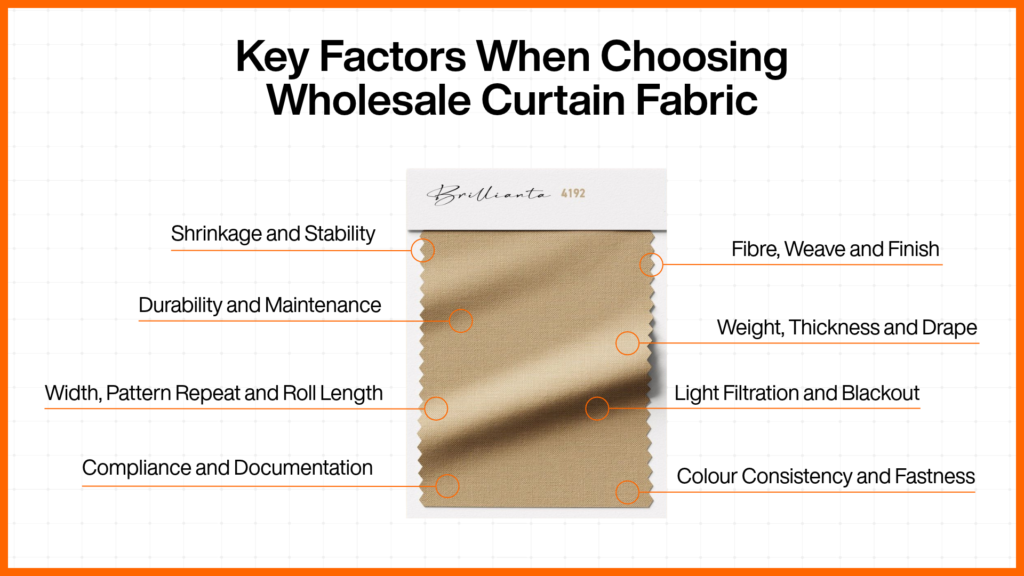
Put each of the factors below into your written specification, so every quote is measured against the same requirements.
Fibre, weave and finish.
Fibre content is a useful first filter, but it says little about how a fabric will perform. A loose voile and a dense coated blackout can both be 100% polyester. Ask for:
- Composition by percentage
- Weave or construction (plain, twill, satin, jacquard, pile or knit)
- Any finishes applied, such as softeners, stain repellents, flame-retardant treatments, or coatings
Finishes matter because some wash out. If a supplier claims a performance benefit from a finish, ask whether it is durable to cleaning and how that was tested.
Weight, thickness and drape
Weight is usually quoted in grams per square metre (GSM). It is a useful comparison between similar fabrics, measured under methods such as ISO 3801 for woven fabrics. It does not tell you how a fabric will hang. A heavy, stiff fabric can fold badly, while a lighter fabric with a fluid hand can drape well. Judge drape by hanging a full-width sample, not by holding a swatch.
Weight also affects hardware. Heavy lined or coated curtains need tracks, brackets, and hooks rated for the load.
Light filtration and blackout performance
Decide the light outcome first: sheer, light-filtering, dim-out or blackout. Then confirm how the fabric achieves it. Light control can come from weave density, a woven-in dark layer, a coating on the back, or a separate lining. Each has different implications for drape, cleaning and cost, covered in the fabric types section below.
Colour consistency and colourfastness
Curtains face more light than almost any other textile in a building. Colourfastness to light is commonly assessed with ISO 105-B02, a xenon arc test using a light source representative of natural daylight. Colour change in these tests is often rated against the grey scale in ISO 105-A02, where grade 5 means no visible change. Ask for results, the method used and, where relevant, fastness to washing or dry cleaning.
Shade consistency between batches is a separate issue. Dyed fabric is produced in lots, and two lots of the same colour reference can differ visibly when hung side by side.
Shrinkage and dimensional stability
Shrinkage changes curtain length after cleaning. On a 240 cm drop, 3% shrinkage removes about 7 cm. Ask for dimensional change results after washing or dry cleaning, for example under ISO 5077, using the cleaning method the curtains will actually receive.
Natural fibres such as cotton and linen also move with humidity, so long curtains in these fibres can lengthen and shorten with the seasons. James Dunlop Textiles notes that high humidity is the largest contributor to drapery movement and that synthetic fibres move less than most natural ones.
Durability, cleaning and maintenance
Curtains are not abraded like sofa fabric, so upholstery rub counts are rarely the main durability measure. Sunlight, humidity, cleaning cycles and handling at the leading edge are what wear curtains out. Ask how the fabric should be cleaned (wash, dry clean, or specialist), at what temperature, and whether any coating tolerates that process.
For sheers and loosely woven fabrics, ask about seam slippage, where yarns pull apart at a sewn seam. It can be tested under ISO 13936-2.
Width, usable width, pattern repeat and roll length
Overall width includes the selvedges. Usable width is what you can actually cut. ISO 22198, adopted in India as IS 1954:2024, defines usable width as the width excluding selvedges, marks, pin-holes, and other non-uniform areas. Always quote and compare usable width.
Patterned fabrics also have a vertical repeat. Each cut drop must be rounded up to a whole repeat so patterns match across panels. Half-drop patterns, where the motif shifts by half a repeat across the width, can need extra fabric per drop, so confirm the match type as well as the repeat size.
Some fabrics are made extra-wide for railroading, where the fabric width becomes the curtain drop, and panels need no vertical seams. Finally, confirm roll length, whether rolls may contain joins or short pieces, and how rolls are packed and labelled.
Compliance and documentation
Curtains in public, commercial and hospitality spaces may need fire-safety certification. The applicable standard depends on location and building type, so it belongs in the specification from day one. See the fire safety section below.
Types of Curtain Fabric for Bulk Sourcing
The table compares the main categories bulk buyers work with. Use it as a starting point. How a fabric actually performs depends on its construction, density, finish, and lining.
Category | Construction and characteristics | Look and drape | Best applications | Durability and maintenance | Limitations | Verify before ordering |
Polyester | Synthetic filament or spun yarns, woven or knitted in any weight; absorbs little moisture | Fluid to crisp; can imitate silk, linen or cotton | High-volume residential, hospitality, offices | Good resistance to sunlight and mildew; usually washable | Not flame retardant unless inherently FR or treated; low-cost qualities can look synthetic | GSM, construction, FR status and how it is achieved, care method |
Cotton and cotton blends | Natural cellulose fibre, often blended with polyester for stability | Soft, matt, natural hand | Residential, informal interiors | Absorbs moisture; mildew risk in humid rooms; can shrink | Usually needs lining for privacy or blackout; long drops move with humidity | Blend percentage, shrinkage result, pre-shrinking, lightfastness of the dyes |
Linen and linen blends | Flax fibre with natural slubs, often blended | Textured, relaxed drape that creases | Premium residential, boutique hospitality | Moves with humidity; can shrink; a lining protects it in sunny rooms | Slub and shade variation between lots; creasing | Blend percentage, shrinkage, lot consistency, lining plan |
Jacquard | Pattern woven into the fabric on a jacquard loom; any fibre | Structured, decorative | Living areas, hotel suites, luxury interiors | Depends on yarns and the length of yarn floats | Large repeats raise metres per window; long floats can snag | Repeat size and match type, float length, appearance of the reverse |
Velvet | Pile fabric in cotton, polyester or blends | Rich, heavy, light-catching surface | Luxury residential, theatres, formal spaces | Pile can crush or mark; often needs specialist cleaning | Heavy, so needs strong hardware; panels look mismatched if pile direction varies | Pile direction marking on rolls, cleaning method, weight per metre |
Sheer and voile | Lightweight open weave or knit, usually polyester | Translucent, soft, airy | Layering, daytime privacy, offices | Lightweight; loose weaves risk seam slippage | Little night-time privacy on its own | Seam slippage result, extra-wide availability, hem weight needs |
Blackout fabric | Coated face fabric or triple-weave construction | Coated types are stiffer; triple weave drapes more like a standard woven | Bedrooms, hotels, media rooms, healthcare | Coatings can be damaged by abrasion and harsh cleaning; creases can stay in the foam | Light can still leak at edges and gaps; coatings may crack with age | Construction type, approved cleaning method, pinholes on the sample, FR testing in the final combination |
Textured and decorative | Slub, embroidered, printed or embellished fabrics | Distinctive surface interest | Feature windows, retail displays | Embellishments may limit cleaning options | Texture and shade can vary between rolls | Roll-to-roll consistency, care method, repeat |
Blackout fabric vs blackout-lined curtains
Buyers often treat these as the same thing. They are three different products:
- Coated blackout fabric. Fine layers of foam are applied to the back of the face fabric. In a three-pass coating, a white layer, a black layer, and a second white layer are applied in turn, as lining maker Skopos explains in its product performance notes. The coating does the light blocking, and it also changes the hand of the face fabric.
- Triple-weave blackout. Three layers are woven together, with dark yarns in the middle. There is no coating, so the fabric usually drapes more naturally.
- A decorative fabric made blackout by a separate lining. The face fabric can be anything. Light blocking comes from the lining, which has its own specification and its own care needs.
Here is why the difference matters when you buy:
- A coated face fabric may not tolerate the cleaning a hotel laundry uses.
- A lined curtain needs two fabric specifications, two sets of test results and, where fire rules apply, testing of the combination.
- A curtain made from blackout fabric can still leak light at the edges, top and gaps if the track, returns and overlaps are not designed for it.
Be careful with claims about thermal insulation, sound reduction or UV protection. Results depend on the whole curtain, its lining and how it is installed. If one of these matters to you, ask for test evidence. If there is none, don’t let the claim sway your decision.
How to Evaluate Curtain Fabric Quality Before a Bulk Order
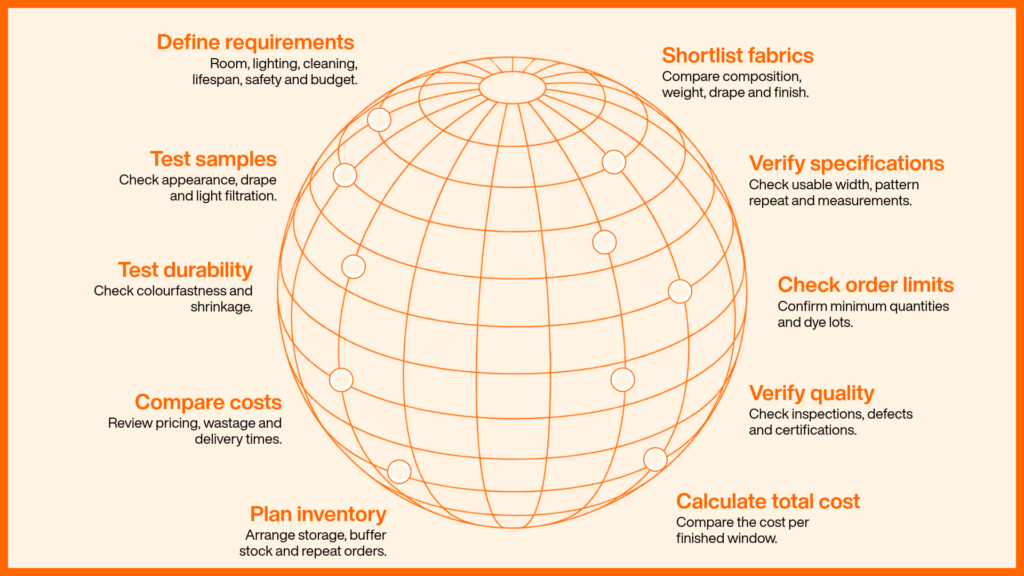
Run through these ten steps for every new quality you plan to buy in volume. Steps 3 to 5 catch the problems that cost the most to fix after delivery.
- Define the application and requirements. Write down the room type, light outcome, cleaning method, expected life, fire-safety needs, and budget per window. This brief becomes the yardstick for every sample.
- Shortlist on composition, weight, drape, and finish. Request spec sheets, not just swatches. Drop any fabric whose supplier cannot state composition, weight, and width.
- Request and evaluate physical samples. Ask for a full-width sample of at least a metre, plus a hanging length where drape matters. View it in daylight and under the lighting of the actual space. Hold it against the window to judge light filtration.
- Check usable width, pattern repeat and specifications. Measure the usable width yourself. Measure the repeat. Compare both with the spec sheet and the quote.
- Test colour consistency and dimensional stability. Wash or dry clean a marked sample as the curtains will be cleaned, then measure it. Compare shade against the approved reference in daylight. For commercial orders, ask for laboratory results such as ISO 5077 shrinkage and ISO 105-B02 lightfastness.
- Understand minimum order and roll quantities. Ask whether the fabric is sold by the metre, by the full roll, or only above a minimum. Ask how much of the order can come from a single dye lot.
- Assess pricing, wastage, lead times and replenishment. Get the price basis in writing, including tax and freight. Confirm the lead time for the first order and for repeats, and whether the quality is stocked or made to order.
- Verify quality control and documentation. Ask how rolls are inspected, how defects are marked, and what the supplier does when a roll fails. Ask for the test reports or certificates your application needs.
- Plan storage, inventory and repeat orders. Decide how much buffer stock to hold for replacements. Store rolls flat or on tubes, dry and away from light, and keep a retained cutting of each lot.
- Calculate the overall procurement cost. Convert every quote into a cost per finished window, using the method in the cost section below, before comparing suppliers.
Sample-to-bulk approval
A sample from a sample book is not the same as a sample from your production lot. For any order where shade matters, ask for a cutting from the actual lot before dispatch and approve it in writing. Keep the approved cutting. If the bulk delivery doesn’t match, that cutting is what you show the supplier.
Inspecting bulk deliveries on arrival
Check the delivery before any fabric is cut. Many suppliers will not accept claims on cut fabric, so confirm the claim window in advance.
- Match roll labels against the order: quality, colour, lot number, and quoted length.
- Measure the usable width and length on a sample of rolls, not just one.
- Unroll a section of each lot and compare it with the approved cutting in daylight.
- Look for weaving faults, coating pinholes, crease marks, stains, and joins, and note any flags the mill has placed on the roll edge.
- Record problems with photographs and roll numbers, and report them within the agreed period.
How to Assess Wholesale Curtain Fabric Suppliers
A good fabric is only half the decision. The supplier has to send you the same fabric, to the same specification, on the first order and the fifth. Look at four things:
- Specification discipline. Can they put composition, weight, usable width, repeat, and care instructions on a spec sheet for every quality you are considering?
- Lot control. Do they record dye lots, label rolls with lot numbers, and keep retained cuttings? Can they tell you how much of each lot is available?
- Supply continuity. Is the quality stocked, made to order, or bought in from another mill? How long has it been in the range, and what notice do they give before discontinuing it?
- Problem handling. What happens when a roll arrives with a flaw, a shade difference, or short length? Who pays return freight, and how quickly is it replaced?
Ask these questions of a market showroom, a mill or an importer alike. We expect buyers to ask them of Abbott Fab too.
Minimum order quantities, roll lengths and packaging
Commercial terms in curtain fabric wholesale vary from supplier to supplier, and even between qualities from the same supplier, so don’t assume any of them. Confirm each one before you order:
- Sales unit. Is the fabric sold by the metre, by the full roll or piece, or only above a minimum quantity? A minimum may apply per colour rather than per order.
- Roll length and tolerance. Ask for the typical roll length and how much it can vary. Ask whether a roll may contain joins or be made up of shorter pieces, and how joins are marked.
- Cut-length charges. Some suppliers charge more for cut lengths than for full rolls. Check whether cutting a roll changes the price.
- Packaging. Ask whether the fabric ships rolled on a tube or folded. Coated blackout and pile fabrics are better rolled, because creases can stay in a foam coating and mark a pile.
- Labelling. Each roll should show the quality, colour, lot number, length and width.
Treat the minimum as a planning question as well. Buying a full roll to cover a small shortfall makes sense if the extra metres become replacement stock from the same lot. It makes less sense if they will sit in the store for years.
Lead times and repeat-order availability
Ask whether the quality is held in stock, made to order, or sourced from another mill on demand. Each has a different lead time and a different risk at reorder:
- Stocked qualities ship quickly but can run out of stock.
- Made-to-order qualities take longer but can be produced in one lot for the whole project.
For long or phased projects, ask whether the supplier can reserve stock or schedule production against your programme, and on what terms.
Defects, shortages and returns
Agree in advance what counts as a defect, how quickly it must be reported, and whether the supplier replaces, credits or repairs. Clarify who pays return freight, and whether fabric that has been cut or processed can still be claimed. Put these terms on the quotation or order confirmation. A verbal promise is hard to rely on once there is a dispute.
Questions to ask a wholesale curtain fabric supplier before confirming an order
Question | Why it matters |
What is the exact composition, and what finishes or coatings have been applied? | Performance and care depend on finishes as much as fibre |
What are the overall width and the usable width? | Your quantity calculation must use usable width |
What are the pattern repeat and match type? Can the design be railroaded? | Repeat, half-drop matching, and railroading all change metres per window |
What is the GSM, and what tolerance do you work to? | Weight variation between rolls affects drape and hardware loads |
Which shrinkage, colourfastness and seam slippage tests have been done, by which method and laboratory? | A result is only useful if you know how it was measured |
Is blackout performance built into the fabric or dependent on a lining? | They are different products with different care and testing needs |
What fire-safety certification does this fabric hold? Is it inherent or a treatment, and is it durable to cleaning? | Commercial projects can fail inspection without the right document |
How is the fabric sold, what is the typical roll length, and is there a minimum? | Determines how much you must buy and how much stock you carry |
Can the full order come from one dye lot? If not, how will lots be labelled? | Prevents visible shade differences within a room or floor |
What are the lead times for the first order and for repeats? Is the quality stocked? | Affects project schedules and future replacements |
Will you send a cutting from the production lot for approval before dispatch? | Lets you catch shade or hand problems before delivery |
Is the price inclusive of tax and freight? What are the payment terms? | Makes quotes comparable |
How do you handle defective, short or mismatched rolls? | Sets expectations before there is a dispute |
How much notice will you give before discontinuing this quality or colour? | Protects repeat orders and replacement stock |
A supplier who answers these clearly is usually a safer choice than a cheaper one who answers vaguely.
How to Calculate Sourcing Costs and Plan Quantities
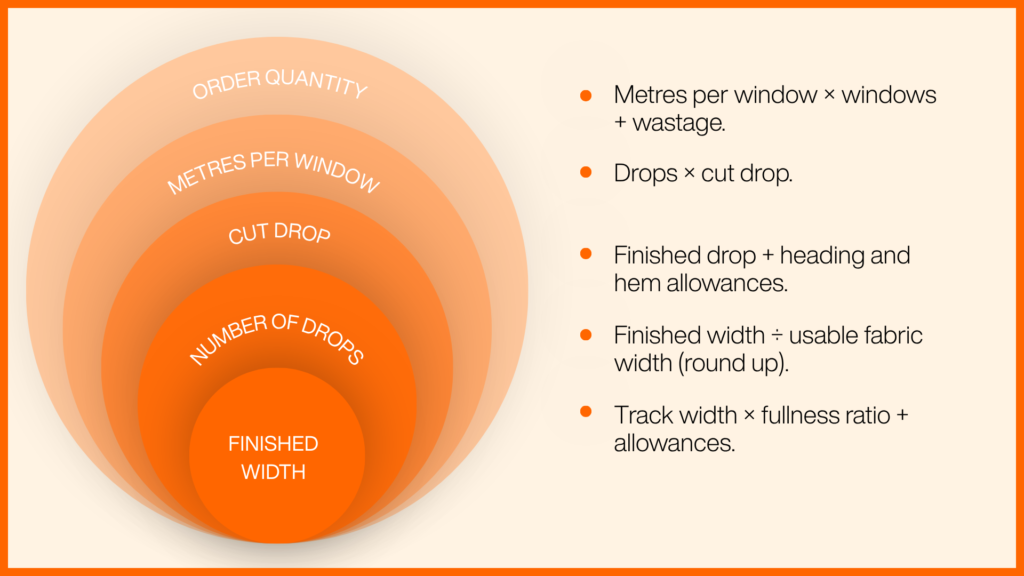
Price per metre is a poor way to compare curtain fabrics. What you actually pay for is the fabric that goes into each finished window, plus wastage, making, freight and tax. Width, repeat, and fullness can change the metres needed by a large margin, as the example below shows.
The basic quantity calculation
- Finished width needed = track width × fullness ratio + allowances for side hems, returns and overlaps.
- Number of widths (drops) = finished width needed ÷ usable fabric width, rounded up.
- Cut drop = finished drop + allowances for heading and hem. For patterned fabric, round up to the next whole pattern repeat.
- Metres per window = number of widths × cut drop.
- Order quantity = metres per window × number of windows + a wastage allowance for flaws, end pieces and cutting errors.
Fullness is a design choice that varies by heading style, so confirm it with the curtain maker. Our room-by-room curtain fabric guide discusses fullness for residential rooms.
Worked example: how width changes the metres you buy
This example compares metres, not prices, so you can apply it to any quote. All assumptions are stated:
- A project has 40 windows, each with a 2.4 m track and a 2.4 m finished drop, dressed with a pair of curtains.
- Curtains use 2× fullness, plus 0.3 m for side hems and returns, giving 5.1 m of finished width per window.
- Heading and hem allowances add 0.3 m to the drop, giving a 2.7 m cut drop.
- Both fabrics are plain. A 5% wastage allowance is added.
Item | Fabric A: standard width | Fabric B: extra-wide, railroaded |
Usable width | 132 cm (137 cm overall) | About 275 cm (280 cm overall), used as the drop |
How each window is cut | 4 widths of 2.7 m, two per panel, one vertical seam per panel | Two lengths of 2.55 m, no vertical seams |
Metres per window | 10.8 m | 5.1 m |
Metres for 40 windows | 432 m | 204 m |
Order quantity with 5% wastage | 454 m | 215 m |
Vertical seams to sew | 80 | 0 |
Fabric B needs less than half the metres. In fabric cost alone, it is the cheaper option whenever its price per metre is less than about 2.1 times Fabric A’s (454 ÷ 215). It also removes 80 seams of making time.
Railroading only works when the cut drop fits within the usable width and the design can run sideways, so the saving won’t apply to every project. The calculation still does, so run it for every quote before you compare.
Pattern repeat shifts the numbers in the same way. If Fabric A had a 64 cm vertical repeat, each 2.7 m cut drop would round up to 3.2 m (five full repeats). The order would rise from 454 m to about 538 m with the same wastage allowance.
Other costs to include
- Cutting, defect and installation wastage. Set the allowance from your own records and the supplier’s roll quality, rather than a fixed rule. Short ends, flagged faults and remakes all consume fabric.
- Lining, interlining and accessories. If light control or fire performance depends on a lining, price it as part of the same specification. Include tapes, weights and hooks where you supply them.
- Tax. Confirm the applicable GST rate for the fabric’s HSN code and whether each quote includes it.
- Shipping and packaging. Rolls are bulky, and tube-rolled packing for coated or pile fabrics can cost more than folded bales. Compare delivered prices.
- Testing and certification. Commercial projects may need laboratory reports or certified fabrics, which add cost and lead time.
- Minimum quantity overage. Metres bought only to meet a roll or minimum rule should be costed, unless they will serve as replacement stock.
- Repeat-order costs. A later order may come from a new lot, at a new price, with a new lead time. For hospitality and commercial buyers, buffer stock from the original lot is usually cheaper than replacing every panel in a room.
- Storage and excess inventory. Stock ties up cash and space, and must be kept dry, flat or on tubes, and away from light.
How Requirements Differ Across Residential and Commercial Projects
A fabric that works well in a home living room can be the wrong choice for a hotel corridor. This table shows how priorities shift by project type.
Application | Main priorities | Typical fabric direction | Sourcing notes |
Residential curtains | Look, light control by room, easy care, budget | Polyester and blends for easy care; cotton, linen or velvet for character, usually lined | Smaller runs per colour; retailers need repeatable shades across seasons |
Hotels and hospitality | Blackout in guest rooms, laundering durability, fire compliance, uniformity | Inherently flame-retardant or certified polyester; triple-weave or coated blackout; FR sheers | Single-lot supply per floor or block; replacement stock from the same lot; certificates on file |
Offices and commercial interiors | Glare control, privacy, low maintenance, compliance | Light-filtering weaves, sheers, dim-out fabrics, often in neutral colours | Check building fire requirements; consider extra-wide fabrics to avoid seams on long runs |
Retail and institutional projects | Durability, cleaning, safety, public-building rules | Hard-wearing polyester constructions with certified fire performance | Schools, hospitals and public buildings often have stricter documentation demands |
Luxury interiors | Hand, drape, colour depth, pattern | Velvet, jacquard, linen, silk-look fabrics, with lining and interlining | Strict sample-to-bulk approval; plan for large repeats and pile direction |
Sheer and decorative treatments | Light diffusion, layering, visual softness | Voiles and open weaves, often extra-wide | Check seam slippage and hem weights; a sheer alone rarely gives night-time privacy |
Blackout and privacy curtains | Light blocking, edge light control, cleaning | Coated or triple-weave blackout fabric, or face fabric with blackout lining | Specify whether blackout is in the fabric or the lining; hardware and overlaps affect results |
Local climate also plays a part. In humid conditions, cotton and linen are more prone to mildew and length movement than polyester. Our guide to the best curtain fabric for monsoon humidity in India covers this in detail for Indian cities.
Fire safety and commercial compliance
Fire requirements for commercial curtain fabrics depend on where the building is and what it is used for. Different countries use different standards. Common examples include:
- India: IS 15741:2007, Textiles: Resistance to ignition of curtains and drapes. According to BIS, it addresses curtains and drapes for public places and buildings, and a Quality Control Order made BIS certification mandatory for these curtains and drapes, or their fabrics, from October 2023. The order has since been amended, so confirm the current position for your product before you buy.
- United Kingdom: BS 5867-2 sets flammability requirements for fabrics used in non-domestic curtains, drapes and window blinds. Where curtains are multi-layer, the fabrics need to be tested in the combination in which they will be used.
- European Union: EN 13773 provides a classification scheme for the burning behaviour of vertically hung curtain and drape fabrics.
- United States: NFPA 701 sets fire test methods for flame propagation of textiles and films, including fabrics used in curtains, draperies and other window treatments.
- India: IS 15741:2007, Textiles: Resistance to ignition of curtains and drapes. According to BIS, it addresses curtains and drapes for public places and buildings, and a Quality Control Order made BIS certification mandatory for these curtains and drapes, or their fabrics, from October 2023. The order has since been amended, so confirm the current position for your product before you buy.
These standards are not interchangeable. A fabric that passes one has not automatically passed another. Before ordering for a commercial or public space:
- Confirm the requirement with the project’s fire consultant or the local authority.
- Ask the supplier for a current test report or certificate for the exact fabric, colour and finish being supplied.
- If fire performance comes from a treatment, ask whether it survives the cleaning method the curtains will receive.
- Confirm the requirement with the project’s fire consultant or the local authority.
Common Wholesale Curtain Fabric Sourcing Mistakes
- Comparing price per metre instead of cost per window. Width, repeat, and fullness can reverse which quote is cheaper.
- Approving a swatch, not a lot. Sample books and current production lots can differ in shade and hand.
- Splitting one project across dye lots. Panels from different lots can look mismatched when they hang side by side in the same room.
- Trusting overall width. Calculations based on overall width instead of usable width leave you short.
- Ignoring shrinkage until after the first clean. By then, every curtain on the project may already be too short.
- Assuming “blackout” means the same thing everywhere. A coated fabric, a triple weave, and a blackout lining are different products with different care needs.
- Leaving fire compliance until installation. Certification is far easier to specify at quotation than to prove after the curtains are up.
- Buying without replacement stock. A single damaged panel in a hotel room can mean re-curtaining the room if the lot has run out.
- Swapping upholstery and curtain fabrics. Each is engineered for different stresses. Heavy upholstery fabric often drapes poorly, and light curtain fabric lacks the strength for seating.
- Comparing price per metre instead of cost per window. Width, repeat, and fullness can reverse which quote is cheaper.
Wholesale Curtain Fabric Supplier Evaluation Checklist
Copy this checklist into your purchasing file and tick each item before you confirm a bulk order.
Specification
- [ ] Composition by percentage and construction stated in writing
- [ ] GSM stated with tolerance
- [ ] Overall width and usable width confirmed, and usable width measured on the sample
- [ ] Vertical and horizontal pattern repeat confirmed
- [ ] Finishes and coatings listed, with care compatibility confirmed
- [ ] Light outcome confirmed (sheer, filtering, dim-out or blackout) and how it is achieved
Testing and documents
- [ ] Shrinkage results for the intended cleaning method
- [ ] Colourfastness to light and to cleaning, with test methods named
- [ ] Seam slippage results for sheers and open weaves
- [ ] Fire-safety report or certificate matching the project’s local requirement, for the exact fabric supplied
Samples and lots
- [ ] Full-width sample assessed in daylight and in the target space
- [ ] Sample washed or cleaned and re-measured
- [ ] Production-lot cutting approved in writing before dispatch
- [ ] Full order from one dye lot, or lots separated and labelled
Commercial terms
- [ ] Sales unit, roll length and any minimum quantity confirmed
- [ ] Price basis confirmed, including tax and freight
- [ ] Lead time for first order and repeat orders confirmed
- [ ] Defect, shortage and return process agreed
- [ ] Discontinuation notice period agreed
Planning
- [ ] Cost per finished window calculated for each shortlisted fabric
- [ ] Wastage allowance included
- [ ] Replacement stock quantity decided
- [ ] Retained cutting of each lot labelled and stored
Buy on Specification, Then on Price
When you buy curtain fabric in bulk, settle the specification before you talk about price. Start from the application, compare suppliers on usable width, repeat, shrinkage, colourfastness, lot control and documents, and only then compare their quotes on cost per finished window. A supplier who can repeat the same fabric next year is often worth more than a small saving on this order.
If you are planning a bulk curtain order, contact Abbott Fab or visit our Kirti Nagar showroom with your window schedule, application and light requirements. We can show you current curtain fabrics from our fabric collection and confirm specifications, quantities, and availability for your project.
Frequently Asked Questions
Check composition, construction, GSM, usable width, pattern repeat and match type, care method, finishes and coatings. Ask for shrinkage and colourfastness results with named test methods, plus any fire-safety certificate the space needs. Then confirm the sales unit, roll length, lead time and dye-lot availability in writing.
It depends on the job. Polyester and polyester blends suit most high-volume residential and commercial work because they are easy to clean and resist sunlight and mildew. Cotton, linen, velvet, and jacquard suit projects where look and hand matter most. The room, light needs, cleaning method, and fire rules decide the choice.
Abbott Fab supplies curtain fabrics, including blackout polyester and sheer curtain fabric, from Timber Market, Kirti Nagar, New Delhi. Kirti Nagar is a well-known furnishing market with many curtain material suppliers. Before ordering in bulk from Abbott Fab or any supplier, ask for written specifications, dye-lot availability, lead times and defect terms, and approve a production-lot cutting.
Blackout fabric blocks light by itself, through a foam coating on the back or a triple-weave construction with dark yarns in the middle. A blackout lining is a separate layer sewn behind a decorative face fabric. Both can block light, but they differ in drape, cleaning needs, and how fire testing is carried out.
Width decides how many drops each window needs, and therefore how many metres you buy. Always calculate with usable width, which excludes selvedges and edge marks. A roll sold as 54 inches can yield noticeably less, and that gap is multiplied across every window in the order.
Multiply track width by the fullness ratio and add hem and return allowances. Divide by the usable fabric width and round up to get the number of drops. Multiply by the cut drop, rounded up to the pattern repeat, then by the number of windows. Add a wastage allowance based on your own records.
A minimum order quantity sets the smallest amount you can buy, often per colour or as a full roll. It affects cash tied up in stock, storage space, and how much is left over. Compare it with your real requirement and replacement needs, and check whether cut lengths cost more than full rolls.
Ask for the whole order from a single dye lot and approve a cutting from that lot before dispatch. If one lot cannot cover the order, keep each lot to a separate room or floor. Store a labelled cutting of every lot and hold replacement stock from it.
Railroaded fabric is cut sideways, so the fabric width becomes the curtain drop. It needs an extra-wide fabric whose usable width exceeds the cut drop, and a design that works when turned. On suitable projects, it removes vertical seams and can cut the metres needed by more than half.
Often, yes, but the requirement depends on the country and building type. Examples include IS 15741 in India, BS 5867-2 in the UK, EN 13773 in the EU and NFPA 701 in the US. Confirm the local requirement first, then ask the supplier for a current report or certificate for the exact fabric supplied.