Diwali Home Decor 2026: A Room-by-Room Styling Guide That Actually Works

Key Takeaways
- Diwali 2026 falls on Sunday, 8 November, giving most households the prior weekend to clean and decorate ahead of the five festive days.
- Decorate in order: clean, then plan lighting, then layer textiles and colour, then style the entrance. Out of sequence, even good decor looks disjointed.
- Deep cleaning is the real first step. Clutter undercuts every decoration that follows it, regardless of quality.
- Layered lighting beats bright lighting. A soft ambient base plus focused accents at the entrance and pooja space creates depth.
- In small homes, pick one focal point per room. Over-decorating punishes tight spaces faster than large ones.
- Festive textiles are the fastest, cheapest room makeover, and cushions, runners, and curtain accents get reused for years.
- Match new festive fabrics to your existing upholstery texture so the room reads intentional rather than crowded.
- The entrance is the highest-impact, lowest-cost zone in the house and the most photographed. Do not skip it for the living room.
- Keep open flames away from fabric, and use LED tealights near curtains, bedding, or anywhere left unattended.
Most Diwali decorating goes wrong for one reason: people buy before they plan. String lights get ordered before the clutter is cleared, cushion covers before anyone has thought about how the room reads under lamplight, a big centrepiece before the entrance, which is the first thing a guest actually sees. Decor is a sequence, and the sequence matters more than the shopping list.
This guide follows that sequence. Clean first, then decide how light should move through the house, then layer in fabric and colour, then finish at the door. Along the way it explains the reasoning behind each choice, because a principle you understand travels from room to room in a way a checklist never does. The perspective here leans on textiles and interiors, since fabric does more visible work in a festive room than almost anything else and is the part most people leave until last.
How to Approach Diwali Decor in 2026
The date first, because timing shapes the plan. Diwali 2026 falls on Sunday, 8 November, with Lakshmi Puja performed after sunset on Kartik Amavasya (Drik Panchang). Because the festival follows the lunar calendar rather than a fixed Gregorian date, it lands in late October or early November each year, and exact puja timings shift by city. The main day sits inside a five-day festival: Dhanteras on Friday 6 November, Choti Diwali (Naraka Chaturdashi) on Saturday 7 November, Diwali itself on Sunday 8 November, Govardhan Puja on Monday 9 November, and Bhai Dooj on Tuesday 10 November.
The Sunday timing is a gift. Work backwards from Dhanteras, not from Diwali day, and use the preceding weekend for the heavy work.
When | What to prioritise |
10 to 14 days before | Deep cleaning, decluttering, small repairs and touch-ups |
5 to 7 days before | Buying diyas, lights, flowers, fabric accents |
2 to 3 days before | Rangoli stencils ready, curtains and cushion covers swapped |
Day before (Choti Diwali) | Final lighting setup, entrance decor, flowers refreshed |
Diwali day | Diyas lit at dusk, pooja space ready, final touches |
Before you buy anything, three questions settle most of the decisions that follow.
How much light do you want, and where? Even, warm light throughout the home reads differently from focused brightness at the entrance and pooja space with softer light elsewhere. Deciding this first tells you how many diyas and light strings to buy and where they go.
What texture does your furniture already carry? A velvet sofa asks for different festive accents than a rexine or fabric-upholstered one. Matching textures instead of fighting them is what keeps a decorated room from looking busy.
How do people move through the space? Guests cluster at entrances, dining areas, and seating. Decoration should follow foot traffic, not wall space. A beautifully styled corner nobody walks past is wasted effort.
Cleaning and Decluttering: The Step Before Decor
Diwali cleaning, the safai ritual tied to welcoming Goddess Lakshmi into a clean home, is also the practical step that makes everything else look better. A few rules make it efficient rather than exhausting.
Declutter before you clean. Sorting wardrobes, shelves, and storage first means you are not wiping down surfaces around piles you will move anyway. Wash or dry-clean curtains and upholstery covers early, because fabric holds more dust than any hard surface in the house, and dull curtains flatten a freshly cleaned room. Deep-clean the entrance and balcony first, since those host rangoli, torans, and diyas and are the first spaces a guest sees. Polish brass and silver, diyas, urlis, and pooja thalis oxidise over a year of storage. And repair before you decorate: chipped paint or a wobbly fixture will undercut good styling every time.
A note on placement that many households follow: in Vastu tradition, the main entrance is treated as the most important zone, which is why torans and rangoli concentrate there rather than spreading evenly through the house, and the north-east corner is favoured for the pooja area and the primary diya arrangement. Whether or not you follow Vastu, the entrance-first logic holds for a simple reason. It is where first impressions are made.
Choosing a Theme Without Overthinking It
A Diwali decor theme comes down to three choices held consistent across the house: a colour direction, a lighting temperature, and a level of ornamentation. Pick one of each and carry it through with variation in intensity rather than variety in style. That is the whole framework; everything below is just how to apply it.
Traditional leans into red, gold, and marigold orange, brass diyas, fresh flower garlands, and warm light. Contemporary keeps the palette tighter, deep jewel tones or metallics, cleaner lines, fewer but larger pieces. The jewel-tone direction is not just a festive instinct; it tracks a broader 2026 interior shift, with Behr naming the smoky jade “Hidden Gem” its Colour of the Year. Neither traditional nor contemporary is better. The mistake is mixing three competing palettes across rooms, which reads as clutter no matter how nice each individual piece is.
The easiest way to modernise without abandoning tradition: keep the ritual elements traditional, the diyas, the pooja setup, the marigold, and let the contemporary choices show up only in textiles and lighting. A brass diya cluster on a jewel-tone velvet runner is both at once, and it works because the traditional and modern elements sit in different layers rather than competing in the same one.
Room-by-Room Diwali Decor
Living Room
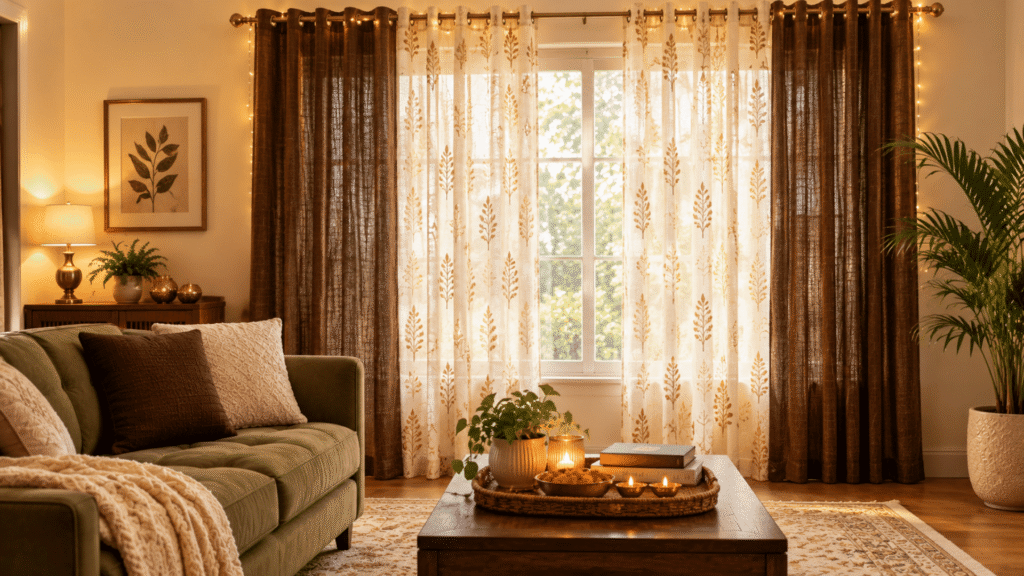
The living room hosts the most guests and does the most visual work, so treat it as the anchor and let two layers carry the change: textiles and light.
Swap in festive cushion covers, a table runner, and a throw in jewel tones or metallics. This is the single fastest transformation available and needs no furniture moved. Anchor one focal wall behind the main seating with a string of fairy lights, a lantern cluster, or a floral hanging, rather than scattering decor evenly around the room. Add a low centre-table diya or urli arrangement with floating candles and marigold petals; kept low, it reads festive without blocking conversation across the table. Then stop. Keep your existing wall art and let textiles and lighting do the seasonal work. Over-decorating a small living room makes it feel cluttered, not festive.
Pooja Room and Mandir
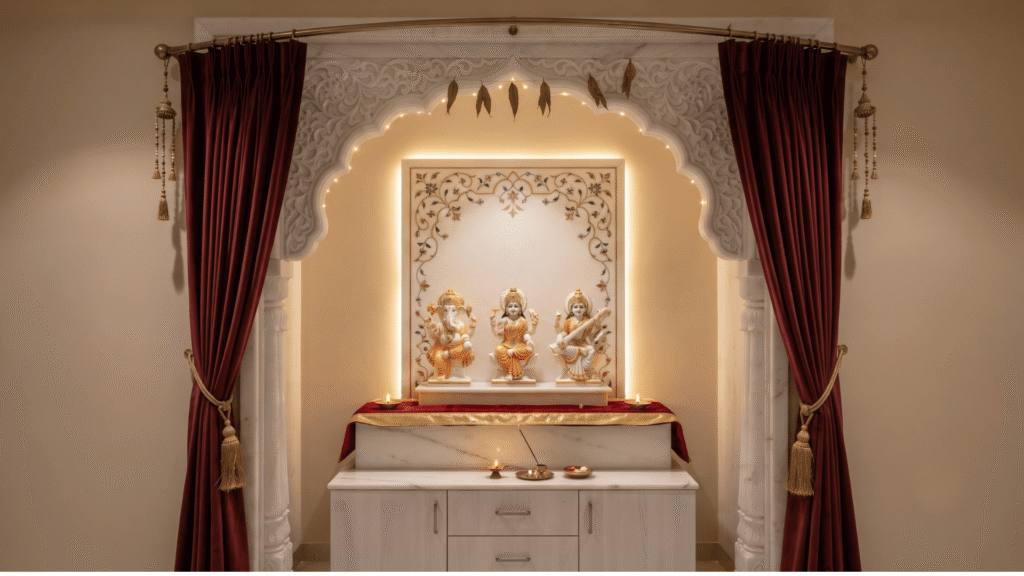
The ritual centre of Diwali deserves the most careful styling and the most caution around flame. Re-drape the mandir in fresh, breathable cotton or silk, and keep synthetic fabric well away from diya flames. Use a cluster of small diyas rather than one large one, since it distributes light more evenly across idols and photographs. Fresh marigold or rose garlands are traditional and double as a way to mask the smell of extinguished matches and incense. Keep a clear, safe gap between any hanging decor, garlands, cloth, paper toran, and open flame.
Bedroom
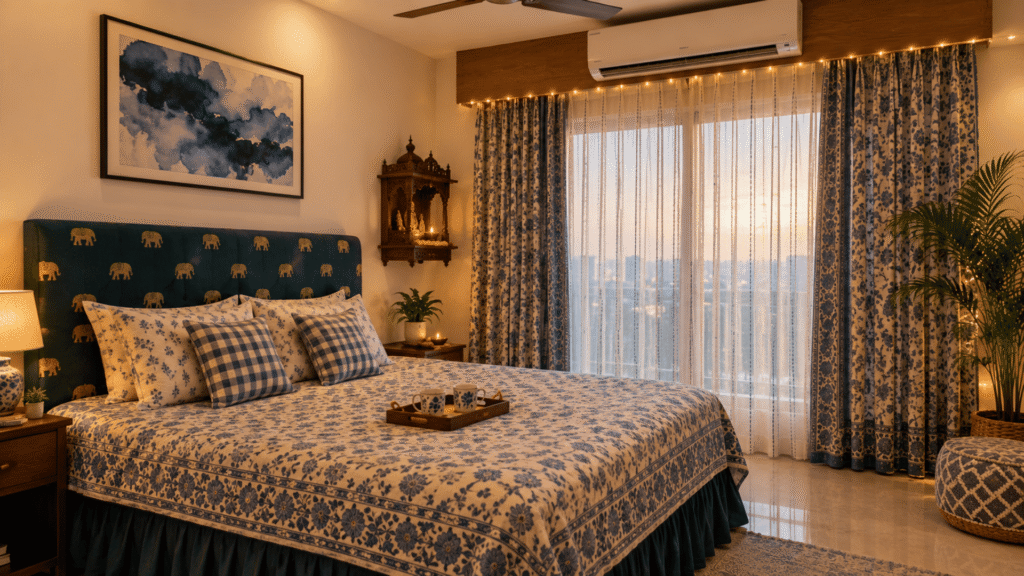
Bedrooms are rarely shown to guests, so decorate for your own comfort, not for display. A single warm-toned lamp or a short string of fairy lights along a headboard or window frame adds ambience without disrupting sleep. Swap in a festive bedspread or cushion covers in richer tones for a low-cost, high-comfort update. Skip open-flame diyas here entirely; use LED tealights if you want the glow without fire risk near bedding and curtains.
Dining Table and Kitchen
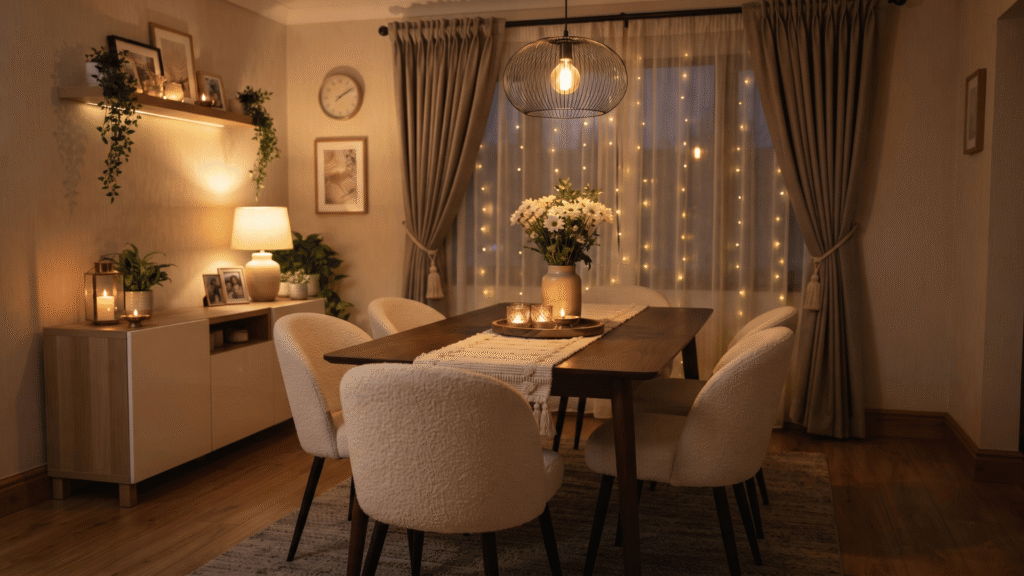
Diwali entertaining centres on food, so style the table to frame it, not hide it. A festive runner down the centre with brass or ceramic diyas creates an instant centrepiece at a height that clears sightlines across the table. Cloth napkins in a coordinating colour lift a table more than almost any other single addition. In the kitchen, keep decor minimal and heat-safe: a small diya near the entrance is traditional, but keep trailing fabric or paper decor away from the stove.
Balcony and Main Entrance
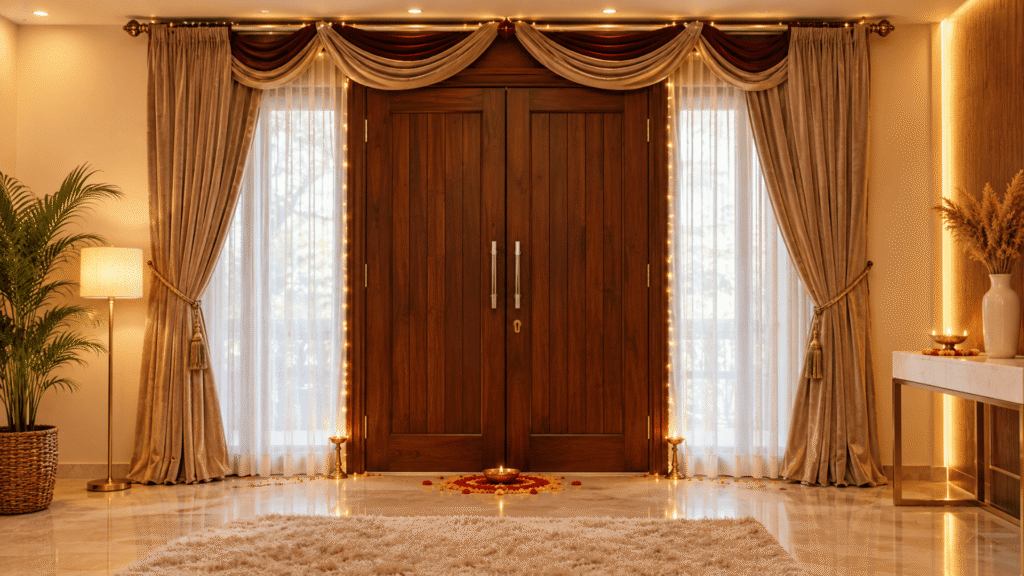
This is the highest-impact, lowest-cost zone in the entire home, and the most photographed. A rangoli at the threshold, a toran above the door, and a row of diyas along the steps or ledge together create the most recognisably “Diwali” moment in the house, and it takes 20 to 30 minutes. String lights along a balcony railing or window grille are visible from outside and signal the festival to neighbours and visitors. Potted marigolds on either side of the entrance add colour that lasts the week without replacement.
Practical Styling Principles
A few principles do more work than any single decoration.
Layer light, do not just brighten it: Professional lighting design combines a soft ambient base with a brighter focused accent. Applied to Diwali: warm ambient string lights across a whole room as the base, then brighter diya clusters or a lantern at the focal point, the entrance, the pooja space, or the centre table. Flat, uniform brightness everywhere looks less festive than deliberate contrast.
Follow foot traffic, not wall space: Concentrate decor where people gather and pass. A dense, well-lit entrance and seating cluster beats decoration spread thinly across every wall.
Change the room without redesigning it: You do not need to repaint or reupholster. Keep large furniture and walls in their existing neutral or muted tones and introduce the festive colour only through cushions, runners, and lighting. The refresh comes off in January without a renovation reversing it.
Match texture to texture: This is where fabric knowledge pays off. A smooth rexine or leatherette sofa pairs well with richer velvet or brocade cushions; the contrast reads as intentional. A fabric-upholstered sofa carries lighter cotton or silk-blend accents better, since piling heavy texture on heavy texture crowds the eye. Treat cushions, curtains, and upholstery as one coordinated decision rather than three separate purchases.
Small Apartments: Restraint Is the Strategy
Small spaces punish over-decorating faster than large ones. The instinct to add more is exactly wrong; the goal is a few high-impact touches, not many small ones.
Pick one focal point per room and commit to it: a single lit corner, one styled console, one dressed entrance, rather than distributing decor evenly and diluting all of it. Use vertical space: a toran, a wall hanging, or string lights along a window frame add festivity without eating floor or table area you cannot spare.
Favour LED tealights and app-controlled fairy lights over sprawling diya arrangements, both for safety in tight quarters and because they need no clear floor zone. And lean hard on textiles, since a cushion cover and a runner change a small room’s whole character while taking up no additional space at all. In a compact home, fabric is the most space-efficient decor there is.
Lighting and Festive Ambience
Diyas remain the emotional core of Diwali, and a few styling notes lift them above a plain row. Vary their heights using small stands or trays so the arrangement has dimension. Group them in odd numbers threes, fives, sevens a common convention that simply looks more balanced. Set floating diyas in a wide, shallow bowl of water, which also catches wax and oil drips.
For the wider lighting setup, three categories cover most homes. Warm-white LED string lights are the reliable, low-cost base layer for any room or balcony. Battery or app-controlled fairy lights give you no visible wiring, ideal for balconies, plants, and window frames. Paper or fabric lanterns with LED inserts are decorative by day, lit by night, and reusable across seasons. Colour-changing smart bulbs that shift between warm ritual tones and cooler party hues through an app have become genuinely useful, letting one setup serve both the pooja evening and a later gathering, and some now include a flicker mode that mimics a diya flame.
Rangoli and the Entrance Frame
Rangoli welcomes guests and, by tradition, prosperity. It belongs directly at the entrance threshold, facing outward, so it is visible before anyone steps inside. A few practical options: stencil-based rangoli gives a clean, symmetrical design in minutes for anyone short on time; floral rangoli of marigold and rose petals is biodegradable and needs no chemical cleanup; and projection-based rangoli, cast onto the floor by a small projector, is an emerging zero-waste option you can change at a tap.
The toran, hung above the door, completes the entrance. Traditional mango-leaf and marigold versions are beautiful but wilt within a day or two. Fabric torans in brocade, velvet, or embroidered cotton last year after year, which makes them the better value if you decorate annually. The strongest entrances layer all three: a toran above the frame, a garland down the sides, and a rangoli below, framing the doorway as a single composition.
Textiles and Soft Furnishings
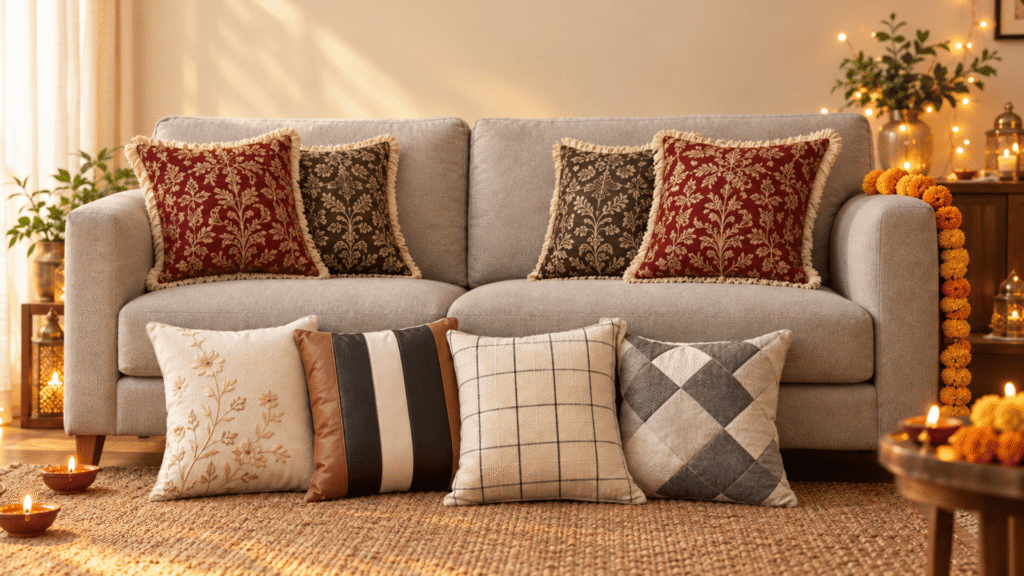
Fabric is the fastest and most cost-effective way to transform a room for Diwali, quicker than painting, cheaper than furniture, and fully reusable. A little knowledge about weight and finish is what separates a festive room from a cluttered one.
Cushion covers are the highest-impact, lowest-cost purchase you can make. A quick guide to matching fabric to use:
Fabric | Feel and look | Best for | Care |
Silk / silk-blend | Rich sheen, formal | Living rooms, festive evenings | Dry clean |
Velvet | Deep colour, plush | Cooler months, formal seating | Dry or spot clean |
Brocade/jacquard | Ornate woven pattern | Statement and accent cushions | Dry clean |
Embroidered cotton | Everyday festive | High-traffic and daily-use seating | Machine washable |
Rexine/leatherette trim | Durable, wipeable | Piping, borders, high-use edges | Wipe clean |
For curtains, you rarely need to replace a whole set for the season. Swap only the sheer or the accent panel for a jewel-tone or metallic layered over your existing neutral base; it is a fraction of the cost and reverses easily afterward. If you are choosing the base fabric itself, weight and lining matter more than colour, and Abbott Fab’s room-by-room curtain fabric guide breaks down which fabric suits which room by light, privacy, and maintenance. Table linen follows one rule: choose a stain-resistant runner; poly-cotton blends or treated cotton hold up through a festive meal far better than raw silk or unlined linen; and coordinate runner and napkin by colour rather than by pattern for a look that reads intentional and photographs well.
Upholstery is the longer-term decision underneath all of this. Where cushions and curtains are a seasonal layer, the sofa fabric changes how a living room reads all year. A durable, wipeable rexine or leatherette upholstery handles a high-traffic festive week, guests, spilled sweets, the odd drip of diya wax, without the staining risk a light fabric carries. If you are weighing a longer-term refresh, Abbott Fab’s complete sofa fabric guide covers how to weigh durability against texture, including what a Martindale rub count actually tells you, before the festive rush, when both stock and prices tighten.
Sustainable and Reusable Decor
Sustainability has become a steady theme in festive decorating, and most of it is also cheaper over time. Choose clay diyas over plastic ones; they are biodegradable and made by local artisans. Use floral rangoli instead of chemical-dyed powder to cut both waste and cleanup water. Pick reusable fabric torans and bunting over single-use paper that gets binned in January. Opt for LED string lights, which draw a fraction of the power of older incandescent festive lighting and last several seasons. And invest in durable cushion covers, runners, and curtain accents built to survive many Diwalis rather than one. The through-line is simple: reusable fabric and clay cost less across a few years than decor bought to be thrown away.
Common Mistakes to Avoid
- Buying lights and diyas before decluttering, so good decor gets lost in visual noise.
- Loading a single room with every decor category at once instead of layering light, colour, and texture deliberately.
- Placing thin cotton or sheer curtains right beside diya clusters or candles.
- Choosing single-use paper or plastic over reusable fabric and clay, adding cost and waste every year.
- Ignoring the entrance in favour of the living room, when the entrance is the first and most photographed moment in the house.
- Carrying three competing colour palettes across rooms instead of one palette at varying intensity.
Budget: Where the Money Actually Goes
Good Diwali decor does not need a large budget; it needs the budget spent in the right order. Lighting and reusable fabric deliver the most per rupee, so weight spending there and treat flowers, the main recurring cost, as the smaller, refreshable line.
Category | Rough share | Why |
Lighting (diyas, string lights) | 30% | Highest visual return per rupee |
Fabric accents (cushions, runners) | 30% | Reusable across future festivals |
Flowers and rangoli | 20% | Fresh flowers are a recurring cost |
Entrance decor (toran, door items) | 15% | Often reusable if fabric |
Miscellaneous / repairs | 5% | Buffer for last-minute needs |
A few genuinely effective low-cost moves: hand-paint plain terracotta diyas with acrylics for a personalised set at a fraction of decorative-diya prices; repurpose glass jars as lanterns with twine and a tealight; upcycle an old saree or dupatta into a runner or cushion covers; and reuse last year’s fairy lights, refreshing only the accent pieces, a new cushion set, fresh rangoli colour, this year’s flowers.
Diwali Decor Safety
Diwali sees a real rise in home fire risk, and it comes almost entirely from three sources: open-flame diyas, decorative lighting, and firecrackers. The encouraging part is that basic precautions measurably work. In 2021, Delhi Fire Service recorded 152 fire-related calls on Diwali, its lowest in fifteen years and down from 205 the previous year, with officials crediting public awareness and pointing to loose wiring, overloaded extension boards, and unattended lamps as the recurring culprits in past years.
A short checklist covers the real risks:
- Never leave diyas or candles unattended, and extinguish them before leaving a room.
- Keep diyas and candles away from curtains, cushions, and hanging fabric. Fabric too close to a flame is the most preventable fire risk in home decor.
- Use LED tealights in bedrooms, near curtains, and anywhere a flame would be left unattended.
- Inspect string lights and extension cords for frayed wiring, and do not overload a single socket with multiple light strings.
- Keep a clear space above and around diya clusters; no trailing garlands, paper torans, or loose fabric over an open flame.
- Set diyas on stable, heat-resistant surfaces in a contain
Where Fabric Fits, and Where Abbott Fab Comes In

Fabric ends up being the most overlooked part of most decor plans even though it does the most visible work: the curtains catching lamplight, the cushions guests sit on, the upholstery that has to survive a week of festive footfall. Getting it right is mostly about matching weight and texture to how a room is used, which is exactly the knowledge a fabrics specialist brings.
Abbott Fab is a Delhi-based manufacturer of rexine and upholstery fabrics, working across furniture, automotive, interiors, and home furnishing, with its base in the Kirti Nagar market. Buying direct from a manufacturer has one practical festive-season upside worth naming: no reseller markup stacked on prices that are already climbing with demand. If a fabric-led refresh is the part of your plan still outstanding, the cushion, curtain, and upholstery layer, it is worth sorting before the rush sets in and stock tightens.
If you’re planning a fabric-led refresh this Diwali, browse the fabric collection or rexine range, and if you’re unsure which material suits your room, the curtain fabric guide breaks it down room by room.
Conclusion
Diwali decor rarely comes down to one big purchase. It is a sequence of smaller decisions, each setting up the next. Clean and declutter first, because nothing looks good in a cluttered room. Decide how light should move through the house before you buy a single diya. Layer fabric and colour once the light plan is set. Finish at the entrance, since that is what a guest sees first. And check every flame, wire, and cord before the celebrations begin.
Followed in that order, though, even a modest budget goes a long way: a clean home, a few well-placed diyas, fresh cushions, and a decorated entrance can transform a space more completely than any single large purchase could on its own. And if fabric is the piece of that plan still sitting on your to-do list, Abbott Fab’s collection is worth a look before the festive rush sets in and both stock and prices start moving.
Frequently Asked Questions
Diwali 2026 falls on Sunday, 8 November, with Lakshmi Puja after sunset. It follows the Hindu lunar calendar, so the date shifts yearly and usually lands in late October or early November. The five-day festival runs from Dhanteras on 6 November to Bhai Dooj on 10 November.
The main entrance, living room, and pooja space. The entrance is the first thing guests see and, in Vastu tradition, where prosperity enters. The living room hosts the most people, and the pooja space is the ritual centre. Prioritise these three when time or budget is tight.
Spend on lighting and reusable fabric rather than one-time pieces. Diyas and string lights give the highest visual impact per rupee, cushion covers and runners get reused for years, and DIY touches like hand-painted diyas or upcycled fabric cost very little while feeling personal.
Jewel tones emerald, sapphire, and aubergine are trending alongside the classic red-and-gold palette, echoing a broader interior-design shift toward deeper, warmer colours; Behr named the smoky jade “Hidden Gem” its 2026 Colour of the Year. Keep walls and furniture neutral and bring these tones in through cushions, runners, and lighting.
Yes, considerably, especially near fabric, curtains, and unattended spaces. LED tealights recreate the warm glow without an open flame, which is why they are the recommended substitute for candles and diyas around anything flammable or in rooms left unattended.
At the main entrance threshold, facing outward. It is meant to be the first visual greeting for a guest and, by tradition, welcomes prosperity and Goddess Lakshmi into the home.
Silk, velvet, and brocade give the richest festive look and photograph well, though they need dry cleaning. Embroidered cotton is the practical choice for daily, high-traffic seating since it is machine washable. Match the cushion texture to your existing sofa rather than choosing in isolation.
Choose clay diyas, floral rangoli, and reusable fabric decor over plastic and single-use paper. LED string lights also use far less power than older incandescent lighting and last several seasons, cutting both waste and recurring cost.
A toran is a hanging decoration above the doorway, traditionally mango leaves, marigold, or fabric. A rangoli is a pattern made on the floor at the threshold using coloured powder, rice, or petals. One frames the door from above; the other greets from the ground.
Start deep cleaning and decluttering 10 to 14 days before Diwali, and begin decorating in the final 5 to 7 days. Cleaning has to happen before decor goes up, so compressing both into the last two or three days means a rushed clean and more stress.
Pingback: Rexine Bags for Diwali Gifting 2026: A Buyer's Guide