Curtain Fabric

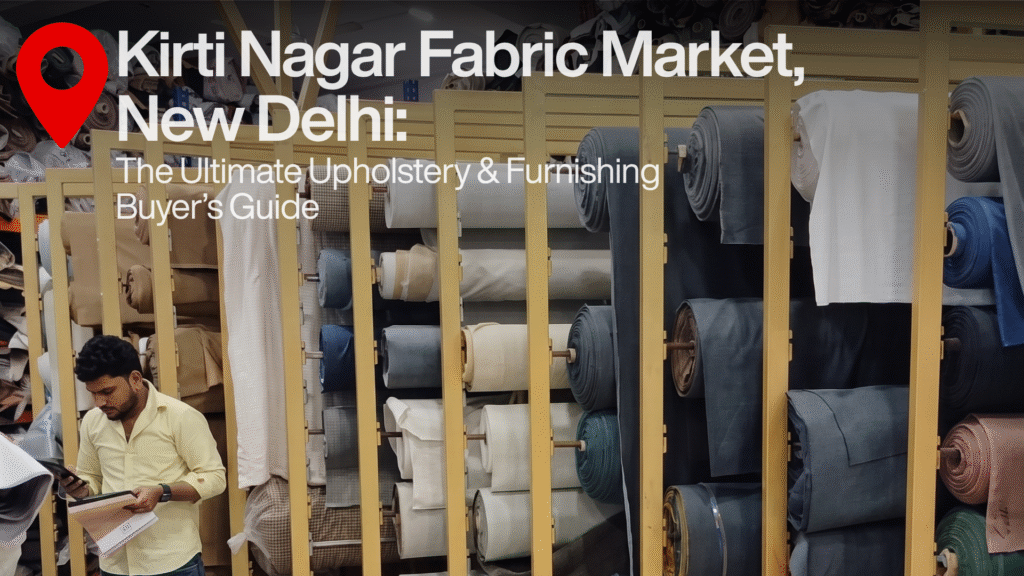
Kirti Nagar Fabric Market, New Delhi: Infographic-style header image featuring a red location pin and white text that reads: "Kirti Nagar Fabric Market, New Delhi: The Ultimate Upholstery & Furnishing Buyer's Guide." The image shows a man in a yellow shirt looking at a phone and notebook, standing in an aisle of a large warehouse with tall metal racks filled with hundreds of fabric rolls.
Curtain Fabric, Curtain Fabric Guide

Kirti Nagar Fabric Market, New Delhi: The Ultimate Upholstery & Furnishing Buyer’s Guide

Kirti Nagar Fabric Market, New Delhi: The Ultimate Upholstery & Furnishing Buyer’s Guide Key Takeaways Get Exact Measurements: Confirm final fabric requirements with your upholsterer or carpenter before visiting. Prioritise Density & Backing: Insist on a minimum of 350 GSM and verify the presence of a reinforced backing layer on all seat fabrics. Check Natural Daylight: Always inspect fabric cuts under natural sunlight outside the showroom to confirm true colour shades. Source From Specialists: Work directly with established wholesale suppliers like AbbottFab (1/91, Basement, WHS Timber Market) to access commercial-grade collections at transparent pricing. Ask for the batch or lot number and buy your whole requirement from one lot. Shade variation between dye lots is the most common reason a reupholstered sofa looks wrong. If you are registered under Goods and Services Tax (GST), take the tax invoice. The Harmonised System of Nomenclature (HSN) code on it also tells you what you actually bought. Quick Answer Box Where is the best place to buy upholstery and sofa fabric in Delhi? The Kirti Nagar Fabric Market, specifically located within the WHS Timber Market and surrounding Furniture Blocks in West Delhi, is Asia’s premier wholesale and retail destination for heavy-duty furnishing textiles. Unlike apparel-centric hubs like Lajpat Nagar or Chandni Chowk, Kirti Nagar specialises in commercial-grade sofa fabrics, upholstery velvet, suede, bouclé, leatherette (rexine), and heavy drapery. Showrooms such as AbbottFab (1/91 Basement, Timber Market) offer mill-direct wholesale pricing to homeowners, interior designers, and furniture manufacturers alike. Whether you are restoring a family heirloom armchair, furnishing a 5-BHK luxury residence, or sourcing high-performance textiles for a boutique hotel chain, every major interior design project in North India eventually leads to West Delhi’s Kirti Nagar. Widely celebrated as Asia’s largest furniture marketplace, Kirti Nagar houses an equally vast, highly specialised Wholesale Fabric and Upholstery District. Spread across the Warehouse Scheme (WHS) Timber Market, Industrial Area Phases, and the main Furniture Block, hundreds of textile importers, mill stocking distributors, and boutique showrooms hold millions of meters of furnishing materials in ready inventory. However, navigating this high-density market can be overwhelming for first-time buyers. Prices swing dramatically across vendors, low-grade printed polyesters often masquerade as heavy woven chenilles, and choosing the wrong rub count or backing layer can leave your new sofa sagging within months. This guide provides an exhaustive breakdown of everything you need to know to navigate the Kirti Nagar Fabric Market with total confidence. Understanding the Landscape: Kirti Nagar vs. Other Delhi Textile Markets To get the most out of your shopping trip, it helps to understand how Delhi’s famous textile markets divide their focus. Sourcing sofa materials from an apparel market often results in lightweight fabrics that tear along seam lines under everyday tension. Market Hub Primary Focus Area Typical Fabric Weights (GSM) Wholesale Availability Ideal Project Type Kirti Nagar (West Delhi) Upholstery, Sofa Fabric, Rexine, Drapery 350 – 700+ GSM Extensive (Mill-Direct) Sofas, Beds, Dining Chairs, Commercial Spaces Lajpat Nagar (Central Delhi) Apparel, Laces, Light Sheers, Dress Materials 100 – 250 GSM Moderate / Retail Focus Tailored Clothing, Light Curtains, Cushion Covers Chandni Chowk (Old Delhi) Ethnic Wear, Bridal Silks, Suiting Materials 80 – 300 GSM High (Garments) Wedding Apparel, Traditional Crafts Shanti Mohalla (East Delhi) Garment Cut-Pieces, Apparel Cotton Scraps 100 – 220 GSM High (Apparel Scraps) Garment Manufacturing, Export Houses Nehru Place (South Delhi) Office Electronics, Retail Drapery, Sheers 150 – 300 GSM Limited Quick Home Soft Decor, Sheer Curtains The Kirti Nagar Advantage Commercial-Grade Durability: Textiles sold here feature heavy structural backings, high thread counts, and specialised surface treatments designed to withstand thousands of sit-stand cycles. Direct Supply Chain: Most major vendors operate as primary importers or mill stocking points for textile centres in Surat, Panipat, Turkey, Italy, and China. Proximity to Craftsmen: Because fabric sellers sit directly adjacent to timber yards, frame makers, master upholsterers, and polishing units, you can source materials and hand them over to your carpenter on the same afternoon. The Upholstery Fabric Masterclass: Material Breakdown Evaluating upholstery requires looking beyond colour cards to understand the physical composition of each weave. Here is an in-depth breakdown of the primary fabric categories available across Kirti Nagar: 1. High-Performance Velvets Modern micro-polyester velvets bear little resemblance to delicate vintage silk velvets. Engineered for daily living, high-grade velvets are naturally stain-resistant because synthetic fibres do not absorb liquids easily. When shopping for velvet in Kirti Nagar: Check the pile direction (nap). Ensure the fabric displays a uniform sheen when brushed in the direction of the weave. Look for high pile density so the backing material does not show through when folded sharply over cushion edges. 2. Technical Rexine & Leatherette (PU vs. PVC) Leatherette is a popular choice for high-use seating. However, it is essential to distinguish between Polyurethane (PU) and Polyvinyl Chloride (PVC): PU Leatherette: Breathable, supple, and soft to the touch. It resists cracking under North Indian temperature shifts and offers an authentic leather feel. PVC Rexine: Rigid, completely waterproof, and highly budget-friendly. Ideal for commercial seating, clinic waiting rooms, or basic dining chairs. 3. Modern Bouclé & Micro-Suede Bouclé (characterised by looped, nubby yarns) has become a staple of contemporary Scandinavian interior design. It conceals minor seam imperfections well on curved furniture profiles. Micro-suede offers a smooth matte finish that remains cool during summer months and cleans easily with a damp microfiber cloth. 4. Woven Jacquards & Chenille Unlike printed fabrics, Jacquard designs are woven directly into the fabric’s structure using complex looms. Combined with soft chenille yarn, Jacquards offer excellent resistance to surface wear, making them ideal for heavy-use family sectionals. Technical Fabric Selection Matrix Category: Velvet Structure: Micro-polyester dense pile with knitted backing  Key Traits: Stain-resistant, soft tactile feel, rich colour depth  Best For: Formal living room sectionals, tufted headboards, accent chairs Category: Rexine / Leatherette (Pu & Pvc) Structure: Synthetic resin layer bonded to cotton or polyester fleece Key Traits: 100% Waterproof, wipe-clean surface, scratch-resistant  Best For: Dining seat cushions, bar stools, office chairs, pet homes Category: Textured Bouclé
Banner for Abbott Fab titled 'Best Curtain Fabric for Monsoon in India: The Complete 2026 Guide' featuring light sheer curtains hanging over a window.
Curtain Fabric, Curtain Fabric Guide

Best Curtain Fabric for Monsoon Humidity in India: The Complete 2026 Guide

Best Curtain Fabric for Monsoon Humidity in India: The Complete 2026 Guide Key Takeaways Synthetics win on physics, not opinion. Polyester’s commercial moisture regain is around 0.4%, against roughly 8.5% for cotton and 12% for linen a 20- to 30-fold difference in how much water the fibre holds. Mould is a moisture problem before it’s a fabric problem. Building-science standards treat sustained surface relative humidity at or above roughly 80% as the point where mould growth becomes likely on susceptible materials. Health, not just housekeeping. The CDC notes that mould grows readily on fabric and upholstery, and that exposure can trigger a stuffy nose, coughing, wheezing, burning eyes or skin rash, with more severe reactions in people who have asthma or a mould allergy. Synthetic doesn’t mean immune. Clean synthetic fabric won’t feed mould, but the dust, skin oils and cooking residue that settle on it will. This is why washing matters even for polyester. Your monsoon isn’t everyone’s monsoon. Mumbai, Kolkata and Delhi-NCR peak with the southwest monsoon from June to September. Chennai’s main rainy season is the northeast monsoon, roughly mid-October to December. Same fabric logic, different calendar. Layering beats picking a single hero fabric. A sheer polyester inner panel against the glass plus a heavier synthetic outer drape gives you fast-drying protection and a finished look. The Short Answer For Indian monsoon conditions, choose polyester, solution-dyed acrylic, or olefin (polypropylene). All three absorb almost no water and dry within hours rather than days, which is what actually determines whether a curtain grows mildew. Treated or blended cotton works in genuinely cross-ventilated rooms. Store velvet, silk, jute, brocade and heavy linen for the season; they combine the highest moisture uptake with the slowest drying. One caveat worth stating upfront: fabric choice reduces risk; it does not eliminate it. Mould needs sustained moisture, and no curtain will fix a room that sits at 85% relative humidity for eight weeks. Fabric is one lever. Ventilation and dehumidification are the other two. Why Curtains Take the Worst of the Monsoon Curtains hang exactly where humid air enters a home: windows, balcony doors, kitchen openings. They are the first textile to meet rain-laden air, and the first to show what that air does over eight to twelve weeks. The numbers are not marginal. Mumbai’s monthly average relative humidity peaks near 86–89% in July, against an annual average of roughly 71–75%. Kolkata runs at about 83–88% through July and August. Delhi-NCR is drier on average but swings hard during the monsoon months, with humidity readings above 80% common on rainy days. Chennai’s own peak arrives later, with relative humidity highest in October and November. Those are outdoor observations. Indoors, in the naturally ventilated homes most Indian families live in, humidity tracks outdoor conditions closely, which is precisely the problem. Sealed, air-conditioned flats fare better, because cooling dehumidifies, but only while the unit is actually running. Why does this matter for a curtain specifically? Because of what mould needs. Laboratory and building-science work converges on a threshold: sustained surface relative humidity around 80% is where germination becomes likely on susceptible materials, with visible growth following over days to weeks of continued exposure. ASHRAE’s moisture-design standard uses a 30-day running average surface RH below 80% as its criterion for avoiding mould growth. A cotton curtain hanging in a Mumbai bedroom in July can sit above that line for most of the season. The consequence isn’t only cosmetic. The US Centres for Disease Control and Prevention lists fabric and upholstery among the materials mould grows on, and recommends keeping indoor humidity below 50% all day long as a core prevention step. The CDC also notes that the 2004 Institute of Medicine review found sufficient evidence linking indoor mould exposure to upper respiratory symptoms, cough and wheeze in otherwise healthy people, and to asthma symptoms in people who already have asthma. Realistically, no Indian home is holding 50% RH indoors in July without mechanical help. That’s the argument for choosing fabrics that don’t hold water and for running an AC on dry mode or a dehumidifier in the rooms that matter most. The Science: Moisture Regain, and Why it Decides Everything Every fibre has a moisture regain: the weight of water it holds, expressed as a percentage of its own oven-dry weight. Trade values are standardised under ASTM D1909 and measured at a reference atmosphere of roughly 21°C and 65% relative humidity. Two things follow from that definition. First, these are comparative benchmarks, not monsoon predictions. At 90% RH, every hygroscopic fibre in the table below holds considerably more water than its listed figure. Second, the ranking holds regardless, and the ranking is what you’re buying on. Fibre Commercial moisture regain What it means for a curtain Olefin (polypropylene) ~0% Effectively nil. Nothing for mildew to feed on or hold onto Polyester 0.4% Barely absorbs; surface moisture flashes off quickly Acrylic 1.5% (published range 1.0–2.5%) Very low; engineered originally for outdoor exposure Nylon (polyamide) 4.0–4.5% Low-moderate; uncommon in curtains Acetate 6.0% Moderate, and weak when wet Cotton 8.5% Moderate. Workable with ventilation and a wash routine Silk 11.0% High. Water-spots, loses lustre, weakens Viscose rayon 11–13% High, and loses significant strength when wet Linen (flax) 12.0–12.4% High; slow-drying, sags, mildews Jute ~13.75% Very high; a lignocellulosic fibre that genuinely rots Wool 16.0% Highest in common use; included for scale Put plainly: cotton holds roughly 21 times more water than polyester at the same conditions, linen about 31 times, wool about 40 times. That gap doesn’t close because of how a fabric is woven or which colour it’s dyed. The Nuance most Guides Skip Synthetic fibres resist mildew because fungi can’t digest them; polyester, acrylic and olefin offer no nutrition. But mould doesn’t only eat fabric. Extension research and textile-conservation guidance both make the same point: soiled synthetic fabric stored warm and damp can and does mildew, because the growth happens on the deposited organic soil dust, skin oils, cooking grease rather than on the fibre. This

Scroll to Top