How to Choose Upholstery Fabric: Complete Guide to Types, Durability & Cost
Quick Answer: How to Choose Upholstery Fabric
Upholstery fabric is a heavy-duty textile engineered to protect furniture. Choosing the right one depends on three factors:
- Durability (Double Rubs): Aim for 15,000+ for everyday use, and 30,000+ for pets or kids.
- Fibre Type: Natural fibres (linen, wool) offer luxury; synthetics (microfiber, polyester) offer durability; blends offer the best of both.
- Use Case: Use performance fabrics for high traffic, solution-dyed acrylic for outdoors, and delicate weaves like brocade for accent pieces.
What Is Upholstery Fabric and How Is It Different?
Upholstery fabric is a structurally engineered textile built to withstand abrasion, tension, compression, and repeated cleaning. Unlike apparel or drapery fabric, it must hold up under daily seating loads, staple stress at the frame, and years of friction without distorting, pilling, or fading.
At AbbottFab, we evaluate every upholstery textile against four performance pillars:
- Weave density: Tighter weaves resist snagging and pilling
- Fibre composition: determines breathability, stretch, and stain behaviour
- Backing: adds dimensional stability and prevents stretching at staple lines
- Finishing treatment: stain repellents, UV inhibitors, flame retardants
If a fabric fails on any of these, it fails on the furniture.
Why Does Upholstery Fabric Choice Matter?
Fabric drives three outcomes most buyers underestimate: longevity, comfort, and total cost of ownership.
A poorly matched fabric can show wear in 18–24 months on a daily-use sofa. A correctly specified fabric on the same frame lasts 15–25 years. Since reupholstery typically runs $1,200–$4,000 for a standard sofa, the wrong fabric is rarely a cheap mistake.
Comfort is directly tied to your local climate. Synthetics can feel clammy in hot, humid climates like the Southeast, making breathable natural blends a better choice. Conversely, in sun-drenched regions or high-altitude areas, UV-resistant acrylics are vital to prevent fading. At AbbottFab, serving the Kirti Nagar, Delhi area, we heavily factor your home’s sun exposure and local humidity into our recommendations. Cleaning code “X” fabrics requires professional service for every spill, a real cost in a busy household.
The cheaper fabric is rarely the cheaper decision.
What Are the Main Types of Upholstery Fabric?
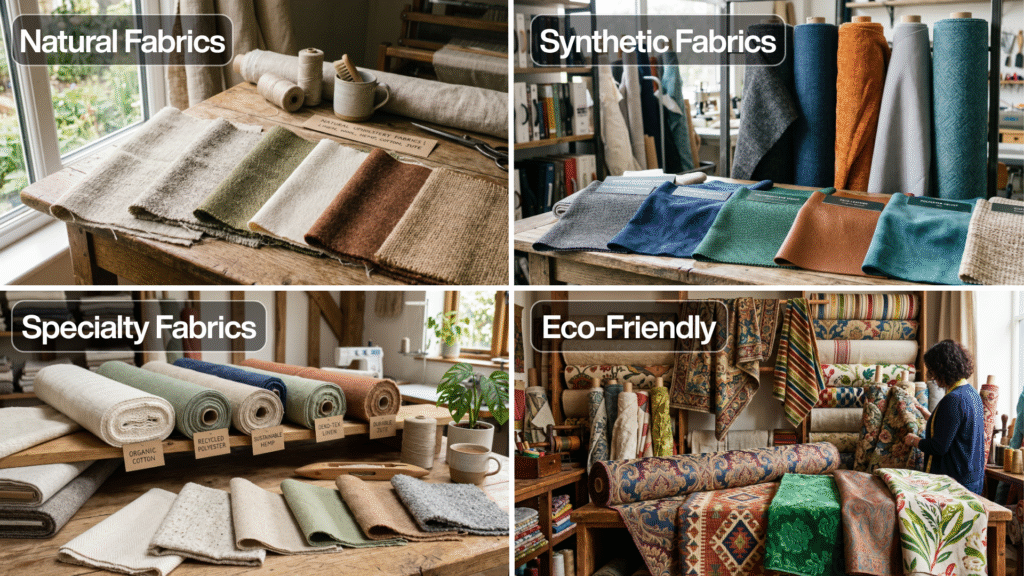
Natural Upholstery Fabrics: Cotton, Linen, Wool & Leather
Cotton: Soft, breathable, and accepts dye well. Wrinkles, fades, stains. Best for casual rooms and accent pieces. Double rubs: 3,000–15,000. Always specify a cotton-poly blend for daily-use furniture.
Linen: Flax-based with a textured matte finish. Wrinkles aggressively, pills, stains easily. Best for low-traffic accent chairs and headboards. Double rubs: 5,000–20,000. Linen-look performance fabrics deliver the aesthetic without the fragility.
Wool: Naturally flame-resistant, soil-resistant, and elastic. Holds shape better than nearly any other fibre. Best for living room sofas and statement chairs. Double rubs: 30,000–100,000+. Underrated in the residential market.
Genuine Leather. Full-grain and top-grain develop a patina rather than degrading. Hypoallergenic, easy to wipe, lasts 20–30+ years. Best for sofas, club chairs, and recliners. Requires conditioning twice yearly.
Synthetic Upholstery Fabrics: Polyester, Nylon, Acrylic & Microfiber
Polyester. Durable, fade-resistant, affordable. Slight artificial sheen when used alone blends solve this. Double rubs: 15,000–50,000+. The workhorse of modern residential upholstery.
Nylon. One of the strongest synthetic fibres. Rarely used alone; blended in to boost abrasion resistance and reduce pilling. Double rubs: 50,000–100,000+. Standard in commercial and high-traffic seating.
Acrylic. Wool-mimicking synthetic with strong UV resistance. Solution-dyed acrylic (Sunbrella and equivalents) is the global standard for outdoor upholstery. Double rubs: 20,000–50,000.
Microfiber / Microsuede. Ultra-fine polyester filaments that mimic suede. Liquids bead at the surface; pet hair vacuums off easily. Double rubs: 30,000–100,000+. The most practical fabric for family homes under $50/yard.
Faux Leather (PU, Bonded, Vegan). Quality varies sharply. Bonded leather peels within 2–4 years and should be avoided. High-grade PU leather is durable, water-resistant, and visually convincing. Double rubs: 30,000–75,000+.
Eco-Friendly Upholstery Fabrics: Organic, Recycled & Upcycled Options
- Organic Cotton & Linen: Grown without synthetic pesticides. Naturally biodegradable, offering the same breathability as standard natural fibres but with a much lower environmental footprint. Double rubs: 10,000–20,000.
- Recycled Polyester (rPET): Spun from recycled plastic bottles. It delivers the exact same high durability and fade resistance as virgin polyester but diverts waste from landfills. Double rubs: 30,000–50,000+.
- Upcycled Leather: Made from leather scraps that are ground down and bound together. While similar to bonded leather, high-quality upcycled leather is a sustainable way to get a leather aesthetic. Double rubs: 20,000–40,000.
Decorative Upholstery Fabrics: Velvet, Brocade, Jacquard & Performance
Velvet. Short, dense pile producing a distinctive sheen. Performance velvet (polyester-based) hits 100,000+ double rubs and resists stains. Silk velvet does not keep its shape on lightly used pieces.
Chenille. Tufted yarn with a fuzzy, caterpillar-like surface. Soft and inviting; flattens under heavy use, snags on claws. Double rubs: 15,000–30,000. Best for reading chairs and casual sofas.
Brocade. Raised relief patterns, often with metallic threads. Delicate, snag-prone, dry-clean only. Reserve for ceremonial or rarely used accent pieces. Double rubs: 5,000–15,000.
Jacquard. A weaving technique, not a fibre patterns are structural, not printed, so they don’t wear off. Double rubs: 15,000–50,000. Excellent for formal sofas and period furniture.
Tweed. Heavyweight wool weave with a tight, dense structure. Durable, classic, dry-clean recommended. Double rubs: 40,000–80,000. Pairs with traditional and heritage interiors.
Performance Fabric. Engineered textiles (Crypton, Sunbrella, Revolution, Perennials) are built to resist stains, UV, moisture, and abrasion simultaneously. Most are solution-dyed, and many are bleach-cleanable. Double rubs: 50,000–100,000+. The dominant choice for families, pets, and commercial.
Upholstery Fabric Comparison Chart: Durability, Cleaning & Best Use
| Fabric | Durability | Cleaning | Best For | Double Rubs |
|---|---|---|---|---|
| Cotton | Moderate | Easy–Moderate | Casual rooms | 3K–15K |
| Linen | Moderate | Difficult | Accent pieces | 5K–20K |
| Wool | High | Moderate | Living rooms | 30K–100K |
| Polyester | High | Easy | Everyday use | 15K–50K |
| Nylon | Very High | Easy | High-traffic | 50K–100K |
| Acrylic | High | Easy | Outdoor | 20K–50K |
| Velvet | Mod–High | Moderate | Statement | 10K–100K |
| Genuine Leather | Very High | Easy | Premium | 100K+ |
| Faux Leather | Mod–High | Very Easy | Budget/vegan | 30K–75K |
| Microfiber | Very High | Very Easy | Families/pets | 30K–100K |
| Brocade | Low–Mod | Difficult | Decorative | 5K–15K |
| Chenille | Moderate | Moderate | Cozy seating | 15K–30K |
| Jacquard | High | Moderate | Formal | 15K–50K |
| Tweed | Very High | Moderate | Traditional | 40K–80K |
| Performance | Extremely High | Very Easy | Family/outdoor | 50K–100K+ |
How Much Does Upholstery Fabric Cost Per Yard?
Budget plays a major role in fabric selection. While reupholstery labour costs between $1,200 and $4,000, the fabric itself is priced by the yard:
- Budget ($15 – $30/yard): Cotton blends, basic polyester, and entry-level microfibers. Great for DIY projects or light-use pieces.
- Mid-Range ($30 – $70/yard): High-grade microfibers, linen-poly blends, mid-tier velvets, and standard faux leathers. The sweet spot for residential daily use.
- Premium ($70 – $150+/yard): Genuine top-grain leather, brand-name performance fabrics (Crypton, Sunbrella), pure wool, and intricate jacquards. Essential for high-end luxury or severe commercial use.
What Is a Double Rub Count? (Wyzenbeek Test Explained)
The double rub count measures abrasion resistance. In the Wyzenbeek test, a weighted cotton duck pad is pulled back and forth across the fabric. Each complete cycle equals one double rub. Testing continues until two yarns break or visible wear appears.
Rating Thresholds
| Double Rubs | Use |
|---|---|
| Under 3,000 | Decorative only |
| 3,000–9,000 | Light residential |
| 9,000–15,000 | General residential |
| 15,000–30,000 | Heavy residential/light commercial |
| 30,000+ | Heavy residential/commercial |
| 100,000+ | Severe commercial/institutional |
Practical guidance from our shop floor: for a daily-use family sofa, 15,000 is the minimum we recommend. For pets, kids, or rentals, push to 30,000+. The European Martindale equivalent of “good residential” lands around 20,000, but the two scales are not directly convertible.
What Is the Best Upholstery Fabric for Each Use Case?
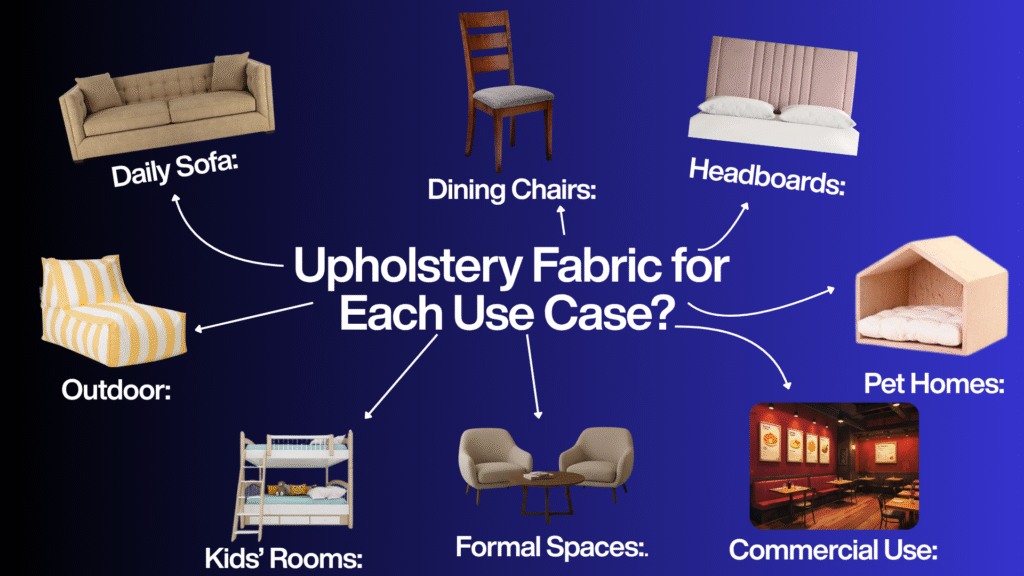
Daily-use sofa: Performance fabric, microfiber, polyester blend, leather. Avoid silk, brocade, and untreated linen.
Dining chairs: Faux leather, microfiber, performance fabric, cotton-poly. Spills are constant; easy cleaning wins.
Headboards: Velvet, linen, cotton, boucle, jacquard. Abrasion isn’t the constraint; texture and comfort are.
Outdoor furniture: Solution-dyed acrylic only. Indoor fabrics, even “treated” ones, break down within a season.
Pet households: Microfiber, performance fabric, scratch-resistant leather. Avoid loose weaves and chenille that catch and pull threads.
Children’s rooms: Performance fabric, microfiber, washable canvas. Bleach-cleanable performance fabrics are worth the upcharge.
Formal sitting rooms: Velvet, jacquard, brocade, leather, silk blends. Light use lets you indulge in delicate textiles.
Commercial seating: Nothing under 30,000 double rubs. Specify FR-rated, solution-dyed performance fabric.
Natural vs. Synthetic Upholstery Fabric: Which Is Better?
Natural fibres (cotton, linen, wool, silk, leather) breathe better, age more gracefully, and feel more authentic. They cost more, stain faster, and often need professional cleaning.
Synthetic fibres (polyester, nylon, acrylic, microfiber) outperform on durability, stain resistance, colourfastness, and price. They breathe less and can feel less luxurious in lower grades.
Blends capture both. The strongest residential performers are typically:
- Cotton-polyester (softness + durability)
- Linen-nylon (texture + strength)
- Wool-nylon (luxury + abrasion resistance)
- Viscose-polyester (drape + easy care)
When a client tells us, “I want linen on a family sofa,” we steer them toward a linen-look performance blend. Same aesthetic. Five times the lifespan.
How to Read an Upholstery Fabric Label (Codes & Specs Explained)
Cleaning Codes
| Code | Meaning |
|---|---|
| W | Water-based cleaner only |
| S | Solvent (dry-clean) only |
| W/S | Either is safe |
| X | Vacuum or brush only |
Other Specs Worth Checking
- Double rub count (Wyzenbeek): non-negotiable for seating
- Martindale rating: European equivalent
- FR rating: required for commercial/hospitality
- UV resistance: critical near windows or outdoors
- Dye lot number: match across all yardage in one project
- Pattern repeat: adds 10–20% to required yardage
If a supplier can’t provide a double rub number, treat it as a red flag.
Which Upholstery Fabric Should You Choose? Final Recommendations
There is no single “best” upholstery fabric. The right choice depends on three variables working together: how the piece will be used, what your home throws at it (sun, humidity, pets, kids), and how long you want it to last.
If you want maximum longevity, choose a performance fabric, leather, or wool blend. If easy cleaning is your priority, microfiber and faux leather are unbeatable. For luxury, velvet and jacquard still lead. For families and pets, performance fabrics rated 30,000+ double rubs are worth every rupee. And for outdoor use, solution-dyed acrylic is the only fabric that earns its place.
| Priority | Best Pick |
|---|---|
| Maximum longevity | Performance fabric, leather, or wool |
| Easiest cleaning | Microfiber, faux leather, performance fabric |
| Luxury feel | Velvet, leather, jacquard |
| Pet & kid resistance | Performance fabric, microfiber, leather |
| Outdoor furniture | Solution-dyed acrylic |
| Sustainability | Organic cotton, linen, recycled polyester |
| Best value | Cotton-poly blend or microfiber |
| Timeless elegance | Linen, wool, tweed, leather |
Specify carefully once, and you’ll live with the result for a decade or more.
If you’d like a second opinion before you commit, our team at AbbottFab in Kirti Nagar, Delhi, is happy to help. Bring a photo of your piece, tell us how it’ll be used, and we’ll walk you through the swatches that actually fit your home no upsell, no pressure. Visit the showroom or drop us a message when you’re ready to narrow it down.
FAQs
Genuine leather, performance fabrics (Crypton, Sunbrella), nylon blends, and tightly woven wool lead the field. For most households, a performance fabric or microfiber rated 30,000+ double rubs gives the best balance of durability, cleanability, and comfort.
Faux leather is the simplest, and most spills are wiped off with a damp cloth. Performance fabrics are close behind, with many rated as bleach-cleanable. Microfiber ranks third because its tight fibre structure prevents most liquids from absorbing immediately.
Microfiber, performance fabric, and scratch-resistant leather. They resist claws, shed fur easily, and clean up fast. Avoid loose-weave fabrics like chenille and textured linen claws snag and pull threads on first contact.
A standard three-seat sofa needs 12–18 yards. Armchairs need 4–6 yards. Dining chairs with a seat pad only need 1–2 yards. Add 10–15% for pattern repeat and cutting waste, and order all yardage from a single dye lot.
Upholstery fabric is engineered for structural performance, tighter weave, higher abrasion resistance, dimensional backing, and tested ratings (double rub count, FR, UV). Standard decorative or apparel fabric lacks these properties and fails quickly under furniture loads.
Modern performance velvet, yes. Polyester-based velvets rated 30,000+ double rubs handle daily family use well and resist stains. Silk velvet, no, it remains a delicate, decorative-only fabric.
Fabric where pigment is added during fibre production rather than applied to the surface. The colour runs through the entire fibre, delivering exceptional fade resistance against UV, bleach, and aggressive cleaning. Essential for outdoor and high-sun applications.
Pingback: Diwali Home Decor 2026: A Room-by-Room Styling Guide.