How to Test Rexine Quality Before Buying: 5 Expert Checks That Stop You Wasting Money
Quick answer: You can judge rexine quality in under five minutes using five hands-on checks a visual and backing inspection, a smell test, a flex-and-pinch test, a fingernail scratch test, and a water drop test. Premium rexine has an irregular grain, woven fabric backing, neutral odour, supple flex, and a sealed, water-beading surface. Low-grade rexine fails on at least two of these.
If you’ve ever watched a “leather-look” sofa peel, crack, and shed flakes onto your carpet within a year of buying it, you already know the problem. In a brightly lit showroom, low-grade rexine looks almost identical to the premium grade. The difference only shows up six to twelve months later, when the plastic top layer separates from the fabric backing, and you’re staring at a fuzzy, ruined armrest.
Most buyers are flying blind. They rely on “the feel” or the salesperson’s word. The good news: you don’t need a lab or a chemistry degree to spot the difference. You need a 4-inch swatch and five minutes.
This guide shows you exactly what to check, what the result means, and how to ask suppliers the right questions before you commit.
What Is Rexine? (And Why the Quality Gap Is So Wide)
Rexine is a composite upholstery material made of two parts: a fabric base (usually woven cotton or polyester) and a synthetic top coating that mimics the look and feel of leather. The original “Rexine” was a UK brand from the early 1900s using cellulose nitrate; today, the term is used broadly across India and South Asia for any faux leather, leatherette, vinyl, or coated upholstery fabric.
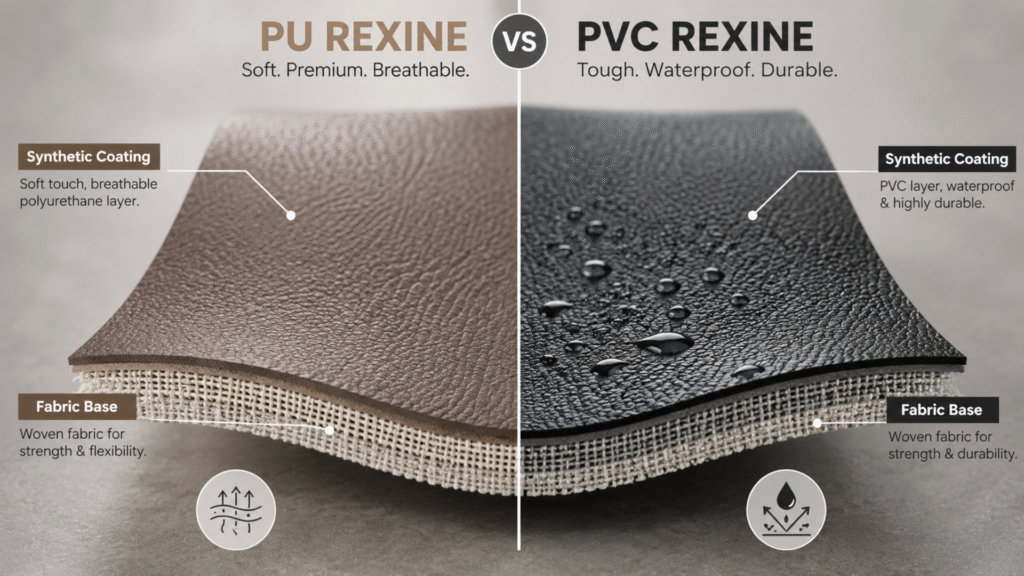
In modern manufacturing, almost all rexine falls into two coating chemistries:
- PU (Polyurethane) leather: a polyurethane resin coating, often microporous, soft, and breathable.
- PVC (Polyvinyl Chloride) leather: a denser, plasticised polymer film, tougher and fully waterproof.
The reason one rexine sofa lasts a decade and another peels in ten months isn’t luck; it’s engineering. Premium rexine uses a thicker, properly cured top coat over a tightly woven fabric base; the two layers flex together. Low-grade rexine puts a paper-thin plastic film over a loose, non-woven backing. The moment you sit on it, the plastic stretches further than the fabric can support, the bond fails, and the surface starts to delaminate.
Your goal is to spot those engineering shortcuts before the material is stapled to your furniture.
PU vs PVC Rexine: Which One Should You Choose?
This is the single most useful decision you’ll make. Neither is universally “better”; they’re built for different jobs.
| Feature | PU (Polyurethane) Rexine | PVC (Polyvinyl Chloride) Rexine |
|---|---|---|
| Feel | Soft, supple, mimics real leather | Firmer, denser, more “plastic” feel |
| Breathability | High (microporous structure) | Low (dense, non-porous film) |
| Water resistance | Resists splashes; not fully waterproof | Fully waterproof |
| Durability against scratches | Good with a quality top coat | Excellent, best in class |
| UV stability | Lower; can crack if untreated | Better with stabilisers added |
| Best use | Living-room sofas, headboards, and premium chairs | Car interiors, restaurant seating, outdoor, hospitals, and gyms |
| Typical price | Higher | Lower |
Choose PU if comfort and the look-and-feel of real leather matter most. It’s the right pick for a primary living room sofa or a bedroom headboard where people will spend long hours in contact with the surface.
Choose PVC if the material will face heavy use, spills, sunlight, or commercial wear, such as car interiors, clinic seating, restaurant booths, gym benches, or homes with pets and small children.
A useful middle path: PU-coated PVC, where a polyurethane top layer is applied over a PVC base. You get PVC’s structural toughness with PU’s softer hand-feel. Many premium upholstery rexines on the Indian market today are this hybrid construction.
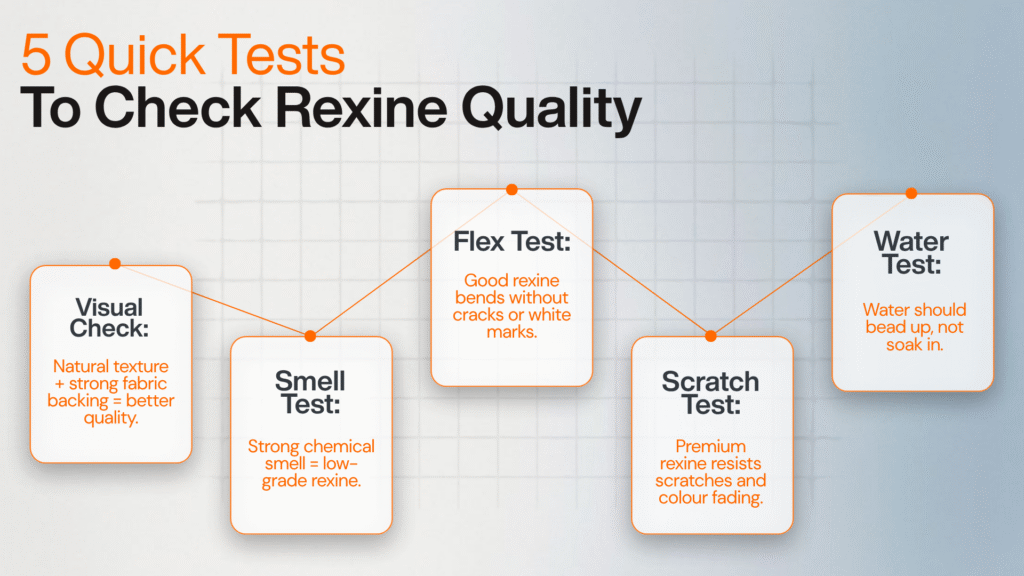
The 5 Tests: How to Check Rexine Quality in Under 5 Minutes
Each test below targets a specific failure point. Run all five on a swatch before you commit to an upholstery order.
Test 1: The Visual and Backing Inspection
What you’re checking: the grain pattern on top, and the fabric strength underneath.
Premium rexine mimics the random, non-repeating pores of real hide. Low-grade rexine is made with a basic roller stamp, so the same grain pattern repeats every few inches like wallpaper. Hold the swatch at an angle under a light. If you can see a clear repeating tile, the material was made cheaply.
Now flip the swatch over. The backing is the skeleton of the entire material, and it tells you more about durability than the surface ever will.
| Premium Rexine | Low-Grade Rexine | |
|---|---|---|
| Backing material | Tightly woven or knitted cotton/polyester | Thin non-woven fibre or paper-like film |
| Feel | Substantial, structured | Flimsy, like a thick film |
| Tear resistance | Holds staples and seams cleanly | Rips at staple points |
If the back looks and feels like paper, walk away. No top coat can save a weak skeleton.
Test 2: The Smell Test
What you’re checking: chemical stability and indoor air safety.
Synthetic materials will never smell like real leather, but a quality rexine should be close to neutral. Hold the swatch right under your nose.
- Pass: neutral or a very faint “new product” scent that fades after a few seconds.
- Fail: sharp, acrid, or solvent-like odour.
A strong chemical smell means the material is off-gassing volatile organic compounds (VOCs), usually from cheap plasticisers or unstable PVC compounds. This isn’t just unpleasant; in a closed Indian apartment with limited ventilation, it can be a genuine air-quality concern. If a showroom sample has been out for weeks and still smells like a chemical factory, the same rexine on your sofa will smell that way for months.
Test 3: The Flex and Pinch Test
What you’re checking: suppleness and the bond between coating and backing.
Pinch a fold of the material between your thumb and forefinger, then bend it sharply over itself. Watch the peak of the fold closely.
- Pass: material creases naturally and relaxes back to shape with no white marks.
- Fail: stiff, plasticky resistance; tiny white stress lines or cracks at the fold.
Those white stress marks are the early stage of cracking. The material is telling you the top coat is too brittle to handle daily flex, it will crack and peel within months.
Cold-weather note: rexine naturally stiffens in low temperatures. If you’re testing in a winter showroom in Delhi or Shimla, rub the swatch between your palms for 30 seconds first. If it’s still rigid after warming, it’s low-grade.
Test 4: The Abrasion and Scratch Test
What you’re checking: how well the coating is bonded to the backing, and how stable the dye is.
The industrial standard for this is the Martindale rub test (ISO 12947), which counts how many cycles of controlled abrasion a material can take before it shows visible wear. You can replicate the basics manually:
- Fingernail scratch: drag your fingernail firmly across the surface in one direction.
Damp cloth rub: rub a single spot with a damp white cotton cloth for 20 seconds.
| Test Result | Premium Rexine | Low-Grade Rexine |
|---|---|---|
| Fingernail scratch | No visible mark or indentation | Permanent scuff or white line |
| Damp cloth rub | Cloth stays clean; surface unchanged | Colour transfers to the cloth |
| Coating bond | The top layer remains fused to the backing | Surface flakes or peels under pressure |
If the colour comes off on a damp cloth in 20 seconds, expect it on your shirts, jeans, and bedsheets for years.
Test 5: The Water Drop Test
What you’re checking: the integrity of the surface seal.
A core advantage of rexine over genuine leather is that it’s non-porous. Quality rexine should act as a complete moisture barrier.
- Place a small drop of water on the surface.
- Wait 30 to 60 seconds.
- Blot, don’t rub with a dry paper towel.
- Pass: water beads tightly, like on a freshly waxed car. After blotting, no darkening, no ring, no trace.
- Fail: water spreads, the material darkens, or you see a faint “tide mark” after blotting.
A failed result means the coating is porous. Once moisture penetrates, it eventually rots the backing fabric and accelerates delamination. In Indian conditions, high humidity in monsoon months, frequent spills in family homes, this is the test that predicts real-world failure most reliably.
Quality Tier Comparison: High vs Mid vs Low-Grade Rexine
| Attribute | High-Quality (Premium) | Mid-Range (Standard) | Low-Quality (Budget) |
|---|---|---|---|
| Realistic lifespan | 5–8+ years of heavy daily use | 3–4 years of light to moderate use | Often peels within 12 months |
| Texture | Supple, soft, natural give | Slightly plasticky, lacks organic movement | Rigid, shiny, sheet-of-plastic feel |
| Smell | Neutral, very faint | Noticeable but fades in days | Sharp, lingers for weeks |
| Backing | Thick woven/knit cotton or polyester | Thinner knit or laminated backing | Paper-thin non-woven fibre |
| Moisture shield | Bead water; zero residue | Repels but may show tide marks | Porous; prone to rings and stains |
| Real cost over time | Best ROI outlasts cheaper grades 2x+ | Fair for low-traffic decorative pieces | False economy: replacement costs erase savings |
The trap most buyers fall into is comparing the price-per-meter sticker. The number that actually matters is the cost per year of useful life. A premium rexine at ₹300/m that lasts 7 years is far cheaper than a budget rexine at ₹150/m that needs full re-upholstery in 14 months.
Industry Standards Every Buyer Should Ask About
If you’re buying for a busy home, an office, a clinic, or any commercial space, lean on the standards the industry already uses. These are the questions that separate professional suppliers from market traders repackaging unmarked stock.
1. Martindale Rub Count (ISO 12947 / ASTM D4966)
The Martindale test is the global benchmark for abrasion resistance. A standardised abrasive head rubs the material in a figure-eight motion until visible wear appears. Use these thresholds:
- Under 10,000 rubs: decorative use only; not suitable for upholstery.
- 10,000–20,000: light domestic use (occasional chairs, accent pieces).
- 20,000–30,000: general domestic use.
- 30,000–40,000: heavy domestic/light commercial.
Premium rexine for primary sofas should clear 30,000 rubies at a minimum. Commercial rexine should be 40,000+. If a supplier can’t produce a Martindale figure on request, treat the lack of data as the data.
2. OEKO-TEX® Standard 100
This certification confirms that every component of the material coating, fabric, thread, and dye has been tested for harmful substances and is safe for human contact. Critical if the rexine will be used in homes with children, on car seats, or in healthcare settings.
Choosing the Right Rexine for Your Use Case
Different applications stress rexine in completely different ways. Match the material to the job.
| Use Case | Recommended Type | Key Specs to Demand |
|---|---|---|
| Living-room sofa (family home) | Premium PU or PU-coated PVC | Premium PU or PU-coated PVC |
| Dining chairs | PVC or PU-coated PVC | High stain resistance; easy to wipe |
| Car interior (seats, dashboard) | UV-stabilised PVC | High heat tolerance; fire-rated |
| Restaurant/café seating | Commercial-grade PVC | 40,000+ Martindale; fire rating; bleach-cleanable |
| Office chairs | Mid-range PU or PVC | 30,000+ Martindale; abrasion resistant |
| Hospital/clinic furniture | Antimicrobial PVC | Bleach-cleanable; non-porous; fire-rated |
| Outdoor patio furniture | “Marine grade” PVC | UV-stabilised; mildew-resistant |
| Headboards / decorative panels | Soft PU | Aesthetic priority; low-traffic |
| Handbags and accessories | PU (often microfibre PU) | Soft hand-feel; flexible |
How to Care for Rexine So It Actually Lasts
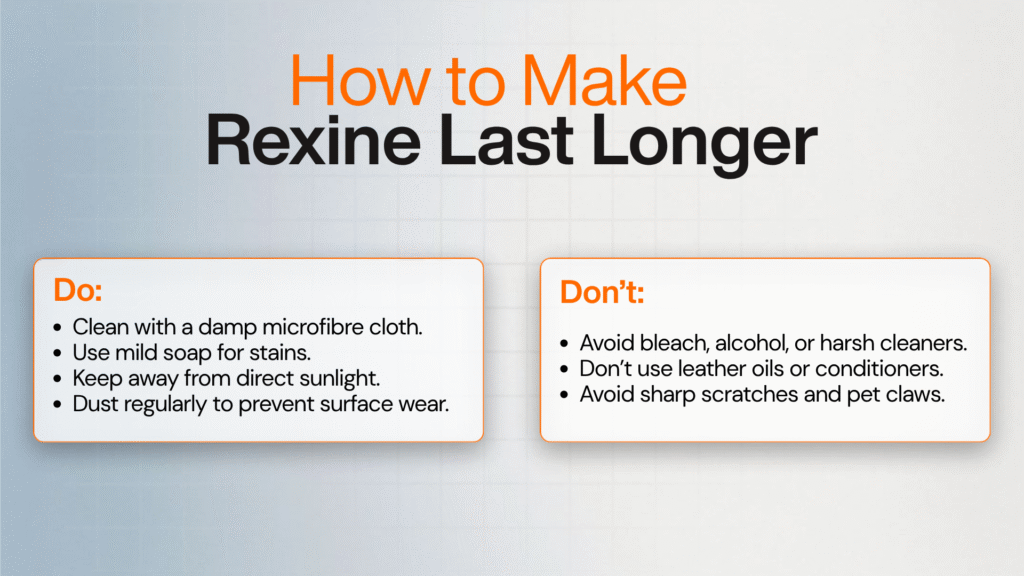
Even premium rexine will fail early if it’s cleaned with the wrong products. Rexine is synthetic it does not behave like real leather, and almost everything sold as a “leather conditioner” is the wrong product for it.
Do:
- Wipe regularly with a slightly damp microfibre cloth.
- Use a drop of pH-neutral soap for stains, nothing stronger.
- Keep the furniture out of direct, prolonged sunlight (use sheer curtains during peak sun in summer months).
- Dust, frequently fine dust, acts like sandpaper under repeated use.
Don't:
- Don’t use bleach, ammonia, or alcohol-based cleaners. They are solvents that attack the PU/PVC coating directly.
- Don’t apply leather conditioners, oils, or waxes. Rexine is non-porous; these products sit on top, trap heat and dirt, and can chemically soften the finish until it goes sticky.
- Don’t park sharp metal denim rivets, watch buckles, or pet claws in repeated contact with the same spot.
A good rule: if a cleaning product strips nail polish, it will damage rexine.
Final Buying Principles
- Demand a swatch: Reputable suppliers always provide a 4×4-inch sample. Test it under your own light, in your own room, at your own room temperature.
- Ask for technical specs: Martindale rub count, backing material, OEKO-TEX/REACH status, and warranty period. If the seller can’t produce them, you’re buying on faith.
- Backing first, surface second: A premium top coat over a weak fabric base will still fail. The skeleton matters more than the skin.
- Trust your senses: Sticky to the touch, lingering chemical smell, or stiff resistance in the flex test, those are the material’s early warning signals. Believe them.
- Buy smarter, not just cheaper. The cost-per-meter that wins on the invoice often loses on the re-upholstery bill two years later.
- Demand a swatch: Reputable suppliers always provide a 4×4-inch sample. Test it under your own light, in your own room, at your own room temperature.
Spending five minutes on these checks turns you from an average buyer into an informed one and makes sure your furniture is as durable as it is good-looking.
Conclusion
Rexine is one of the most widely used upholstery materials in India and one of the most widely misunderstood. The difference between a sofa that looks great for a decade and one that’s shedding plastic by next monsoon isn’t luck, brand name, or showroom price. It’s five minutes and a swatch.
Check the grain. Flip it over. Smell it. Fold it. Drop water on it.
Those five checks cost you nothing and tell you everything a salesperson won’t. Pair that with the right questions, Martindale count, backing material, and OEKO-TEX status, and you’re no longer buying on faith. You’re buying on evidence.
The cheapest rexine on the invoice is rarely the cheapest rexine over time. Buy smarter, and the furniture you choose today is still furniture two, five, or eight years from now.
FAQs
Run five quick checks on a swatch: look at the grain (should be irregular, not repeating), check the backing (should be woven fabric, not papery film), smell it (should be neutral, not chemical), fold it sharply (should crease without white stress marks), and place a water drop on it (should bead and wipe away with no residue). If it passes all five, the rexine is of good quality.
Peeling is the delamination of the plastic top layer, separating from the fabric backing. It happens when the coating is too thin, the adhesive bond is weak, or the backing fabric is too loose to support the surface during flex. Premium rexine uses thicker coatings, stronger adhesives, and tightly woven backings that flex together as a single unit.
Choose PU rexine for living-room sofas, headboards, and anywhere comfort and a soft, leather-like feel matter most. Choose PVC rexine for car interiors, commercial seating, outdoor furniture, and high-traffic spaces where waterproofing and abrasion resistance matter more than softness. PU-coated PVC is a strong middle ground.
Once the surface starts to delaminate, it cannot be permanently restored. Small nicks can be patched, but patches stay visible, and the surrounding area usually keeps peeling. The lasting solution is re-upholstery with a higher-grade material, which is why getting the original choice right is so much cheaper.
Quality rexine is non-porous, so it doesn’t trap dust mites, pet dander, or pollen the way fabric upholstery does, making it a strong choice for allergy-prone households. The caveat: choose OEKO-TEX 100 or REACH-compliant rexine to avoid VOC off-gassing from cheap plasticisers, which can irritate sensitive airways.
For domestic sofas, look for at least 30,000 Martindale rubs. For commercial spaces (restaurants, hotels, offices), look for 40,000+. Anything under 20,000 is suitable only for decorative or light-use applications.
Not necessarily. Showroom prices often reflect branding, design, and dealer markup more than material quality. The five hands-on tests in this guide measure engineering, not price. Always test the physical material. A moderately priced rexine that passes all five checks will outperform an expensive one that fails on the backing or scratch test.
Only if it’s specifically rated for outdoor use, usually labelled “marine grade” or “outdoor rated” PVC, treated with UV stabilisers, standard indoor rexine breaks down quickly under direct sunlight and temperature swings, becoming brittle and cracking within a single season.
A faint synthetic scent in fresh material clears in 48–72 hours with open windows and a fan. If the smell is sharp, acrid, or still present after a week, that’s a sign of poorly cured chemicals; the off-gassing can last weeks and indicates a low-grade product. Returning the material is the right call.
Rexine is a synthetic composite (fabric + polymer coating); genuine leather is a tanned animal hide. Rexine is cheaper, more uniform in colour and texture, easier to clean, fully vegan, and water-resistant, but typically lasts 5–10 years versus 20+ for high-quality leather. Leather develops a patina with age; rexine does not. For high-moisture or high-spill environments, rexine is usually the more practical choice.
Pingback: How to Maintain Rexine Furniture: Festive Season Care Guide
Pingback: Best Upholstery Fabrics for Festive Home Decor (2026 Ranking)