The Complete Sofa Fabric Guide (2026): How to Choose the Best Upholstery
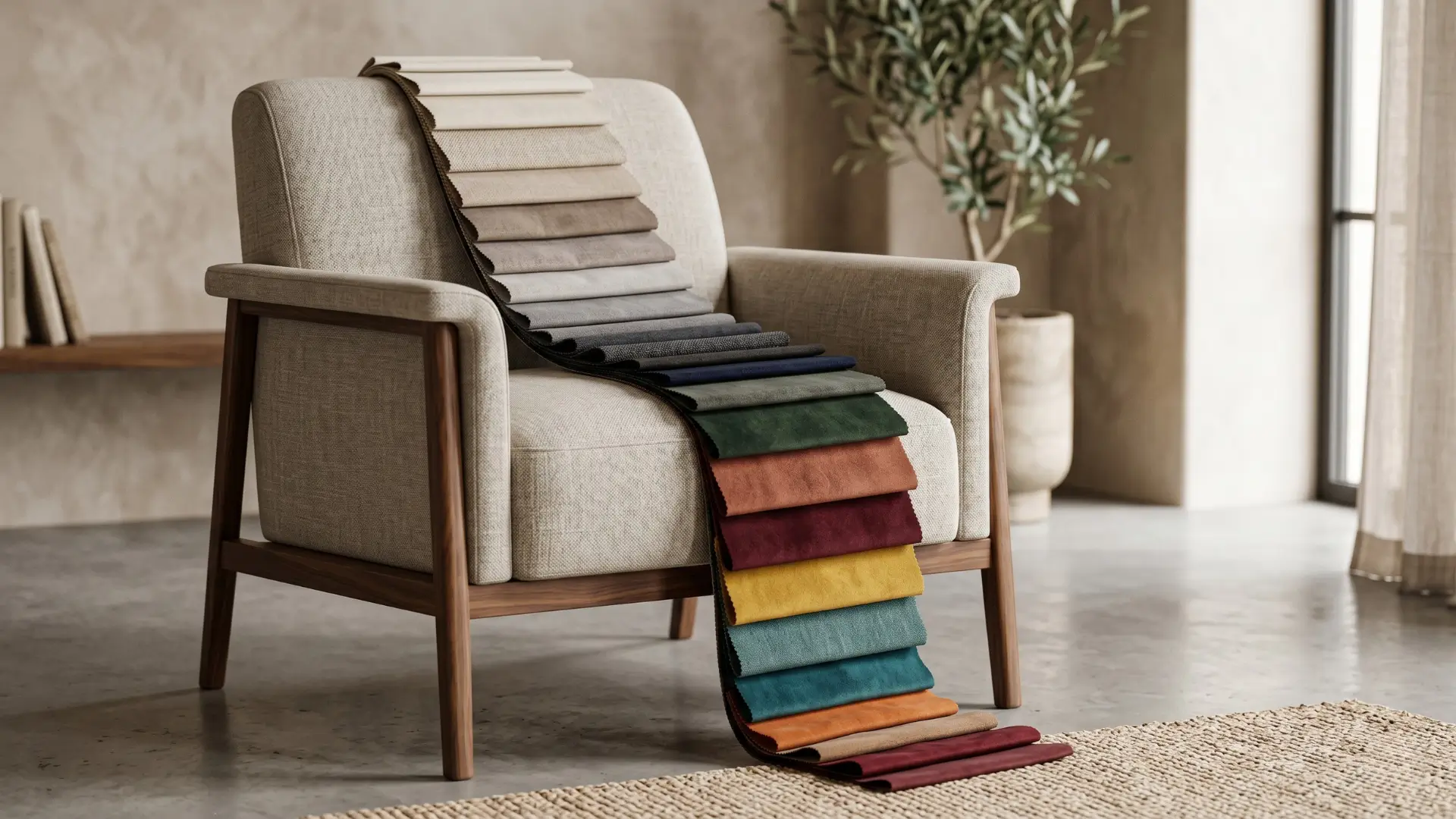
Key Takeaways: How to Choose the Right Sofa Fabric
- Identify your primary stressor: kids, pets, sunlight, humidity, or heavy guests.
- Set a Martindale floor: 20,000+ rubs for a home sofa; 30,000+ if it faces daily punishment.
- Match fibre to climate: cotton or linen blends for hot/humid regions; performance polyester for monsoon-prone areas; velvet only in climate-controlled rooms.
- Ignore the “grade” label on price tags; it reflects cost-to-manufacturer, not quality-to-you.
- Request a swatch. Rub it, spill water on it, sit on it in your actual room, with the lighting. No swatch, no sale.
Sofa Fabric Trends: What’s New in Upholstery for 2026?
Here’s a scenario most furniture buyers recognise: you walk into a showroom, fall in love with a sofa’s silhouette, and never once flip the seat cushion to read the fabric composition tag. Three monsoons later, the upholstery has pilled, faded near the window, and developed a permanent outline of your Sunday-afternoon nap. The sofa frame is fine. The foam is fine. It’s the fabric that failed.
In 2026, the upholstery landscape is materially different from even two years ago. Performance fabrics, engineered textiles that resist stains, repel liquids, and withstand serious abrasion, have moved from niche family-friendly options to the baseline expectation across price points. Sustainability certifications now influence sourcing decisions at the mill level, with recycled polyester and PFC-free stain treatments replacing older chemical finishes. And trend-wise, the industry has shifted toward warm, earth-connected neutrals (sand, mushroom, terracotta) while cool grey, once ubiquitous, is being treated as dated and clinical.
But the fundamentals still trip people up. Most buyers confuse fabric grade with fabric quality. They don’t know what a Martindale rub count measures, actually, or why a 100,000-rub rating isn’t twice as good as a 50,000-rub rating. They pick velvet for a Chennai living room or pure linen for a household with two Labradors. This guide is built to prevent those mistakes.
What Are the Different Types of Sofa Fabrics?
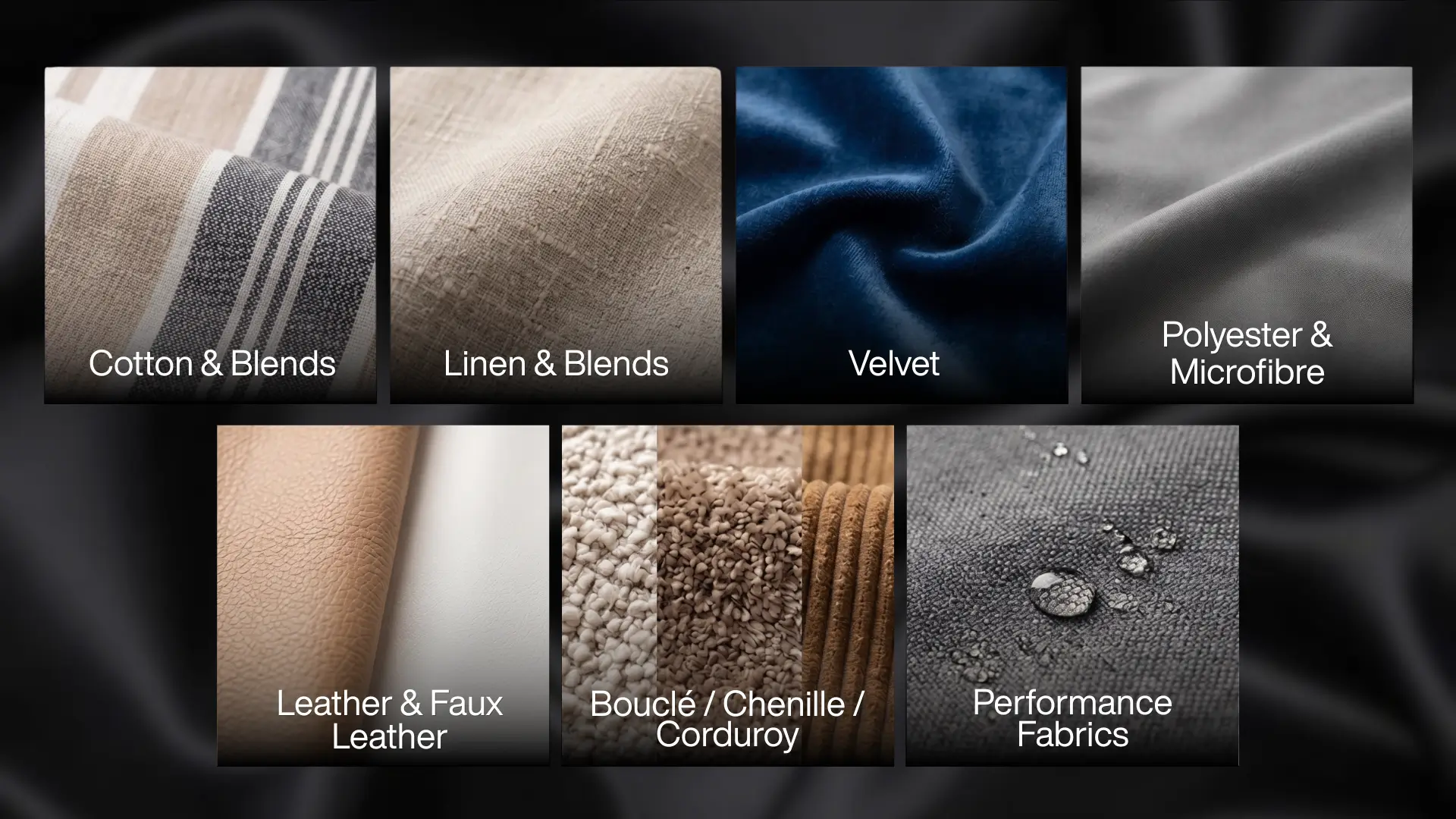
Every sofa fabric on the market falls into one of three categories: natural fibre, synthetic fibre, or a blend. The “best” choice depends on how you live, where you live, and what you’re willing to do (or not do) to maintain it. Here’s what each fabric actually delivers in practice.
What Are the Different Types of Sofa Fabrics?
Cotton is the best sofa fabric for Indian households because it breathes exceptionally well in heat, feels cool against skin, and takes dye beautifully. Pure cotton wrinkles and stains easily, so the real workhorse is a cotton-polyester blend (typically 60/40 or 70/30). The polyester component adds wrinkle resistance and colour retention without sacrificing much breathability. Martindale scores for quality cotton blends typically range from 15,000 to 30,000 rubs.
Linen & Linen Blends: Best for Humid Climates
Linen is the sophisticate’s choice: it has a natural slub texture that hides dust well and gets softer with age. It’s naturally mildew-resistant, making it a strong option for humid coastal cities. The catch? Pure linen wrinkles dramatically and shrinks when washed in hot water. A linen-cotton or linen-viscose blend solves most of these issues. Linen also weakens under prolonged UV exposure, so keep it away from south-facing windows. Ideal for formal living rooms with moderate traffic.
Velvet & Performance Velvet: Best for Luxury
Velvet is back in force for 2026, but the category has splintered. Traditional cotton velvet breathes reasonably well and develops a lived-in patina. Polyester velvet traps heat, avoiding it in hot climates. Performance velvet (a newer category using solution-dyed synthetic fibres) offers stain resistance and easy cleaning while retaining the signature sheen of velvet. Velvet is a dust magnet and shows “tracking” marks where the pile direction changes, which some love and others find maddening. Martindale scores for performance velvets can exceed 50,000 rubs.
Polyester & Microfibre: Best for Stain Resistance
Polyester is the industry’s workhorse: fade, moisture, and mildew-resistant, and colourfast in direct sunlight. Microfibre, essentially ultra-fine polyester woven tightly, is one of the most stain-resistant fabrics available and works well in humid climates because it wicks moisture and dries quickly. The downside is breathability: polyester can feel warm against skin in peak summer, especially in non-air-conditioned rooms. Solution-dyed polyester (where colour is embedded in the fibre itself, not applied on top) offers the best fade resistance in the category.
Leather & Faux Leather: Best for Longevity
Genuine leather breathes better than most people assume and develops character over time. But it requires conditioning (especially in dry climates) and becomes uncomfortably sticky in heat without air conditioning. Today’s premium faux leather has closed much of the quality gap. It handles humidity and temperature swings better than real leather and requires almost no maintenance. In India specifically, high-quality vegan leather is increasingly popular for its resilience in monsoon conditions. Neither is technically a “fabric,” but both compete in the same buyer decision.
Bouclé, Chenille & Corduroy: Best for Textured Style
These textured fabrics are defining the 2026 upholstery aesthetic. Bouclé (looped yarn) adds tactile depth and hides minor wear; contemporary versions favour tighter, subtler loops than the oversized textures of 2023–24. Chenille delivers a plush, velvety hand-feel with good stain resistance. Corduroy wider-wale versions in particular have re-emerged as a design-led choice that balances nostalgia with warmth. All three disguise dust, pet hair, and everyday use better than flat-weave fabrics, making them practical despite looking luxurious.
How to Measure Sofa Fabric Durability: The Martindale Rub Test
What is a Good Martindale Score for a Sofa?
The Martindale test is the international standard for measuring how well a fabric resists abrasion. A machine rubs a disc of worsted wool against a stretched fabric sample in a figure-eight (Lissajous curve) motion under constant pressure of 12 kPa. The test counts cycles until the fabric shows visible distress, pilling, yarn breakage, or a noticeable change in surface appearance. That cycle count becomes the fabric’s Martindale rating.
The test is simple to understand: higher numbers mean more resistance to rubbing and friction. But here’s what most product listings won’t tell you.
Insider Note
In the textile industry, results above 50,000 rubs have diminishing practical significance. A fabric rated at 100,000 will not last twice as long as one rated at 50,000 in real-world conditions. The test only measures abrasion; it doesn’t account for UV damage, chemical exposure, pet claws, embedded dirt, or the way humidity weakens certain fibres over time. Don’t pay a premium solely for an inflated Martindale number.
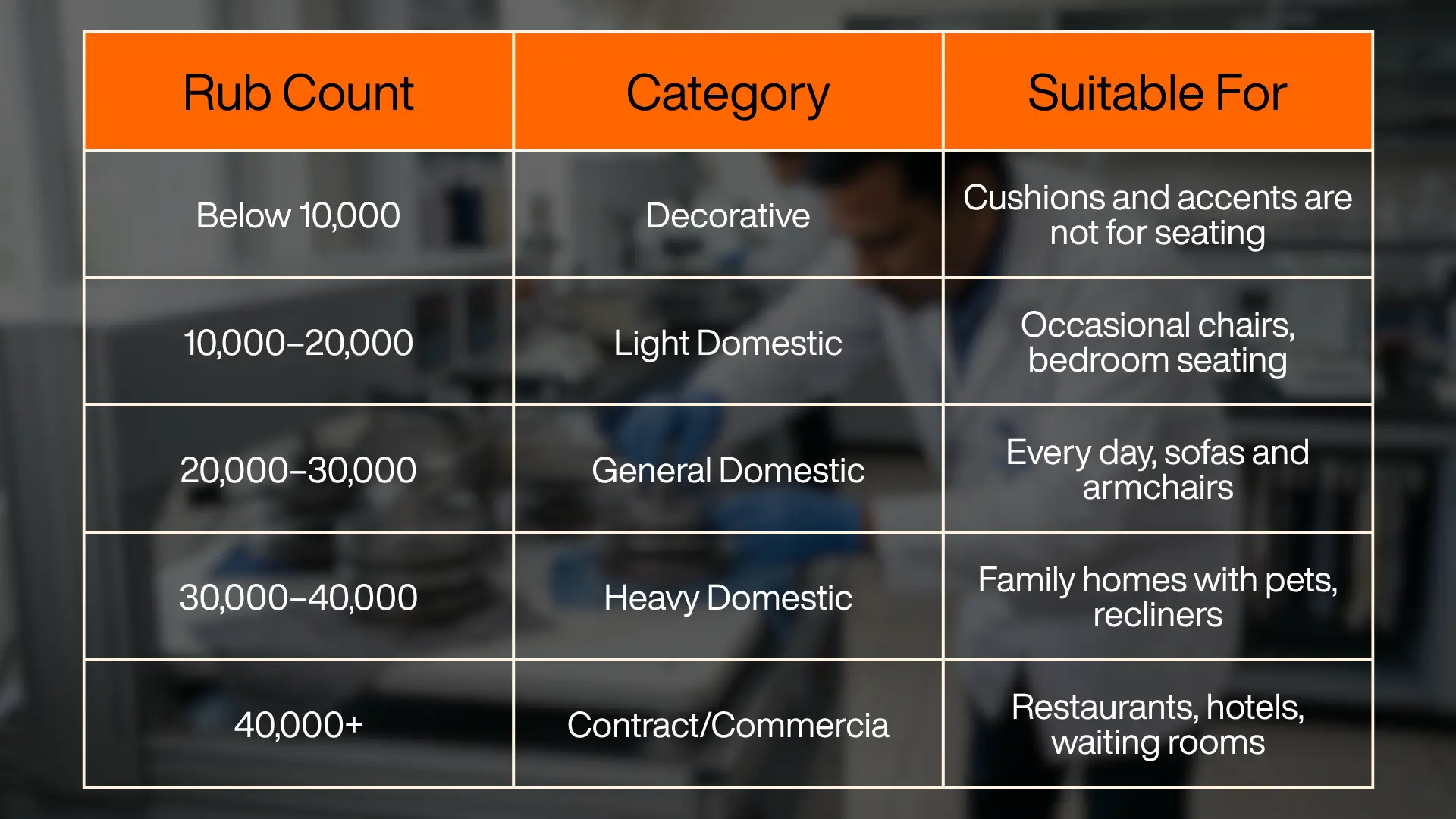
Martindale Rating Scale Explained (Chart)
| Rub Count | Category | Suitable For |
|---|---|---|
| Below 10,000 | Decorative | Cushions and accents are not for seating |
| 10,000–20,000 | Light Domestic | Occasional chairs, bedroom seating |
| 20,000–30,000 | General Domestic | Every day, sofas and armchairs |
| 30,000–40,000 | Heavy Domestic | Family homes with pets, recliners |
| 40,000+ | Contract/Commercial | Restaurants, hotels, waiting rooms |
Martindale Lab Ratings vs. Real-World Durability
A Martindale rating tells you how a fabric handles friction in a controlled environment. Your living room is not a controlled environment. Sunlight degrades fibre strength over time (particularly linen and silk). Humidity in coastal regions causes natural fibres to swell and weaken faster. Cleaning products with harsh chemicals can strip protective finishes. And pet claws create a type of damage that no rub test simulates.
The practical takeaway: use the Martindale score as a minimum threshold, not a guarantee. For a family sofa in India, aim for at least 25,000 rubies. If you have pets, look for 30,000+. And always ask about the other performance metrics, lightfastness (resistance to fading), pilling grade, and whether the fabric has been treated with a stain repellent.
What Do Sofa Fabric Grades Mean? (A, B, C, D Explained)
Walk into most furniture stores, and you’ll see sofa fabrics labelled as Grade A, B, C, D, and so on. The assumption is intuitive: Grade A must be the best. It’s also wrong.
Fabric grades are a pricing classification system, not a quality ranking. They reflect what the fabric costs the manufacturer to source, not how durable, fade-resistant, or long-lasting it will be for you. A Grade D velvet might be expensive because of its complex weave and imported yarn, but it could have a lower Martindale score than a Grade A polyester blend that costs a fraction of the price to produce.
The grading system exists because furniture manufacturers offer the same sofa frame with multiple fabric options at different price tiers. Rather than listing 80 individual fabric prices, they group them into grades for simplicity. Grade A is typically the least expensive (basic polyesters, simple cotton blends), while higher grades include imported textiles, hand-finished weaves, or designer collaborations.
Why Higher Fabric Grades Don’t Mean Better Quality
Higher fabric grade does not mean higher fabric quality. A Grade A performance polyester with a 50,000 Martindale score will outlast a Grade E hand-loomed silk on every functional metric. The silk costs more because of its raw material and craftsmanship, not because it will survive your Tuesday-night Netflix marathon any better.
How to Read Furniture Fabric Grades
Treat the grade as a price indicator, then evaluate the fabric on its own merits. Ask for the Martindale/Wyzenbeek score, fibre composition, cleaning instructions, and whether it’s been treated with stain or UV protection. These objective specifications tell you far more about real-world performance than the letter on the tag.
5 Steps to Choosing the Best Sofa Fabric for Your Home
Choosing sofa cover fabrics isn’t a single decision; it’s a series of filters. Work through these in order, and you’ll narrow from hundreds of options to a handful that actually fit your life.
Start with your lifestyle, not your Pinterest board
Households with young children need stain resistance above everything else. Pet owners need claw resistance and fabrics that don’t trap hair (tight weaves over loose textures). If you entertain frequently, prioritise cleanability. If it’s a formal, low-traffic room, you can prioritise aesthetics. Be honest about how the sofa will actually be used.
Factor in your climate, especially in India
India’s climate zones demand different fabrics. For hot, humid cities (Mumbai, Chennai, Kolkata), cotton and linen blends are ideal for breathability. For dry-heat regions (Delhi, Jaipur), polyester blends handle dust and UV exposure better. For monsoon-prone areas, microfibre or performance fabrics resist moisture and dry quickly. Avoid polyester velvet in any non-air-conditioned room in a tropical region, as it traps body heat.
Set a durability floor using Martindale scores.
For the main family sofa: 25,000+ rubs minimum. For a sofa with pets or kids: 30,000+. For an accent chair in a guest room: 15,000 is fine. Don’t overpay for astronomical ratings; anything above 50,000 offers negligible real-world benefit over 40,000.
Decide how much maintenance you'll actually do
Be realistic. If you won’t vacuum your sofa weekly, avoid velvet and bouclé. If you won’t professionally dry-clean, avoid pure linen and silk blends. Performance fabrics that clean with a damp cloth and mild soap are designed for people who want to spend zero effort on upholstery maintenance, and there’s nothing wrong with choosing them for exactly that reason.
Always request a swatch and test it properly.
Sit on the swatch fabric in your own room, with lighting. Spill water on it and time how quickly it beads or absorbs. Rub it against itself and check for pilling. A responsible supplier will send swatches at no cost. If they won’t, consider that a red flag.
What is the Best Sofa Fabric for Indian Climates?
| Climate Zone | Best Fabrics | Avoid | Key Concern |
|---|---|---|---|
| Hot & Humid Mumbai, Chennai, Kolkata | Cotton blends, linen blends, microfibre | Polyester velvet, pure leather | Breathability, mildew |
| Hot & Dry Delhi, Jaipur, Ahmedabad | Polyester blends, performance fabrics, cotton-poly | Pure linen (UV damage), silk | Dust, UV fading |
| Moderate Bangalore, Pune | Velvet, linen, cotton, blends, most options work | No major restrictions | Dust accumulation |
| Cold & Dry Shimla, Leh, Srinagar | Wool blends, velvet, chenille, corduroy | Thin cotton, lightweight linen | Warmth, insulation |
| Monsoon-Prone Coastal regions, NE India | Performance polyester, microfibre, solution-dyed acrylic | Pure cotton, untreated linen | Moisture, mould, odour |
6 Common Sofa Fabric Buying Mistakes (And How to Avoid Them)
After years in textile sourcing, certain buyer mistakes come up again and again. Avoiding these will save you money and frustration.
1. Choosing fabric in the showroom lighting
Showroom lighting is designed to make fabrics look their best. Your living room has different light temperatures, angles, and intensities. Always take a swatch home and evaluate it in morning light, afternoon sun, and evening artificial light before committing.
2. Equating fabric grade with fabric quality
As explained above, grades reflect cost, not performance. A Grade A polyester can outperform a Grade D silk on every durability metric. Always ask for the technical specifications separately.
3. Ignoring the cleaning instructions before purchase
Some fabrics require professional dry-cleaning only. Others shrink when washed. If you aren’t willing to maintain a fabric the way it demands, don’t buy it, no matter how beautiful it looks on day one.
4. Buying fabric without checking the weave direction
Fabric has a “nap” or pile direction, particularly velvet and corduroy. If panels are cut in different directions, sections of your sofa will appear to be different colours under the same light. This is a manufacturing error that’s surprisingly common with cheaper upholsterers.
5. Falling for "anti-microbial" marketing without verification
Many anti-microbial treatments wash out after a few cleanings. Ask whether the treatment is topical (applied on the surface) or solution-dyed (embedded in the fibre). Only solution-dyed treatments last the life of the fabric.
6. Not ordering enough fabric: the dye-lot problem
Fabrics are dyed in batches (dye lots). If you run short and reorder, the new batch may not match the original colour exactly. Always order 10–15% more than your upholsterer’s estimate, and confirm the dye-lot number is consistent across all rolls you receive.
Where to Buy High-Quality Upholstery Fabric
The supplier you buy from matters almost as much as the fabric you choose. Here’s what separates a reliable upholstery fabric source from one that will cause problems downstream.
4 Things to Look for in a Fabric Supplier
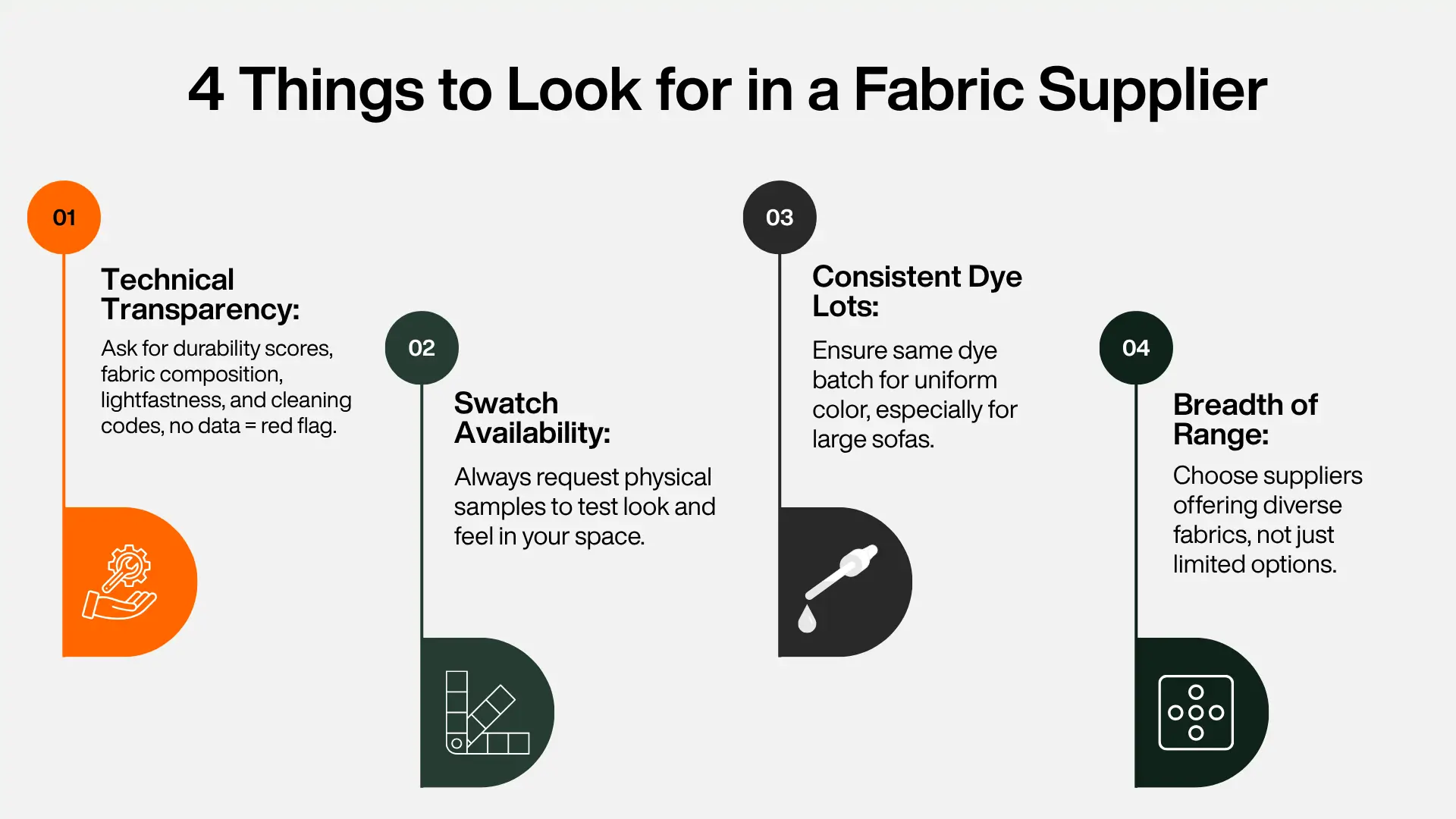
- Technical transparency: A good supplier provides Martindale/Wyzenbeek scores, fibre composition percentages, lightfastness ratings, and cleaning codes (W, S, WS, X) for every fabric. If this information isn’t available on request, the supplier either doesn’t test their fabrics or doesn’t want you to know the results. Either is a problem.
- Swatch availability: You should be able to request physical swatches, ideally, large enough to drape over your existing sofa and evaluate in your own lighting. Many established suppliers like AbbottFab provide curated swatch sets and detailed fabric specifications, which saves considerable time when evaluating multiple options across different grades and price points.
- Consistent dye lots: Ask whether the supplier can guarantee a single dye lot for your full order. This is especially important for larger sectional sofas or when ordering backup fabric for future repairs.
- Breadth of range: A supplier that stocks only one or two categories (say, just polyesters) will naturally push you toward what they have, not what you need. Look for suppliers who carry natural fibres, synthetics and blends. Platforms such as AbbottFab tend to consolidate this range, making it easier to compare options side by side rather than sourcing from multiple vendors.
Sofa Fabric Comparison Chart: Durability & Maintenance
A side-by-side reference for the fabrics covered in this guide. Use this as a shortlist tool, not a final decision. Your climate, lifestyle, and maintenance preference should be the deciding factors.
| Fabric | Durability | Maintenance | Breathability | Best For |
|---|---|---|---|---|
| Cotton Blend | ★★★ | Moderate | Excellent | Hot climates, budget homes |
| Linen Blend | ★★★ | High | Excellent | Formal rooms, humid areas |
| Polyester / Microfibre | ★★★★★ | Low | Moderate | Kids, pets, monsoon zones |
| Cotton Velvet | ★★★ | High | Moderate | AC rooms, style-led homes |
| Performance Velvet | ★★★★★ | Low | Moderate | Luxury + practicality |
| Bouclé | ★★★★ | Moderate | Good | Contemporary, textured look |
| Chenille | ★★★★ | Moderate | Good | Comfort-first, family rooms |
| Faux Leather | ★★★★ | Low | Low | Easy-clean, modern décor |
| Genuine Leather | ★★★★★ | Moderate | Moderate | AC rooms, executive spaces |
| Performance Fabric | ★★★★★ | Very Low | Good | Pets, kids, worry-free use |
Final Thoughts on Choosing Couch Upholstery
Choosing the right sofa fabric is not about finding the “best” fabric in absolute terms; it’s about finding the best match for your specific climate, household, usage pattern, and maintenance tolerance. A fabric that performs brilliantly in a Bangalore apartment may fail in a Mumbai flat during the monsoon season. A fabric that looks flawless in a showroom may pill within months if your lifestyle doesn’t match its care requirements.
The 2026 upholstery market gives you more genuinely good options than ever before. Textured weaves like bouclé and chenille offer both style and practicality. Sustainability is becoming embedded at the fibre level, not just marketed on the tag. Use the frameworks in this guide, the Martindale threshold, the climate-matching table, and the step-by-step filter, and you’ll arrive at a decision you can trust for years, not just the afternoon you bring the sofa home.
The sofa frame holds the structure. The foam holds your weight. But it’s the fabric that holds up to your life. Choose accordingly.
Frequently Asked Questions
Tightly woven microfibres are the strongest options. They resist claw damage better than loose-weave textures, don’t trap pet hair the way velvet and bouclé do, and most stains (including pet accidents) can be cleaned with soap and water. Avoid any fabric with a looped or open weave pet claws that will snag and pull threads within weeks. A Martindale rating of 30,000+ is recommended for pet-owning households.
In terms of pure abrasion resistance, high-quality genuine leather and solution-dyed performance polyesters score the highest, often exceeding 50,000 Martindale rubs. But longevity isn’t just about abrasion; it depends on UV exposure, cleaning habits, humidity, and usage intensity. A well-maintained leather sofa can last 15–20 years. A performance fabric sofa in a family home will typically hold up for 7–12 years before showing noticeable wear.
There’s no single answer because India’s climate varies enormously. For hot, humid regions (coastal cities, eastern India), cotton and linen blends offer the best breathability. For dusty, dry-heat regions (northern plains), polyester blends handle UV and dust better. For monsoon-prone areas, microfibre and performance fabrics resist moisture and dry quickly. The common thread: in most Indian conditions, a cotton-polyester blend (60/40 or 70/30) offers the best all-round balance of comfort, durability, and affordability.
It’s a standardised abrasion test. A machine rubs a rough surface against a fabric sample in a circular motion and counts how many cycles it takes before the fabric shows visible damage (pilling, fraying, or broken threads). The resulting number, say, 25,000 or 40,000, is the Martindale rating. Higher mean s more rub-resistant. For a regular home sofa, 20,000–30,000 rubs is sufficient. For commercial furniture, look for 30,000+.
No. Fabric grades reflect cost-to-manufacture, not performance or durability. A Grade A fabric is the least expensive option offered on a particular sofa frame. A Grade D or E fabric is costlier because of its raw material, weave complexity, or import cost, but it may actually be less durable than the Grade A option. Always check the Martindale score, fibre composition, and cleaning instructions independently of the grade.
A standard 3-seater sofa typically requires 12–15 metres of 54-inch-wide fabric. If the fabric has a pattern repeat, you’ll need more, sometimes 15–20% more, to ensure the pattern aligns correctly across panels. Always consult your upholsterer for an exact measurement based on your sofa’s specific dimensions and the fabric’s width, and repeat.